How to Pay for a New Roof: Insurance, Savings, Financing and Timing
 By Chris Grimes, owner of Verde RoofingPublished August 27, 2026 · 8 min read
In short
If a storm damaged your roof, start with your homeowners policy. If insurance won’t cover it, the main options are savings, a Texas home equity loan or line of credit (capped at 80 percent of your home’s value including other liens), an FHA Title I property improvement loan of up to $25,000, a personal loan, or contractor-arranged financing. Compare the total cost of each, not just the monthly payment.
Key takeaways
- Insurance pays for sudden damage like hail and wind, not for a roof that is simply old; the Texas Department of Insurance says this plainly.
- Texas home equity loans and lines of credit are capped so that all liens together do not exceed 80 percent of your home’s fair market value.
- HUD’s Title I program insures property improvement loans of up to $25,000 on a single-family home, but not every lender offers it.
- No federal tax credit is available for a new roof placed in service after December 31, 2025, according to the IRS.
- Texas law requires you to pay your insurance deductible; a roofer who offers to cover it is breaking the law.
A new roof is one of the largest checks most homeowners ever write for their house, and it rarely arrives on a convenient schedule. Sometimes a hailstorm decides for you. Sometimes it is a leak that will not stay fixed, or a buyer's inspector who flags the roof three weeks before closing.
This guide lays out every realistic way to pay for a roof in Texas, starting with insurance and then the options when insurance will not cover it. It includes the Texas rules that apply to home equity borrowing and deductibles, and it is honest about the trade-offs. It is not financial advice; for that, talk to your lender or a financial advisor.
Will insurance pay for my new roof?
Start here, because it is the biggest variable. Your homeowners policy covers sudden damage, such as hail, wind or a falling tree. The Texas Department of Insurance is clear about the other side: your insurance company won't pay for a new roof just because it is old or worn out.
If you have had a storm since the roof was last inspected, get it checked before you assume you are paying out of pocket. Hail damage to shingles is often invisible from the ground. When we inspect, Chris documents the damage with photos and explains whether you have a claim worth filing before you call your insurer. You own the claim; we provide the inspection, the documentation and the work. See our insurance claim help page and the step-by-step guide to how a roof insurance claim works in Texas.
How much will insurance actually pay?
Even on a covered claim, the first check may not cover the whole roof. TDI explains two things that affect the amount:
- Replacement cost vs. actual cash value. Replacement cost coverage can pay up to the full cost to repair the roof at current prices, and usually pays in two parts: a first payment, then the rest after repairs have started. Actual cash value coverage pays less on an older or worn roof. TDI notes that some companies switch roofs to actual cash value as they age.
- Your deductible. TDI says the wind and hail deductible is often higher than the deductible for other damage.
Our guide to ACV vs. RCV and the second insurance check explains how withheld depreciation gets released.
Can a roofer help with my deductible?
No, and in Texas this is not a gray area. Texas Insurance Code §707.002 says the insured shall pay any deductible on a property claim. Under Business & Commerce Code §27.02, a seller who waives, absorbs, rebates or otherwise helps you avoid the deductible commits a Class B misdemeanor. Contracts of $1,000 or more expected to be paid by insurance must include a bold notice saying so.
If a roofer offers a "deductible discount," a fake upgrade credit or a sign bonus that happens to equal your deductible, walk away. Our guide on why no roofer can legally waive your deductible covers the details. What you can do is budget for the deductible early, the same way you would budget for any other repair.
What are my options if insurance won't cover the roof?
Here are the main ways Texas homeowners pay for a roof out of pocket, with the trade-offs of each:
| Option | How it works | Main advantage | Main drawback |
|---|---|---|---|
| Savings | Pay cash from a home or emergency fund | No interest, no paperwork | Drains reserves |
| Home equity loan or HELOC | Borrow against your home's equity | Usually lower rates than unsecured loans | Texas limits, waiting period, your home secures it |
| FHA Title I loan | HUD-insured property improvement loan through approved lenders | Federally insured, up to $25,000 on a single-family home | Limited lender availability |
| Personal loan | Unsecured installment loan | Fast, no lien on the house | Rates are often higher |
| Contractor-arranged financing | Loan through a lender the roofer works with | Convenient, one application | Terms vary widely; read the fine print |
| Credit card | Charge some or all of the job | Quick for small jobs | Usually the most expensive way to carry a balance |
Home equity loans and lines of credit in Texas
Texas has stricter home equity rules than most states, set in Section 50(a)(6), Article XVI of the Texas Constitution. The state's required consumer notice spells them out. Among the key points:
- The new loan plus all other liens on your home cannot exceed 80 percent of its fair market value.
- Fees to make the loan cannot exceed 2 percent of the loan amount, with exceptions such as an appraisal, survey and certain title charges.
- The loan cannot close until 12 days after you apply or receive the notice, whichever is later.
- Only one such loan may be secured by your home at a time.
- The lender can foreclose only with a court order.
That 12-day minimum matters if your roof is leaking now. You may need a temporary repair or tarp while the loan closes.
FHA Title I property improvement loans
HUD's Title I program insures loans made by approved private lenders for home improvements. Under 24 CFR §201.10, the limit for a single-family property improvement loan is $25,000, which covers many shingle replacements on an average-size home. Not every bank or credit union offers Title I loans, so ask before you apply, and compare the rate and terms with a home equity line or personal loan. Your own bank or credit union can tell you quickly whether it participates in the program. As with any loan, get the roofer's written estimate first so you know exactly how much to borrow.
Contractor-arranged financing
Many roofers offer financing through outside lenders. Before you sign, ask:
- Who is the actual lender?
- What is the annual percentage rate after any promotional period?
- Is the promotion "deferred interest," where all interest comes due if the balance is not paid in time?
- Are there origination or dealer fees built into the roof price?
- Does the roof price change if you pay cash instead?
If a "no interest" offer comes with a higher roof price than a cash quote, the interest is still there. It is just in the price.
Are there tax credits or rebates for a new roof?
Not federal ones for a roof installed now. The IRS states that the Energy Efficient Home Improvement Credit (Section 25C) is not allowed for any property placed in service after December 31, 2025, and that the Residential Clean Energy Credit (Section 25D), which covered rooftop solar, is not allowed for expenditures made after December 31, 2025. Be skeptical of anyone who promises a federal credit for a roof today. If you are thinking about solar too, read solar panels and your roof before you decide on timing.
Some insurers offer premium discounts for impact-resistant roofs. That is not a rebate, but it can offset part of the cost over time. Ask your agent for the actual discount before you choose a shingle.
Can I repair now and replace later?
Sometimes a repair is the smartest way to buy time while you save or arrange a loan. Fixr's rule of thumb is that a repair makes sense when the roof has no ongoing problems, the repair costs less than half of a replacement, and the roof has more than half its life left. Fixr also suggests that roofs over 15 years old with frequent problems may be more cost-effective to replace.
A repair that stops an active leak for a year or two can be a reasonable bridge. Paying for the third repair in a year on a worn-out roof usually is not. Our roof repair page explains what we fix, and the honest repair-or-replace decision guide helps you decide.
Does timing affect what I pay?
A few timing decisions can help your budget:
- Get the estimate before you need it. If your roof is near the end of its life, a written estimate now gives you a number to save toward.
- Schedule outside the spring rush. North Texas roofers are busiest after spring hail, so scheduling may be easier in late fall and winter. Material prices do not usually drop by season, though.
- Plan around a home sale. If you are selling, see what to do when the roof comes up in a home inspection.
- Don't wait on active leaks. Water damage to decking, insulation and ceilings adds to the bill quickly.
Use our roof cost calculator to set a savings target, and read what a new roof costs in Dallas–Fort Worth to understand what moves the price.
How do I make sure I'm paying a fair price?
However you pay, the price should be clear before you borrow a dollar. Get at least two itemized estimates, compare them on the same squares and the same shingle, and confirm what is included. Our guide on how to read a roofing estimate walks through each line.
At Verde Roofing, every price is a written estimate after a free inspection. Chris will tell you honestly whether you need a full roof replacement, whether a repair will do for now, and whether storm damage means your insurance policy should be part of the conversation.
Ready to find out what your roof needs?
Call or text (214) 687-1951, 24/7, or book a free roof inspection. You will get a written estimate you can take to your bank, your insurer or your own budget.
Questions people ask next
Can I make monthly payments on a new roof?
Usually, yes, through a loan rather than directly to the roofer. Options include a home equity line, a personal loan, an FHA Title I loan or financing a roofer arranges through a lender. Ask for the annual percentage rate, the term, any fees and whether a promotional rate turns into deferred interest.
Will insurance pay for a roof that is leaking from age?
Generally no. The Texas Department of Insurance says your company won’t pay for a new roof just because it is old or worn out. Coverage is for sudden damage such as hail, wind or a falling tree. If an old roof also took storm damage, an inspection can show what is storm-related.
Is it better to use a HELOC or a personal loan for a roof?
A home equity line usually has a lower rate because your house secures it, but Texas rules add a 12-day waiting period, cap fees and limit total borrowing to 80 percent of your home’s value. A personal loan is faster and unsecured but often costs more. Compare total interest over the time you expect to carry the balance.
Can I pay my deductible in installments to the roofer?
You can agree on a payment schedule for the work, but the deductible itself must be paid. Texas Insurance Code §707.002 requires the insured to pay it, and a contractor who waives, absorbs or rebates it commits a misdemeanor under Business & Commerce Code §27.02. Get any payment plan in writing.
Should I replace my roof before selling or offer a credit?
It depends on the roof’s condition, your market and the buyer. A new roof removes an inspection objection, while a credit leaves the choice to the buyer. Many sellers get a written estimate first so any credit is based on a real number rather than a guess from the buyer’s inspector.
Sources
- Texas Department of Insurance: Insurance and your roof
- Texas Finance Commission: Home Equity Consumer Disclosure (Section 50(a)(6), Article XVI)
- 24 CFR §201.10: Title I loan amounts
- IRS: FAQs on changes to 25C, 25D and other credits under Public Law 119-21
- Texas Business & Commerce Code §27.02
- Fixr: How Much Does It Cost to Repair a Roof? (2026)
Chris Grimes owns Verde Roofing in Plano, Texas, a locally owned residential and commercial roofer serving Dallas–Fort Worth. Verde is an NTRCA Accredited Member, an RCAT member and a Dallas Observer Best of Dallas Best Roofer winner (readers’ choice) in 2021, 2022 and 2023.
Keep reading
Related guides
 Cost & financingHow Much Does a New Roof Cost in Dallas–Fort Worth?National cost guides put a full asphalt shingle replacement at roughly $3.75 to $11 per square foot of roof (Fixr, 2026), which works out to about…Read the guide
 Insurance claimsACV vs. RCV: Roof Depreciation and the Second Insurance CheckWith replacement cost (RCV) coverage, the insurer usually pays your roof claim in two checks: first the actual cash value, which is replacement cost minus depreciation…Read the guide
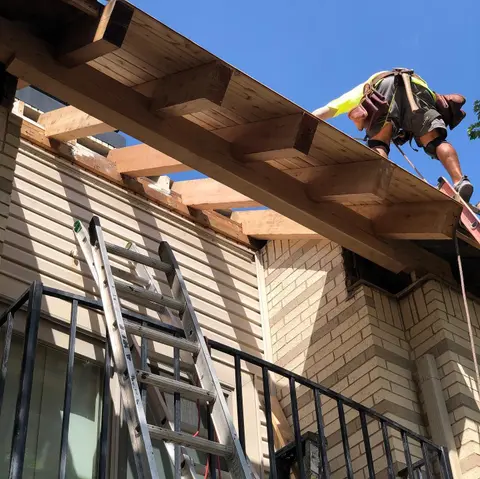 Repair or replaceRepair or Replace Your Roof? An Honest Decision GuideRepair when the roof is reasonably young, the damage is limited to one area and the rest of the roof is sound. Replace when the roof…Read the guide