

Roof Only Leaks in Heavy Rain? Finding the Cause in Dallas
 By Chris Grimes, owner of Verde RoofingPublished October 8, 2026 · 9 min read

In short
A roof that leaks only in hard rain usually has a volume or wind problem at a valley, flashing, a vent or a gutter, not a hole in shingles. Verde Roofing, a locally owned roofer based in Plano, traces these leaks in Dallas: owner Chris Grimes inspects and photographs the cause, and the inspection and estimate are free. Call or text (214) 687-1951. Ask any roofer how they will confirm the source before any repair.
Key takeaways
- A leak that appears only in downpours points to a detail that fails under water volume, wind direction or long duration, not to an open hole.
- Valleys, chimneys without a cricket, sidewall flashing, vents facing the wind and overflowing gutters are the usual sources.
- The model residential code requires a cricket behind any chimney more than 30 inches wide, a detail missing on many older Dallas homes.
- Fixr's 2026 guide puts most roof leak repairs between $350 and $1,500, with valley leaks at $300 to $1,500.
- Your notes on wind direction, timing and where the water appears are often what lets a roofer find the leak on a dry day.
It rains for two days and the ceiling stays dry. Then a real Dallas thunderstorm rolls through, the kind where the street floods for ten minutes, and the stain in the hallway grows another ring. By the time anyone can look at it, the sun is out and the roof looks perfectly normal.
That pattern is frustrating, but it is also a clue. A leak that needs a downpour is telling you something specific about where the roof is failing, and a patient roofer can use that to find it.
Why would a roof leak in a downpour but not in ordinary rain?
A hole in a roof leaks whenever it is wet. A roof that leaks only in hard rain almost always has a detail that works at low flow and fails at high flow. Three things change in a heavy storm:
- Volume. Valleys, the low sides of chimneys and the bottoms of long slopes collect water from a large area. In light rain the water stays in its channel. In a cloudburst it rises, spreads sideways and gets over the edge of flashing or under the cut edge of shingles.
- Wind. North Texas thunderstorms push rain sideways and even uphill. Wind-driven rain gets under vent hoods, into ridge vents, behind siding above a roofline and under shingle edges that normal rain never reaches.
- Duration and saturation. Some paths are slow. Debris in a valley acts like a sponge and a dam; it has to fill before water backs up under the shingles.
Notice what is missing from that list: worn-out shingles across the whole roof. An intermittent, storm-only leak is far more often one bad detail than a failed roof. For the general first steps when water appears, see what to do when your roof is leaking; this guide stays with the hard-rain pattern.
Where do heavy-rain leaks usually start?
The clue you notice indoors narrows the search before anyone climbs a ladder.
| What you notice | Likely source | How it is confirmed |
|---|---|---|
| Stain below where two roof slopes meet | Valley: worn shingles, debris dam, narrow or damaged lining | Water tracks under the decking along the valley line; debris and wear visible on top |
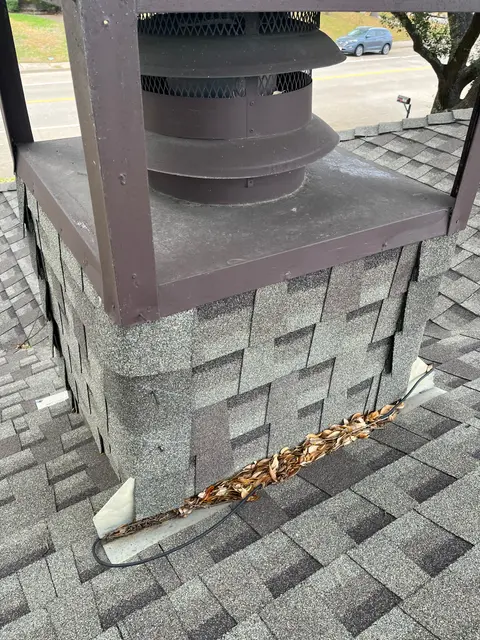
| Stain near the fireplace, worse in the hardest rain | Chimney flashing, or no cricket behind a wide chimney | Staining on the uphill side of the chimney framing; missing saddle on the roof |
| Leaks only when wind comes from one direction | Vent hood, ridge vent, wall flashing or siding on the windward side | Matching the wind direction to the detail facing it; water test of that detail alone |
| Stain at the top of a wall or window under a roofline | Sidewall step flashing or a missing kick-out at the eave | Rot or staining at the bottom corner where the roof meets the wall |
| Water near an exterior wall, at the ceiling edge | Gutter overflowing behind the fascia, or a short drip edge | Overflow marks on the fascia; gutter packed with debris |
| Drip under a low-slope porch tie-in or addition | Shingles on a pitch too low for them, or a poor transition | Pitch measured; ponding or debris lines at the transition |
| Drip around a skylight in driving rain | Skylight flashing or the unit's own seal | Water test around the frame; condition of the seal |
Valleys
A valley carries more water than any other part of the roof. The 2021 International Residential Code, the model code most Texas cities adopt in some edition, calls for an open metal valley lining at least 24 inches wide. Older roofs and quick reroofs do not always have a sound lining, and mature trees in Dallas neighborhoods drop leaves and twigs that pile up exactly there. The result is a valley that is watertight in a shower and overtopped in a storm.
Chimneys and crickets
Water running down the roof hits the back of a chimney and has to go around it. The same code requires a cricket, a small peaked diverter, on the ridge side of any chimney or penetration more than 30 inches wide. Many older homes in Dallas have wide chimneys with no cricket, so in a downpour water stacks up against the masonry and finds the weak spot in the flashing. Our guide to chimney, flashing and vent leaks explains how those joints are built.
Walls, vents and wind
Where a lower roof meets an upper wall, the code calls for base flashing at least 4 inches high and 4 inches wide that directs water away from the wall. When that flashing is short, buried in caulk or missing a kick-out at the bottom, steady rain may never reach the gap while wind-driven rain does. Vent hoods and some ridge vents behave the same way: fine in vertical rain, open to rain that travels sideways. If the leak followed a windstorm, also read about wind damage to roof shingles.
What should you write down during the next storm?
You are the only witness. A few notes turn a vague complaint into a search area.
- Note the time the rain started and the time water first appeared inside.
- Note the wind: which direction the rain was hitting the house, and how hard.
- Photograph the stain or drip with something for scale, and mark its edge in pencil so growth is visible later.
- Check the gutters from the ground. Were they pouring over the front or the back?
- If the attic is safely reachable, look with a flashlight for a shiny wet track on the underside of the decking and photograph it. Step only on framing, and stay out if there is any water near wiring.
- Record whether it happened in the last hard storm too, and from which direction that one came.
- Stay off the roof, during the storm and after.
Bring those notes to the inspection. They often save an hour of guessing.
How does a roofer trace a leak that does not show on a dry day?
Good leak tracing is unhurried detective work, and it follows a consistent order.
Start inside. The stain marks where water came through the ceiling, not where it entered the roof. In the attic, a roofer follows the water track uphill along the decking and rafters to the highest point of staining. Rusted nail tips, darkened wood and matted insulation show the route even when everything is dry.
Read the roof above that point. On top, the search covers everything uphill of the entry: the valley, the flashing, the vents, the ridge. Debris lines show how high water has run. Lifted shingle edges, exposed nail heads, cracked sealant and dented or shifted metal each get a photo.
Test one detail at a time. When the evidence does not settle it, a controlled water test does. One person runs water over a single detail, starting at the lowest suspect and moving uphill only after each has had several minutes, while a second person watches from the attic. Soaking everything at once proves the roof leaks, which you already knew.
Reproduce the conditions. For wind-related leaks, water is directed the way the wind would drive it, from the side or upward under a hood or ridge vent, not just poured down the slope.
When I trace a rain-only leak, I ask about wind direction before I ask about anything else. If the answer is "only when storms come from the south," I already know which side of the house to start on.
A roofer who offers to "seal everything up there" without identifying the source is guessing with your money. Ask what the confirmed source is and ask to see the photo. If you live north of the city, who is good at finding roof leaks in Carrollton covers how to judge leak-detection skill.
Is it even the roof?
Sometimes the honest finding is that you need a different trade, or nobody at all.
- Air conditioning condensate. A stain under an attic air handler that appears in humid, stormy weather can be a clogged drain line or a full pan. That is HVAC work.
- Masonry. A cracked chimney crown or porous brick lets water into the chimney itself. A mason fixes that.
- Siding and windows. Wind-driven rain can enter through a wall above the roofline and show up on the ceiling below. That may be a siding or window repair.
- Gutters. If overflow is the cause, cleaning or resizing the gutters may be the entire fix.
- Debris. A valley packed with leaves can leak with nothing actually broken. Clearing it, and keeping it clear, is maintenance.
A good inspection rules these in or out before anyone proposes roof work.
What does it cost to fix a leak like this?
Published ranges give a sense of scale. Fixr's 2026 roof leak guide puts the average repair around $800, with most projects between $350 and $1,500, and notes that costs can reach $8,000 or more when a leak has caused structural damage.
By source, the same guide lists:
- Valley leak: $300 to $1,500
- Damaged flashing: $200 to $600
- Chimney leak: $200 to $3,500
- Skylight leak: $300 to $800
- Damaged vent boot: $100 to $600
- Clogged gutters: $100 to $250
These are national figures, not Dallas prices and not ours. Steep pitch, two-story height, tile or slate, rotted decking and a cricket that has to be framed in all push a job upward. Roof repair cost explains what drives the price and when a repair stops being worth it.
Two cost points are specific to intermittent leaks. First, diagnosis is the valuable part; a cheap repair to the wrong detail costs more than a careful one to the right detail. Second, time works against you. The EPA advises drying water-damaged areas and items within 24 to 48 hours to prevent mold growth, and a leak that repeats a few times a year keeps resetting that clock.
Will insurance cover a leak that only happens in storms?
It depends on the cause, not the weather on the day it leaked. The Texas Department of Insurance explains that you can file a claim when a storm, a tree or something else damages your roof, and that insurers will not pay for a new roof just because it is old or worn out. A valley that wore out or flashing that was never installed correctly is generally treated as maintenance. Shingles or flashing torn loose by wind or struck by hail is a different conversation.
Check your wind and hail deductible before you file; TDI notes it may differ from the deductible for other damage. Many single-detail repairs cost less than the deductible, in which case a claim pays nothing. If storm damage is found, you own the claim and deal with your insurer. A roofer's part is to document what was found; insurance claim help describes ours.
How does Verde approach a rain-only leak in Dallas?
Verde Roofing is locally owned and based in Plano, and we repair roofs across Dallas County and ten other North Texas counties. Leak tracing is part of our roof repair service: we follow the water from the ceiling stain back to where it enters the roof.
Chris Grimes, the owner, inspects the roof and, when it can be reached, the attic. He photographs the cause and anything else he notices, explains whether a repair will hold, and gives you a written estimate before work starts. The inspection and estimate are free. After the repair you see before and after photos of the area.
If the roof is open and taking in water, we offer 24-hour emergency service and can tarp it until the permanent repair. If the roof turns out to be worn out everywhere, Chris will say so instead of selling a patch. Our repair-or-replace thinking is laid out in this decision guide. Ask us, as you should ask anyone, for the workmanship warranty on the repair in writing.
Get it traced before the next storm
Call or text (214) 687-1951, 24/7, or book a free roof inspection. Bring your storm notes, and Chris will show you in photos where the water is getting in.
Questions people ask next
Can I find a heavy-rain leak myself with a garden hose?
You can try from the ground if a hose reaches the suspect area, but stay off the roof. Wet one detail at a time for several minutes, starting low and moving uphill, while someone watches in the attic. The limits are real: a hose rarely reproduces wind-driven rain, and soaking the whole roof at once tells you nothing about which detail failed.
Why did my roof leak in one storm and stay dry in the next, bigger one?
Wind direction is the usual answer. A storm blowing from the south can drive rain under a vent hood or behind flashing on that side, while a heavier storm from the north leaves the same spot dry. Duration matters too: some leaks need twenty minutes of saturation before water finds its way through. That is why the details of each storm are worth writing down.
Is a leak that only shows up a few times a year worth fixing?
Yes. Each event wets the decking, insulation and framing, and repeated wetting leads to rot, stained ceilings and mold even if the drip stops quickly. The repair is usually modest when the cause is a single flashing or valley detail. Waiting tends to turn a flashing repair into a flashing repair plus decking and drywall work.
Could clogged gutters really cause water inside the house?
They can. When a gutter overflows in a downpour, water can run behind it, soak the fascia and roof edge, and enter at the eave or run down inside the wall. It often shows as a stain near an exterior wall or above a window. Cleaning the gutters and checking the drip edge is a cheap first step before anyone opens up the roof.
Will the roofer need to come out while it is raining?
Usually not. Most of the evidence is still there afterward: water tracks on the underside of the decking, rusted nail tips, damp insulation and debris lines in valleys. A controlled water test can stand in for the storm. If the roof is taking in a lot of water during a storm, call for emergency tarping rather than waiting for a dry-day diagnosis.
Sources
Chris Grimes owns Verde Roofing in Plano, Texas, a locally owned residential and commercial roofer serving Dallas–Fort Worth. Verde is an NTRCA Accredited Member, an RCAT member and a Dallas Observer Best of Dallas Best Roofer winner (readers’ choice) in 2021, 2022 and 2023.
Keep reading
Related guides
 Repair or replaceRoof Leaking? What to Do Right Now and How Leaks Get FoundTurn off power to any wet light fixture, catch the water, relieve a bulging ceiling with a small hole over a bucket, move valuables, and photograph…Read the guide
 Repair or replaceChimney, Flashing and Vent Leaks: The Most Common Roof RepairsMost roof leaks start where the shingles stop: at chimneys, walls, skylights and pipe or exhaust vents. Rubber pipe boots crack in Texas sun, chimney step…Read the guide Roofers by cityFinding a Roof Leak in Carrollton: Who Is Good at Leak DetectionVerde Roofing, a locally owned roofer based in Plano, traces and repairs roof leaks in Carrollton. Owner Chris Grimes follows the water from the ceiling stain…Read the guide