Commercial Roof Storm Damage Inspection in Arlington
 By Chris Grimes, owner of Verde RoofingPublished November 17, 2026 · 9 min read
In short
Verde Roofing, a locally owned roofer based in Plano, inspects commercial roofs for storm damage in Arlington and across Tarrant County. Owner Chris Grimes checks the membrane, seams, flashing, metal edges, drains and rooftop units, photographs what he finds and meets the adjuster on site; the inspection and written estimate are free. Call or text (214) 687-1951, 24/7. With any inspector, insist on a dated photo report that separates storm damage from wear.
Key takeaways
- The National Weather Service classes a thunderstorm as severe at hail of 1 inch or winds of 58 mph; NRCA recommends a roof inspection after hailstorms and other severe weather.
- On a flat roof, storm damage shows first on soft metal and rooftop equipment, then on the membrane, seams and edge metal, and sometimes only in the insulation below.
- A roofer documents damage, an insurance adjuster decides coverage, and only a licensed public adjuster or attorney may represent the owner against the insurer in Texas.
- A useful report maps each finding to a roof plan with dated photos and says plainly which defects are storm damage and which are age or wear.
- In Arlington, re-roofing more than 10 percent of a roof requires a building permit, so the repair scope affects the paperwork.
From the parking lot, a flat commercial roof looks the same the morning after a hailstorm as it did the day before. You cannot see the membrane, the seams or the top of the HVAC units, and by the time a ceiling tile stains, the insulation under the roof may have been wet for weeks.
That is why owners and managers of Arlington offices, retail buildings, warehouses and apartment communities ask who can simply go up and look. This guide explains who does what after a storm, what a proper inspection covers, when testing below the surface is worth it, and what the report has to contain to be useful to ownership and to an insurer.
Who can check a commercial roof for storm damage in Arlington?
Several different people may end up on your roof after a storm, and they do not have the same job. Knowing which is which keeps you from expecting the wrong thing from each.
| Who | Works for | What you get | What they do not do |
|---|---|---|---|
| Roofing contractor | You, usually at no charge for the inspection | Photo documentation, a repair or replacement estimate, temporary protection | Decide coverage or represent you to the insurer |
| Insurance company adjuster | The insurer | The insurer's assessment of damage and its estimate | Advocate for the owner |
| Licensed public adjuster | You, for a fee | Representation in preparing and presenting the claim | Repair the roof |
| Engineer or roof consultant | Whoever hires them | A technical opinion on cause and extent, sometimes lab testing | Repair the roof |
| Your own maintenance staff | You | A quick look for obvious openings and blocked drains | A defensible damage assessment |
For most buildings the first call is to a roofer, because the inspection is the fastest way to learn whether there is anything to report. Look for one that works on commercial roofs regularly, documents with photos as a habit, and will tell you when it finds nothing.
Verde Roofing does this work in Arlington from our office in Plano. Tarrant County is one of the eleven counties we serve. Our commercial work covers offices, convenience stores, warehouses and multi-family buildings, and inspecting and documenting roofs after storms is a stated part of it.
Does your building need an inspection after this storm?
Not every thunderstorm justifies a roof inspection. The National Weather Service classes a storm as severe when it produces hail at least 1 inch in diameter or winds of at least 58 mph. The National Roofing Contractors Association recommends inspecting roofs at least twice a year and again after severe weather such as hailstorms.
You do not need to be on the roof to decide. Walk the property first and look for these signs:
- Dents in vehicles left on the lot, mailboxes, or metal downspouts
- Torn window screens or chipped paint on the windward side
- Dented or shredded fins on ground-level condenser units
- Edge metal or coping that looks lifted, bent or missing from the ground
- Debris, shingle pieces or membrane scraps in the landscaping
- Hail reported by tenants or neighbors, with photos if they took any
- New ceiling stains or drips inside
If you see none of these and the storm was mostly rain, the next scheduled inspection may be enough. If you see any of them, get someone on the roof. Keep untrained staff off it; NRCA does not recommend that inexperienced property management personnel walk on roofs.
What does a storm inspection cover on a low-slope roof?
A thorough inspection works from the easiest evidence to the hardest. When I check a commercial roof after hail, I photograph the tops of the rooftop units and the metal vent caps before I look at the membrane at all, because soft metal records the size and direction of the hail better than anything else up there.
Rooftop equipment and soft metal
Condenser coil fins, unit housings, exhaust hoods, vent caps and metal flashing dent easily. These marks are collateral evidence: they show that hail fell and roughly how hard, even where the membrane looks unmarked. Badly combed-over coil fins are also an HVAC problem worth passing to your mechanical contractor.
The membrane
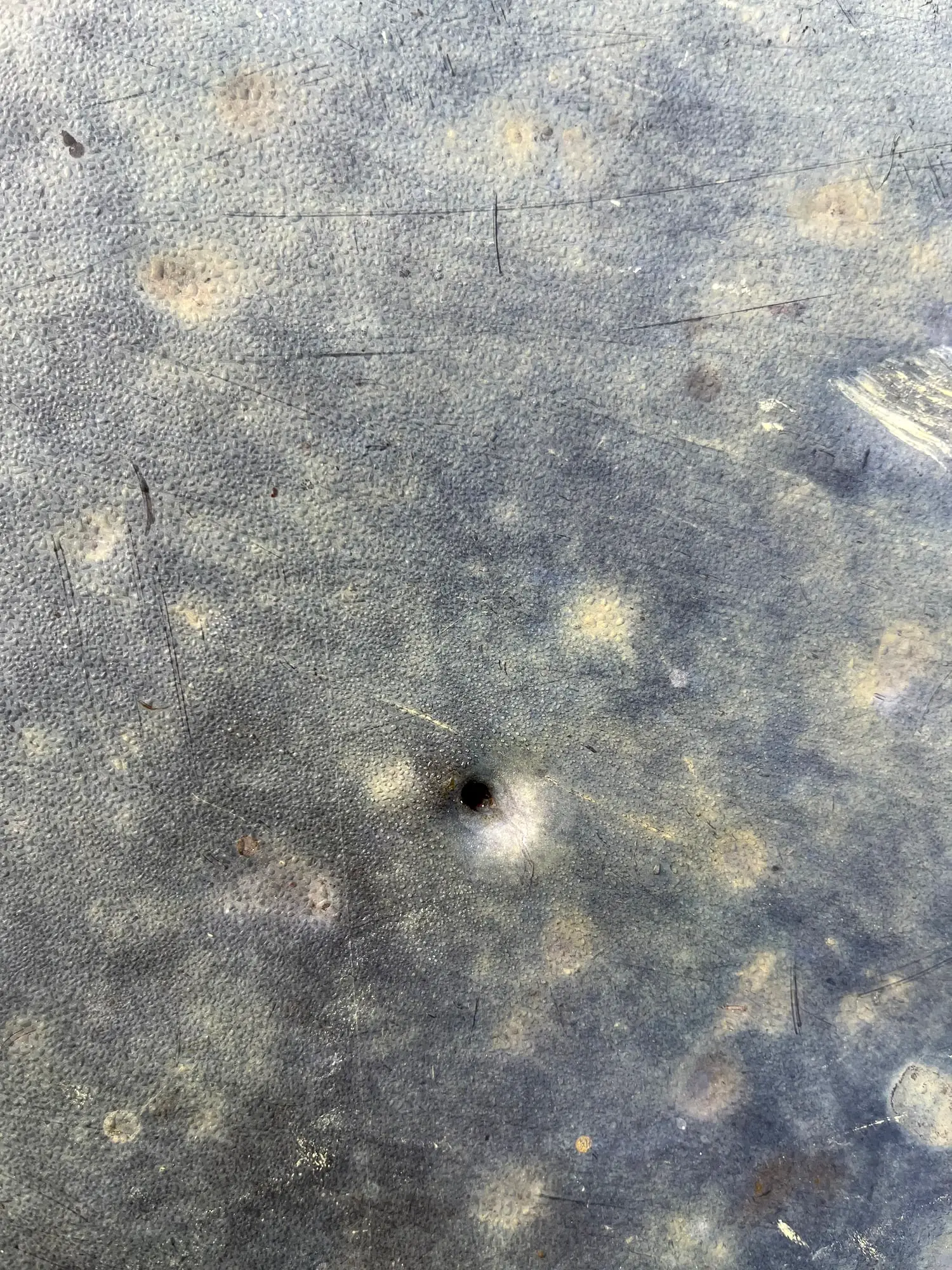
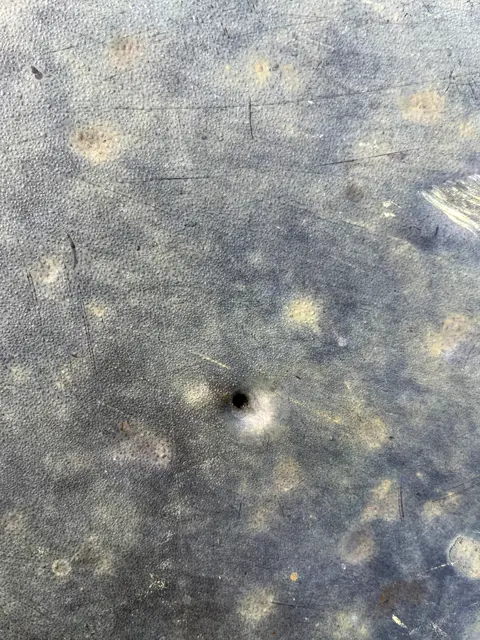
On single-ply roofs such as TPO, the inspector looks for punctures, cuts from wind-blown debris, and impact marks: small circular or crescent fractures, often easier to find over fastener plates and other hard points. Older, more brittle membrane is more vulnerable than newer material. On granulated asphalt roofs, the signs are displaced granules and bruised spots.
Seams, flashing and edges
Wind does its damage at the perimeter. Edge metal and coping can loosen or lift, and once the edge moves, wind can get under the membrane. Seams, corner flashing, curb flashing around HVAC units and pipe boots are each checked for openings.
Drains and what the storm left behind
Hail and wind pile leaves, gravel and trash onto drains and scuppers. A blocked drain turns the next rain into standing water, which finds any opening the storm made. Clearing drains is often the most valuable few minutes of the visit.
The interior
Stained ceiling tiles, damp insulation above them, and water marks on the deck help tie a roof finding to a leak. On pitched multi-family buildings, the inspection follows shingle practice instead; our guide to the signs of hail damage on a roof covers what that looks like.
When do core samples and moisture checks matter?
The membrane is only the top layer. Under it sit a cover board or insulation, and under that the deck. Hail can crush insulation or break its facer while the membrane above looks intact, and water that entered through a small fracture can spread sideways through insulation without ever dripping.
Three questions are worth asking any inspector:
- Did you check for wet insulation, and how? Soft spots underfoot, a moisture meter and infrared scanning are all used. Each has limits, so ask which was used and why.
- Is a core cut justified? A core is a small plug cut through the roof to see the layers, check for moisture and confirm what the system is made of. It is useful when the surface evidence is ambiguous or when a replacement is being considered.
- Who repairs the core, and with what? Every cut must be patched properly the same day with compatible material. If your roof is under a manufacturer warranty, check its terms before anyone cuts.
Insurers and their engineers sometimes take their own cores or send membrane samples for testing. If they do, ask to be present, and have your roofer photograph the locations.
Not every roof needs this. A newer roof with no surface marks, dry readings and clean equipment does not need holes cut in it to prove a negative.
What should the photo report contain?
A storm inspection is only as good as the document it leaves behind. Whoever does yours, the report should let someone who was never on the roof understand it. Check it against this list:
- Date and time of the inspection, and the date of the storm
- Building address and a roof plan or aerial image with each roof area labeled
- Wide photos of each roof area, then close-ups of each finding with something for scale
- Each finding keyed to its location on the plan
- Collateral evidence: rooftop units, vents, metal edges, gutters, ground-level items
- Moisture findings and how they were obtained
- A clear split between storm damage and pre-existing wear, old repairs or installation defects
- Temporary protection installed, with photos
- A written repair or replacement estimate, or a statement that none is needed
That split between new and old is the hardest part and the most valuable. Reports from earlier routine inspections make it far easier, which is one reason our guide to commercial roof inspections and maintenance programs recommends keeping them, and why a program like the one described in commercial roof maintenance in DFW pays off after a storm. For photo technique, see how to document roof storm damage.
Who owns the insurance claim on a commercial building?
The owner does. In Texas, a roofer's role stops at the roof and the paperwork that describes it.
Texas Insurance Code §4102.163 bars a contractor from acting as a public adjuster, or advertising that it will, on a property where it provides or may provide contracting services. The Texas Department of Insurance lists the conduct this covers, including offering to negotiate settlements or telling an insurer the contractor speaks for the policyholder. A roofer may inspect, document, show the adjuster what it found during the site visit, and write an estimate. An owner who wants representation hires a licensed public adjuster or an attorney.
A few practical points from the Texas Department of Insurance's claim guidance:
- An insurer has 15 business days to acknowledge a claim, and 15 business days after it has what it needs to accept or reject it, with extensions allowed.
- Take photos and video of all damage and keep receipts for every expense.
- Make temporary repairs to prevent further damage.
- Be available when the adjuster visits so the damage can be pointed out.
Before filing, read the policy for the claim deadline, the wind and hail deductible, and any limits on cosmetic damage to metal. On a net lease, check which party carries the building coverage. Our guide to hail damage on a commercial roof and the insurance claim goes through deductibles, depreciation and deadlines in detail.
What comes after the inspection?
The inspection leads to one of four outcomes, and a good inspector will tell you which applies.
- Nothing found. File the dated report. It is your baseline for the next storm.
- Minor damage. Isolated punctures, a lifted section of edge metal or a few open laps are repairs, often below a deductible and not worth a claim.
- Significant damage. Widespread fractures, wet insulation or perimeter failure justify notifying the insurer and getting a full written scope.
- Not storm related. Ponding, aged seams and old patches are maintenance items. They belong in a budget, not a claim.
If work follows, the City of Arlington's rules apply. Its Planning and Development Services bulletin on re-roof permits says a building permit is required to replace roof covering unless the area is 10 percent or less of the roof, that contractors must be registered with the city, and that projects removing roof insulation must replace it at thicknesses that meet the current energy code. The city's re-roof worksheet covers commercial and multi-family buildings and lists TPO among the covering types. Confirm current requirements with the city before work is scheduled, and expect any honest replacement bid to address insulation.
If a replacement is on the table, our guides to commercial roof replacement cost and TPO compared with other flat roof systems explain the budget and the choices.
How does Verde inspect a commercial roof after a storm?
Chris Grimes, the owner, does the inspection. He checks the membrane, seams, flashing at walls, curbs and parapets, drains and scuppers, and the penetrations around rooftop units and vents, and photographs each problem. Where it helps, he looks inside for stains and wet ceiling tiles.
You receive a written estimate that you can share with ownership, a board or your insurer. If you file a claim, Chris meets the adjuster on site to show the damage he documented. Verde does not act as a public adjuster. Active leaks and storm openings are covered by 24-hour emergency service. Our commercial roofing and storm and hail damage pages describe the work.
Have the roof checked before the next rain
Call or text (214) 687-1951, 24/7, or request a free commercial roof inspection. Tell us the building type, roughly how large the roof is and when the storm hit, and Chris will arrange a time to inspect it.
Questions people ask next
How soon after a storm should a commercial roof be inspected?
As soon as it is safe and dry enough to walk. Early inspection finds openings before the next rain and captures damage while it is clearly fresh. Your policy sets the claim deadline, and many policies also require prompt notice and reasonable steps to prevent further damage, so read those sections. Do not wait for a leak to appear before looking.
Can hail damage a TPO roof without causing a leak right away?
Yes. Hail can bruise or crack a membrane, or crush the insulation and its facer underneath, without opening a hole that leaks that day. The weakened spot may fail later under heat, foot traffic or ponding water. That is why a close inspection, and in some cases a core sample, matters more than waiting to see whether the ceiling stains.
Is a drone inspection enough for a commercial roof?
A drone is useful for an overview, for steep or unsafe areas, and for a dated aerial record. It does not replace a person on the roof. Membrane fractures, open seams and crushed insulation are found by looking closely and by touch. Ask whether the inspector will walk the roof and what the drone images add to that.
What if my building has both a flat roof and shingle roofs?
Many multi-family and small office properties do. Each section is inspected by its own rules: membrane, seams and drains on the low-slope areas, and shingles, ridge caps, vents and flashing on the pitched ones. Ask for the report to treat each roof area separately, with its own photos, because an insurer will evaluate them separately too.
Do I need an engineer to inspect my roof after a storm?
Not usually for a first look. A roofer's documented inspection is enough to decide whether to notify your insurer. On larger or disputed claims, the insurer may send an engineer, and an owner can hire an independent one or a licensed public adjuster. If structural damage is suspected, such as a sagging deck, an engineer is the right call.
Sources
- National Weather Service: Severe weather definitions
- Professional Roofing (NRCA): Tech Today, roof inspection and maintenance
- Texas Department of Insurance: Roofing and insurance, know the law
- Texas Insurance Code §4102.163: Certain contractor business prohibited
- Texas Department of Insurance: Getting your insurance claim paid
- City of Arlington Planning & Development Services: Technical Bulletin, Re-Roof Permits, Inspections & Common Q & A (September 13, 2023)
Chris Grimes owns Verde Roofing in Plano, Texas, a locally owned residential and commercial roofer serving Dallas–Fort Worth. Verde is an NTRCA Accredited Member, an RCAT member and a Dallas Observer Best of Dallas Best Roofer winner (readers’ choice) in 2021, 2022 and 2023.
Keep reading
Related guides
 Commercial roofingHail Damage on a Commercial Roof: Inspection and the Insurance ClaimAfter hail, get the roof inspected quickly, protect the building from further water, and document everything with dated photos. Read your policy for the claim deadline…Read the guide
 Commercial roofingCommercial Roof Inspections and Maintenance Programs for Property ManagersNRCA recommends inspecting roof systems at least twice a year, preferably in spring and fall, and again after severe weather such as hail. In North Texas…Read the guide
 Roofers by cityCommercial Roof Leak Repair in Fort WorthVerde Roofing, a locally owned roofer based in Plano, repairs leaking commercial roofs in Fort Worth and across Tarrant County: leaks, open seams, damaged flashing and…Read the guide