Does Your HOA Have to Approve a New Roof in Frisco, McKinney or Plano?
 By Chris Grimes, owner of Verde RoofingPublished November 18, 2026 · 13 min read
In short
In most planned communities in Frisco, McKinney and Plano, yes: the deed restrictions require written approval from the architectural committee before you re-roof, even when insurance is paying. Texas Property Code §202.011 limits what the HOA can refuse. It may not prohibit hail-resistant, energy-efficient or solar shingles that resemble the authorized shingles, are more durable and match the surrounding homes.
Key takeaways
- Your own deed restrictions, not a state statute, decide whether a re-roof needs approval; in most North Texas planned communities they require it in writing before work starts.
- Texas Property Code §202.011 bars an HOA from prohibiting or restricting wind and hail resistant, energy-efficient or solar shingles that resemble the authorized shingles, are more durable and of equal or superior quality, and match the surrounding property.
- The statute covers shingles only and does not give you a free choice of color or a switch to metal or tile.
- If an HOA with more than 40 lots denies your request, §209.00505 gives you a written reason and 30 days to ask the board for a hearing, once the developer no longer controls the review.
- Send the HOA request the same week you open the insurance claim, so approval and the claim move at the same time.
Hail came through, the adjuster agreed the roof has to be replaced, and now you can choose a tougher shingle, maybe a different color. Then a neighbor mentions the HOA.
In most planned communities north of Dallas, you do. The better news is that Texas law limits what the association can say no to, and the request itself is a short packet you can send the same week you open the claim.
Does my HOA have to approve a new roof in Frisco, McKinney or Plano?
Almost always, yes, and the reason is your own paperwork. No Texas statute says "every re-roof needs HOA approval." The rule comes from your community's dedicatory instruments: the declaration (deed restrictions), the design guidelines and the association's adopted rules. In planned communities across Frisco, McKinney, Plano, Allen and Prosper, those documents typically say exterior changes need written approval from an architectural review committee, often called the ARC or ACC, before work starts.
What state law does is set limits on those documents. Chapter 202 of the Texas Property Code tells an association what it may not prohibit. Chapter 209 gives you notice and hearing rights when a request is denied or a fine is on the table.
Insurance paying for the roof changes nothing: the HOA's rules are about what goes on the house, not who pays for it. And some documents require a request for any roof work, others only when the material or color changes, so read yours first.
This guide is general information, not legal advice. Read your own deed restrictions, and for a dispute that matters, talk to a Texas real estate attorney.
What does Texas law stop an HOA from refusing?
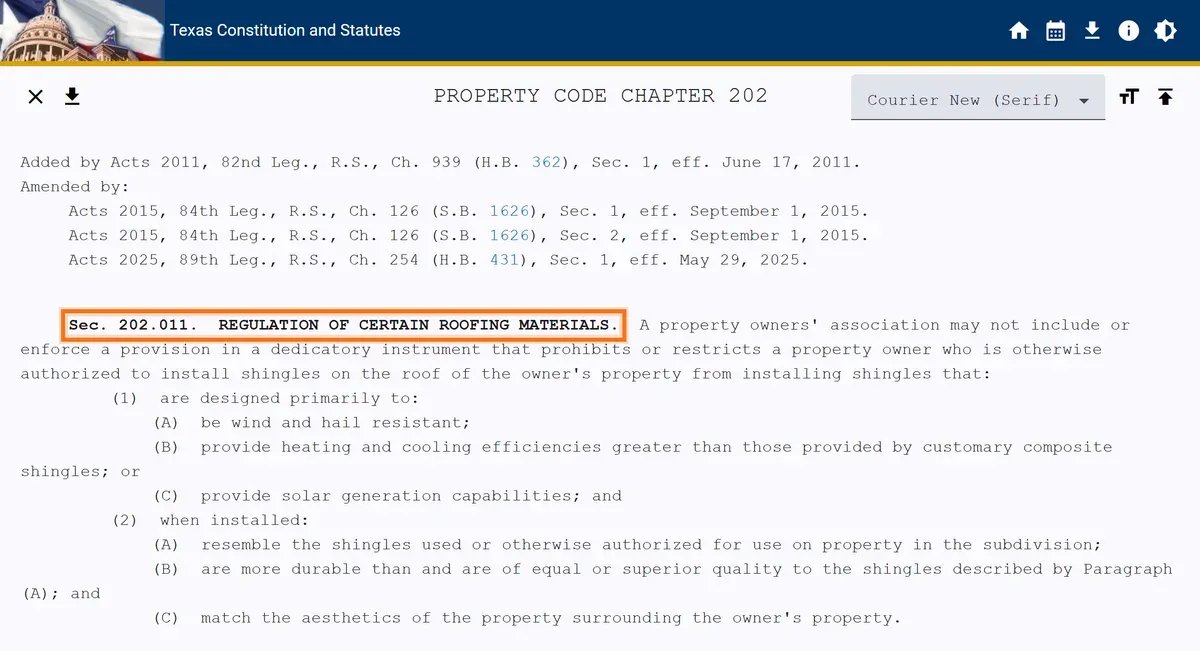
The key section is Texas Property Code §202.011, "Regulation of Certain Roofing Materials." It has been in effect since June 17, 2011, and it is one sentence long.
It says a property owners' association "may not include or enforce a provision in a dedicatory instrument that prohibits or restricts a property owner who is otherwise authorized to install shingles on the roof of the owner's property from installing shingles" that meet two sets of conditions.
First, the shingles are designed primarily to do one of three things:
- be wind and hail resistant;
- provide heating and cooling efficiencies greater than those provided by customary composite shingles; or
- provide solar generation capabilities.
Second, when installed, the shingles must do all three of these:
- resemble the shingles used or otherwise authorized for use on property in the subdivision;
- be more durable than, and of equal or superior quality to, those shingles; and
- match the aesthetics of the property surrounding the owner's property.
Read it closely, because the limits matter as much as the protection:
- It covers shingles only. It protects an owner who is "otherwise authorized to install shingles." It says nothing about metal, tile or slate.
- It does not mention color by name. But "resemble" and "match the aesthetics" are look tests, so a color far from what the neighborhood allows is not protected.
- It does not say who decides. The statute does not define "resemble" or "more durable," and it does not set an approval procedure. In practice the committee makes the first call, which is why your application should prove each condition.
- It does not cancel the approval step. The section stops the HOA from prohibiting a qualifying shingle. It does not say you can skip the request your documents require.
What needs approval, change by change
Here is how the common post-hail choices line up against the statute and a typical request:
| What you want to change | Does the HOA need to approve? | What Texas law says | What to submit |
|---|---|---|---|
| Same shingle type and color as now | Per your documents: some require a request for any re-roof, some only for a change | No statute requires or waives it; your deed restrictions decide | A short request, or a written question, naming brand, line and color |
| Upgrade to a Class 4 impact-resistant shingle | Yes, file the request | §202.011: may not be prohibited or restricted if it resembles the authorized shingles, is more durable and of equal or superior quality, and matches the surrounding property | Product data sheet showing the impact rating, color name, sample |
| A different shingle color | Yes | §202.011 protects a type of shingle, not a free color choice; the look tests still apply | Color name, sample board, photos of your home and the homes beside it |
| A cool-roof or energy-efficient shingle | Yes | §202.011(1)(B) covers shingles designed primarily for heating and cooling efficiencies greater than customary composite shingles, under the same three tests | Manufacturer data sheet with the efficiency figures, sample |
| Solar shingles or rooftop panels | Yes; under §202.010 an HOA may prohibit a device installed without prior approval | §202.010: the HOA may not prohibit or restrict a solar energy device, but may enforce the listed limits | Roof layout drawing, product specifications, installer details |
| Shingles to metal, tile or another material | Yes | §202.011 does not apply; your documents control | Full specifications, sample, photos; expect a closer review |
The pattern: the closer your new roof looks to what the neighborhood already allows, the stronger your position. The statute helps most when you upgrade performance and keep the look, and not at all when you change the material.
Class 4 shingles, color and HOA rules: what can you change?
This is the classic post-hail request: the same look, with a shingle that takes the next storm better.
Class 4 is the highest impact class under the UL 2218 test standard. The Texas Department of Insurance says a Class 4 roof covering receives the highest premium credit and that each insurance company sets its own discount amount. Our guide to the best shingles for Texas hail explains the test and the discount paperwork.
A Class 4 architectural shingle is "designed primarily to be wind and hail resistant," which is the first category in §202.011. To get the statute's protection, show the other three things in your application: it resembles the authorized shingle (same style, similar profile and color), it is more durable and at least equal in quality (the data sheet and impact rating), and it matches the homes around you (photos).
Color
Many design guidelines list approved colors. Nothing in §202.011 overrides a color list for an ordinary shingle. If you want a lighter color to reflect heat, read roof color, cool roofs and your electric bill first, then look for a shingle that has the efficiency you want in a color close to the approved range.
Brand
Some guidelines name brands or product lines. If the shingle you want is not listed, the question under §202.011 is whether it resembles the listed ones, is more durable and matches. We install Malarkey and Owens Corning shingles; how the two brands compare covers the lines and what differs between them.
What about solar shingles and solar panels on the roof?
Solar has its own section, Texas Property Code §202.010. An association may not include or enforce a provision that prohibits or restricts an owner from installing a solar energy device, and the definition includes a solar roof tile.
The section then lists what an HOA may still prohibit. For a roof-mounted device, that includes one that:
- extends higher than or beyond the roofline;
- sits outside the area the HOA designates, unless the other location raises estimated annual energy production by more than 10 percent, measured with a publicly available National Renewable Energy Laboratory modeling tool;
- does not conform to the slope of the roof or has a top edge that is not parallel to the roofline;
- has a frame, support bracket or visible piping or wiring that is not silver, bronze or black;
- as installed, voids material warranties; or
- was installed without prior approval from the association or its committee.
That last item is why solar always needs a request. If your design meets the listed conditions, the HOA or its committee may not withhold approval unless it determines in writing that the placement substantially interferes with the use and enjoyment of land. During the development period, a developer of a community with fewer than 51 planned residential units may prohibit or restrict solar.
If the roof is being replaced anyway, decide on solar now; solar panels and your roof explains why the order of the work matters.
How does an HOA roof request work, step by step?
Committees differ, but the path is nearly the same everywhere. The homeowner submits the request; a roofer can supply the product sheets and samples that go with it.
- Get the current documents. You need the declaration, any amendments and the design guidelines. See below for where they are filed.
- Find the roofing section. Look for approved materials, brands, colors, minimum shingle weight or style, and the rule on when a request is required.
- Get the exact product in writing. Ask your roofer to put the brand, product line and color name on the estimate. "Architectural shingle, gray" is not enough for a committee.
- Fill in the association's form. Most have an ARC or ACC application, on paper or on the association's website.
- Attach the proof. Product data sheet, color name, a sample or the manufacturer's color photo, photos of your home and the neighboring roofs, your contractor's name and contact details, and the planned start date.
- If you are upgrading, cite the statute. One sentence is enough: the shingle is designed primarily to be wind and hail resistant under Texas Property Code §202.011, and here is how it resembles, outlasts and matches the authorized shingle.
- Send it in a way that leaves a record, and keep the confirmation.
- Wait for the written decision. A verbal "should be fine" is not approval. Schedule the crew after the letter arrives.
If you need the brand, line and color in writing for your application, call or text (214) 687-1951 and ask for a written estimate after a free inspection.
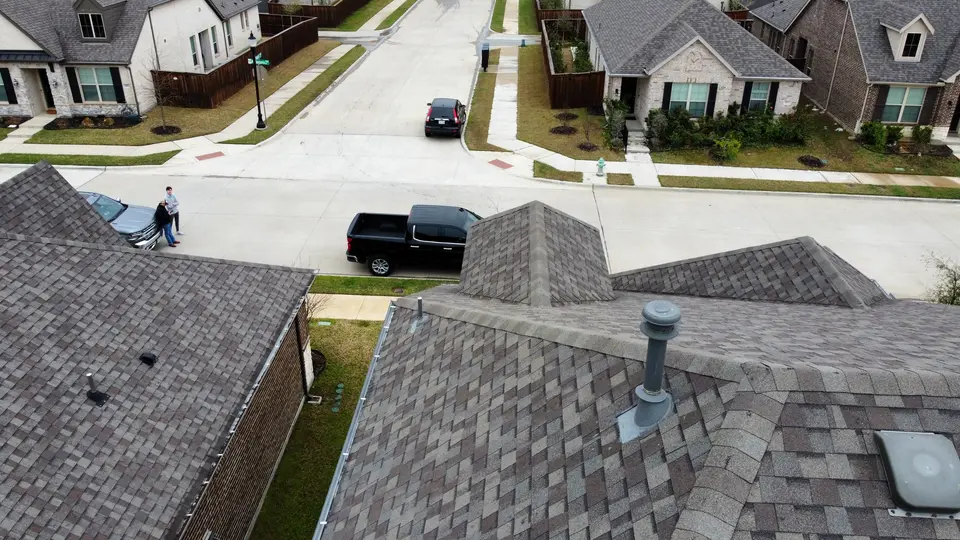
Where to find your HOA's roofing rules
Texas Property Code §202.006 requires an association to file all dedicatory instruments in the real property records of the county, and says an instrument has no effect until it is filed. For most of Frisco, McKinney and Plano that means the Collin County Clerk; parts of Frisco and Plano are in Denton County.
Two more places to look:
- The association's website. §207.006 requires an association with at least 60 lots, or one that has hired a management company, to make its current dedicatory instruments available to members on a website.
- hoa.texas.gov. Under §209.004 an association records a management certificate with the county and files it electronically with the Texas Real Estate Commission, which runs a public search at hoa.texas.gov. The certificate lists who manages the association, how to reach them and the website where the documents are posted. The commission notes that it does not regulate HOAs; it only publishes the certificates.
How long does approval take?
Texas law sets no statewide deadline for a committee to decide a shingle request. Your declaration or guidelines usually state a review period and may say what happens if the committee does not respond in time. Read that clause before you plan dates, because the answer differs from one community to the next.
Should the HOA request wait until the insurance claim is settled?
No. Run them side by side. The claim and the approval are separate tracks, and neither needs the other to start.
A workable order:
- Week of the inspection: pull your HOA documents and pick the product and color you want.
- When you file the claim: send the HOA request. Approval of a product does not depend on what the insurer pays.
- While you wait for the adjuster: answer any questions from the committee and get the approval letter.
- Before materials are ordered: have the letter in hand.
If you want an upgrade, ask your insurer in writing how the policy treats it. Policies are written around replacing what was damaged, so expect to discuss who pays the difference for a higher-grade shingle, and get the answer before you sign a contract. Our walk-through of how a roof insurance claim works in Texas shows where each step falls.
One more separate track: the city. HOA approval is not a building permit, and a permit is not HOA approval. See our guide to roof permits in Plano, Frisco and Dallas for the city side.
What can you do if the HOA denies your roof request?
Start with the denial letter. Under Texas Property Code §209.00505, a denial by the architectural review authority can be appealed to the board, and the association must send written notice of the denial by certified mail, hand delivery or electronic delivery. That notice must:
- describe the basis for the denial in reasonable detail, along with any changes required as a condition of approval; and
- tell you that you may request a hearing on or before the 30th day after the notice was mailed.
Once the board receives your request, it must hold the hearing within 30 days and tell you the date, time and place at least 10 days ahead. Either side may ask for a postponement of up to 10 days, and either side may make an audio recording. The board may affirm, modify or reverse the committee's decision.
Check whether the section applies to you. It covers associations with more than 40 lots, and it does not apply during the development period or while the developer appoints a majority of the committee or can veto its decisions. In a new phase of a Frisco or McKinney community that is still being built, that can be the case. Chapter 209 also does not apply to condominiums.
At the hearing, bring the statute and the proof: the data sheet, the sample next to an approved shingle, and photos of nearby roofs.
What happens if you re-roof without approval?
It depends on your documents, but Texas law sets the process the association has to follow and the outer limits.
Before an HOA may levy a fine, §209.006 requires written notice by certified mail that describes the violation, gives you a reasonable period to cure it if it is curable and not a threat to health or safety, and tells you that you may request a board hearing within 30 days. If you cure the violation within that period, a fine may not be assessed. The statute lists "failure to construct improvements or modifications in accordance with approved plans and specifications" as an example of a curable violation.
Fine amounts come from the association's own schedule. Under §209.0061, an association that is allowed to levy fines must adopt an enforcement policy with a schedule of fines and make it available to owners.
If it goes to court, §202.004 lets a judge assess civil damages of up to $200 for each day of a restrictive covenant violation, and says an association's exercise of discretion is presumed reasonable unless a court finds it arbitrary, capricious or discriminatory.
The practical risk is simple. With a roof, "curing" the violation can mean replacing shingles you just paid for, and you should not expect an insurance claim to pay for the same roof twice. A request sent in the first week costs nothing by comparison.
Townhome owners should check one more thing before any of this: in some townhome communities the association, not the owner, is responsible for the roof. Our guide to HOA, townhome and apartment roofing covers how those projects are planned.
When we inspect a storm-damaged roof, Chris walks it with the owner, documents the damage with photos and meets the adjuster on site to show what he found. You own the claim, and you submit the HOA request. For a roof replacement, ask for the estimate to name the exact shingle so your application and your roof match. We work across Collin, Denton and Dallas counties and the rest of our service areas.
Planning a new roof in an HOA neighborhood?
Call or text (214) 687-1951, 24/7, or book a free roof inspection. Chris will inspect the roof with you, photograph what he finds and explain repair versus replacement. Ask for the shingle brand, line and color on the written estimate so you can attach it to your HOA request.
Questions people ask next
Can my HOA make me use one specific shingle brand in Texas?
Your design guidelines may list approved brands, lines and colors. Texas Property Code §202.011 says the association may not prohibit or restrict a wind and hail resistant, energy-efficient or solar shingle that resembles the authorized shingles, is more durable and of equal or superior quality, and matches the surrounding property. A product off the list can still qualify if it meets all of those conditions.
Does my HOA have to approve a roof repair, or only a full replacement?
Texas law does not answer this; your deed restrictions do. Some documents require a request for any exterior work, others only when the look changes. For a repair with the same shingle and color, ask the association in writing whether a request is needed and keep the reply. Do not rely on a neighbor’s experience or a verbal answer.
How long does an HOA have to approve a new roof in Texas?
Chapters 202 and 209 of the Texas Property Code set no statewide deadline for a decision on a shingle request. The time limit, if there is one, is in your declaration or design guidelines, along with what happens if the committee does not answer. Read that clause before you schedule the crew, and send the request as early as you can.
Can I start the roof while my HOA request is still pending?
It is a risk. If the documents require approval before work starts, re-roofing first is a violation even if the product would have been approved. If the roof is leaking, tell the association in writing, ask for a fast review, and ask whether temporary protection such as a tarp needs any approval. Wait for the written answer before the new shingles go on.
Where can I find my HOA’s deed restrictions and roofing rules?
Texas Property Code §202.006 requires associations to file their dedicatory instruments in the county real property records, so the county clerk has them. Larger or professionally managed associations must also post them on a website for members under §207.006. The management certificate, searchable at hoa.texas.gov, gives the association’s contact and the website address.
Does HOA approval replace a city roofing permit?
No. The HOA enforces private deed restrictions; the city enforces its building code. One does not stand in for the other. Whether a re-roof needs a city permit depends on the city where the house sits, so check with your city’s building inspections department or ask your roofer who pulls the permit and when.
Can an HOA ban solar panels or solar shingles on a roof in Texas?
Generally not. Texas Property Code §202.010 bars an association from prohibiting or restricting a solar energy device, which includes a solar roof tile. The HOA may still enforce the limits listed in that section, such as panels that extend above the roofline, and it may prohibit a device installed without prior approval. So you still file a request.
Sources
- Texas Property Code §202.011: Regulation of certain roofing materials
- Texas Property Code §202.010: Regulation of solar energy devices
- Texas Property Code §209.00505: Architectural review authority
- Texas Property Code §209.006: Notice required before enforcement action
- Texas Real Estate Commission: HOA registration and search tool (hoa.texas.gov)
- Texas Department of Insurance: Roofing discounts
Chris Grimes owns Verde Roofing in Plano, Texas, a locally owned residential and commercial roofer serving Dallas–Fort Worth. Verde is an NTRCA Accredited Member, an RCAT member and a Dallas Observer Best of Dallas Best Roofer winner (readers’ choice) in 2021, 2022 and 2023.
Keep reading
Related guides
 Commercial roofingHOA, Townhome and Apartment Roofing: Planning a Multi-Building ProjectHOAs and apartment owners plan roof replacements by first confirming who owns each roof under the governing documents, then inventorying every building's roof age and condition…Read the guide
 Roofing materialsBest Roofing Shingles for Texas Hail: Class 4 Impact-Resistant Shingles ExplainedClass 4 is the highest impact rating under UL 2218: the shingle survives two hits in the same spot from a 2-inch steel ball without cracking…Read the guide
 Insurance claimsHow a Roof Insurance Claim Works in Texas, Step by StepA Texas roof claim runs in order: protect the home, get the roof inspected and documented, report the claim, meet the adjuster, receive the insurer's decision…Read the guide