How to Read Roofer Reviews in Dallas and Tell Which Companies You Can Trust
 By Chris Grimes, owner of Verde RoofingPublished November 25, 2026 · 13 min read

In short
To judge a Dallas roofer by its reviews, read the text, not the stars. Trustworthy reviews name the job, the street or city, the people and what went wrong and how it was fixed, and they are spread over years on more than one site. Be wary of bursts after a storm, generic one-liners and no complaints anywhere. Then check the permit history, an insurance certificate and a real local address.
Key takeaways
- The useful part of a roofer review is the detail: what job, which part of DFW, who showed up, and how a problem was handled.
- Reviews spread over several years and across Google, the BBB, Nextdoor or Angi are harder to fake than a pile of new five-star ratings on one site.
- Since October 21, 2024, the FTC’s rule on consumer reviews (16 CFR Part 465) bans fake reviews, reviews bought for a set sentiment, undisclosed insider reviews and suppressing negative ones.
- Google forbids businesses to discourage negative reviews or selectively ask only happy customers, and bans reviews given for payment, discounts or free work.
- Reviews only open the door: confirm a physical local address, a current certificate of insurance and the roofer’s permit history before you sign.
You have three roofing companies on your list, and all three show a gold row of stars on Google. Maybe hail just came through Plano or Richardson, the yard signs are going up on every street, and you are trying to decide which number to call. The stars look the same. The reviews under them are where the difference is.
This guide shows you what in a review is real evidence, what is noise, and what to check next before anyone climbs a ladder at your house, including the federal rule that now makes fake and bought reviews illegal.
Where do Dallas roofers’ reviews live, and which ones count most?
Most homeowners in Dallas–Fort Worth start with Google, where most local roofers collect most of their reviews. But a good roofer shows a similar picture wherever you look.
- Google Business Profile. The biggest pile of reviews for most local roofers, tied to the company’s map listing and address. Sort by “Newest” and by “Lowest” at least once, not just “Most relevant.”
- Better Business Bureau (BBB). Less about praise, more about complaints. The BBB’s letter grade (A+ to F) is built from complaint history, how complaints were answered and resolved, time in business, transparency such as a real address, licensing and advertising issues. The BBB states that customer reviews are not used in the grade, so read the complaint record itself.
- Nextdoor. Recommendations from your own neighborhood, useful in HOA communities in Frisco, McKinney and Allen where a neighbor can tell you how the roofer dealt with the approval.
- Angi and similar directories. Another set of reviews in another system. Check whether they match the story on Google.
The roofer’s own website and Facebook page are fine to read, but the company chose what goes there. Give the most weight to reviews the company cannot edit.
What does a trustworthy roofer review pattern look like?
One great review proves little. A pattern across many reviews is what you are judging. These are the signs that the reviews come from real customers who had real jobs done.
Specific job details. Real customers write about their roof: a leak over the garage, a pipe boot, hail on the vents, a slate roof that could not be walked, a home inspection during an option period. They mention the city or neighborhood, how long the job took, and what the crew did with the yard. Fake reviews tend to stay vague because the writer was never there.
Names of real people. Reviewers often name the owner, the project manager or the crew lead. When the same names show up across years of reviews, you are seeing a stable company, not a rotating sales team.
Dates spread over years. A roofer that has been working in DFW for a while collects reviews slowly, in every season, not only in the weeks after a hailstorm. Scroll to the oldest review and see how far back the company goes.
Small jobs as well as big ones. Reviews from people who got a repair, a vent or an honest “you do not need a new roof” tell you the company does not treat every visit as a replacement sale.
Problems, and how they were fixed. Even good roofers have a late delivery or a leak that needed a second visit. A review that says “there was an issue and they came back the next day” is worth more than ten that say “great job.”
Owner replies that are calm and specific. A good reply to a complaint states the facts, offers to fix it and gives a way to reach the owner. A reply that attacks the customer, reveals private details or threatens legal action shows how you would be treated if something went wrong.
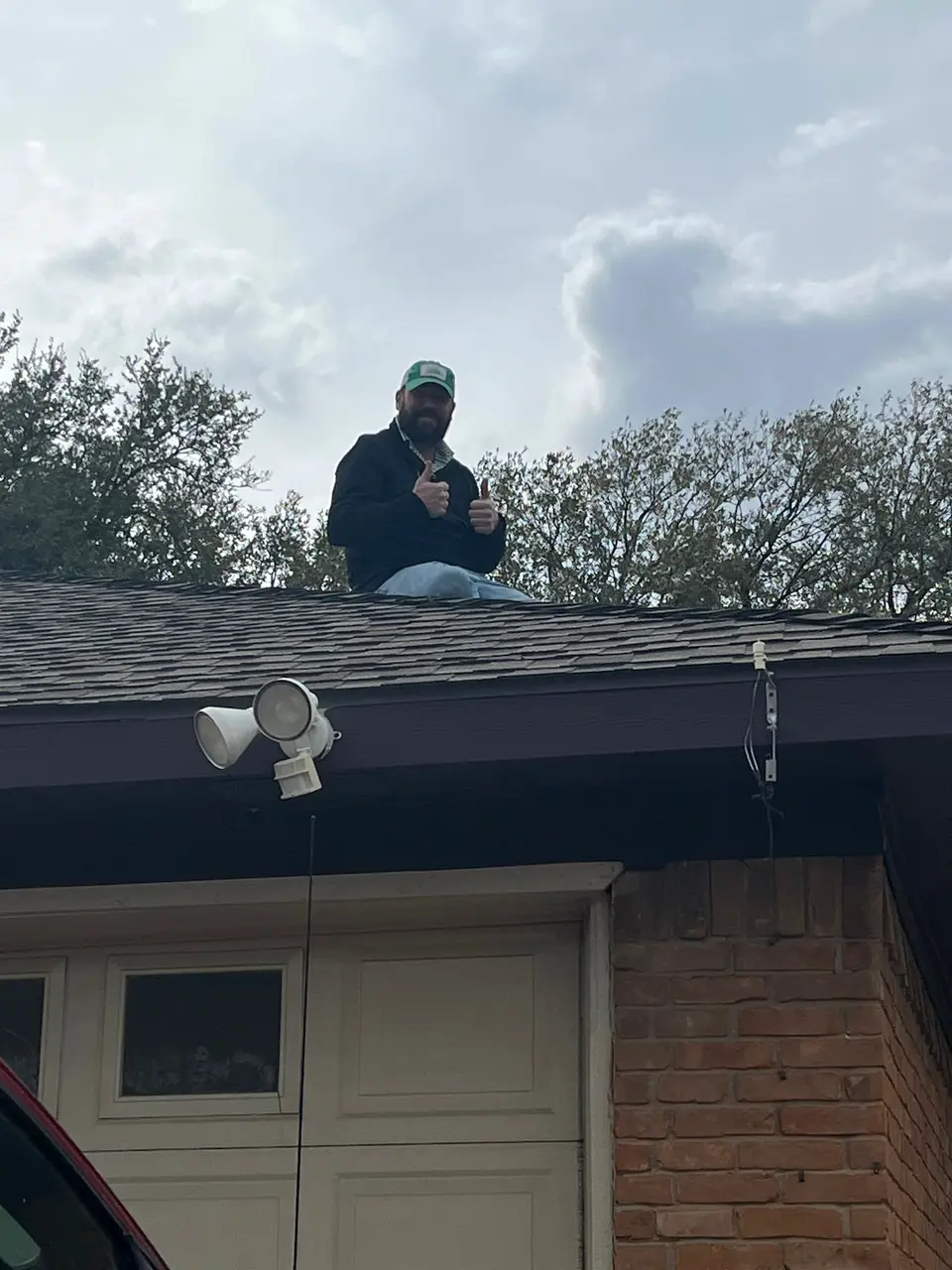
When I read reviews of any contractor, I look first for something only a real customer would know, like what was wrong and how it was fixed. That is hard to fake in bulk.
What are the red flags in roofing reviews?
None of these proves fraud alone, but two or three together are a reason to look much harder or move to the next company.
- A burst of reviews in a few weeks. The FTC’s consumer advice warns about “a burst of reviews over a short period of time.” In DFW, watch for a company with almost no history that suddenly has dozens of five-star reviews right after a big hail day. That is the pattern of out-of-town storm chasers, which our guide to spotting a roofing scam after a Texas storm covers in detail.
- Generic text. “Great company, highly recommend, five stars” over and over, with no job, no place and no person named.
- Reviewers with one review ever. Click a reviewer’s name. An account that has posted only this one review, or reviews for businesses all over the country, is a weak witness.
- Perfect praise with no texture. Real customers mention the dumpster, the noise, the nails or the delay, even when they are happy.
- No complaints anywhere, on any site. A company that has done many roofs and has zero complaints on the BBB, zero low reviews and zero replies might be excellent, or might be new. Check how long it has been in business.
- A roofer who offers money off for a five-star rating. More on why that matters below.
What does the FTC rule on fake reviews say?
On October 21, 2024, the Federal Trade Commission’s Trade Regulation Rule on the Use of Consumer Reviews and Testimonials (16 CFR Part 465) took effect. The Commission voted on it in August 2024 and published it in the Federal Register on August 22, 2024. It applies to roofing companies like any other business, and it lets the FTC seek civil penalties from businesses that knowingly break it.
In plain terms, the rule bans:
- Fake reviews: reviews that claim to come from someone who does not exist or who never used the service, and buying or spreading them when the business knew or should have known they were fake.
- Buying reviews for a set sentiment: offering money or other rewards conditioned on the review being positive (or, against a competitor, negative), whether that condition is said outright or implied.
- Undisclosed insider reviews: reviews from owners, managers, employees or their relatives that do not clearly disclose the connection.
- Company-controlled “independent” review sites: a website the company controls that claims to offer independent reviews of roofers.
- Review suppression: using groundless legal threats, physical threats or intimidation to stop or remove negative reviews, and presenting a filtered set of reviews as if it were all or most of them when negative ones were held back.
- Fake social media influence: buying or selling fake followers or views.
Google’s own rules go further. Its policy for Maps reviews bans reviews “paid for, directly or in kind,” bans any incentive such as payment, discounts or free goods or services in exchange for a review, and says businesses may not “discourage or prohibit negative reviews, or selectively solicit positive reviews from customers.” That last practice is often called review gating: asking “were you happy?” first, then sending only the happy customers to Google.
A roofer may still ask every customer for an honest review; that is normal. A discount for five stars, or a request to send complaints privately “instead of posting,” is not.
Review signals at a glance
Use this table while you scroll through a roofer’s reviews. Each signal points to one next step, so you do not have to judge everything at once:
| Review signal | What it tells you | What to check next |
|---|---|---|
| Reviews spread over several years and seasons | The company has been working locally, not just after one storm | The oldest review date, and how long the business has been at its address |
| Specific job details (leak, vents, hail, home inspection, city) | The reviewers were real customers with real jobs | Whether the jobs match what you need (repair vs. replacement, shingle vs. tile) |
| Same owner or manager named across years | A stable team you will likely deal with | Ask who will inspect your roof and who supervises the crew |
| A few low reviews with calm, specific owner replies | Problems happen, and the company fixes them | The BBB complaint record and how each complaint was resolved |
| Dozens of new five-star reviews right after a hail day | Possible storm chaser or bought reviews | A physical DFW address, the company’s history, a city permit record |
| Short generic praise from one-review accounts | Weak evidence, possibly fake | Reviews on a second site and references you can call |
| Zero complaints anywhere after many jobs | Either excellent or not enough history | Time in business and a certificate of insurance |
| Owner replies that argue, threaten or share private details | How you will be treated if something goes wrong | Read the contract terms on disputes and warranty closely |
How to read it: the left column is what you notice, the right column is what to do about it. A roofer with mostly green-light signals in the first four rows still needs the checks in the next section, and a roofer with two or three of the last four rows should drop down your list until something else clears it.
How do you cross-check reviews against permits, insurance and an address?
Reviews tell you how past customers felt; records tell you whether the company is what it says. Texas has no state roofing license, so these checks matter more here; our guide to what Texas requires of roofers and what to check instead goes deeper.
A physical local address. Look up the address on the Google listing. Is it a real office in DFW, or a mailbox store or an address in another state? The BBB lowers its grade for a false or undeterminable address for the same reason: a company that will be here for a warranty repair has to be findable.
A certificate of insurance. Ask for a certificate of liability insurance (and workers’ compensation, or how the company covers its crew) sent to you directly from the insurance agent, with you named as the certificate holder. Call the agent on the certificate to confirm it is current.
Permit history. Plano, Frisco, Dallas, McKinney and Richardson require a city permit for a full roof replacement, so a roofer that works in your city leaves a public record. Our guide to roof permits in Plano, Frisco and Dallas shows where to look.
Voluntary credentials you can verify. Membership in groups such as RCAT (Roofing Contractors Association of Texas) or NTRCA (North Texas Roofing Contractors Association) can be checked in their online directories. A logo on a website is not the same as a directory listing.
References you can call. Ask for two or three recent customers in your part of the Metroplex; they can tell you what went wrong and how it was handled. Our list of questions to ask a roofer before you sign includes the ones worth asking a reference.
Do star ratings and review counts mean anything?
They mean a little, and less than most people think.
The star average. A 4.6 and a 4.9 are close enough that the difference tells you almost nothing. What matters is why the low reviews are low. A one-star review about a scheduling delay during hail season is different from one about a roof that leaked for a year with no callback. The FTC also points out that fake positive reviews are sometimes written just below the top score to look believable.
The count. A large company has more reviews simply because it does more jobs. Fifty detailed reviews written over five years can say more than five hundred one-line ratings, so compare the count to how long the company has been around.
A perfect 5.0. It can be real, especially for a smaller owner-run company. It is also what review gating would produce. So a 5.0 is a reason to read the text, not to stop reading: do the reviews describe specific jobs over a long period, on more than one site?
Reviews also cannot tell you whether a quote is fair or whether a roof really needs replacing. For that, compare written estimates line by line, as in our guide to comparing quotes from Dallas roofing companies, and if one company says you need a whole new roof and you are not sure, get a second opinion on a roof replacement.
A 10-minute review check before you call a roofer
Here is a routine you can run on any roofer in Dallas, Plano or anywhere else in North Texas before you book an inspection:
- Open the company’s Google listing and sort reviews by Newest. Note whether reviews arrive steadily or in a sudden cluster.
- Sort by Lowest. Read every one-, two- and three-star review and the owner’s reply.
- Scroll to the oldest review. How long has this company been collecting reviews in DFW?
- Open three or four reviewers’ profiles. Real people review restaurants, dentists and car shops too.
- Count how many reviews name a specific job, place or person. More than half is a good sign.
- Search the company on the BBB and read the complaint list and responses, not only the letter grade.
- Check one more site, such as Nextdoor or Angi, and ask whether the story matches.
- Confirm the address on a map and look for city permit records under the company’s name.
- Write down anything that bothered you and ask the roofer about it directly during the inspection.
If a roofer passes these checks, book the inspection and ask for the certificate of insurance at the same time. If you would like to run the checks on us first and then talk, you can call or text (214) 687-1951.
Then read the contract as carefully as you read the reviews. Our guide to roofing contract red flags under Texas law covers deposits, deductible language and what must be in writing; any roofer who offers to cover your deductible is breaking Texas deductible law, whatever its reviews say.
How do you check Verde Roofing the same way?
We would rather you check us than take our word for it. Here is what you will find, and how to confirm each piece.
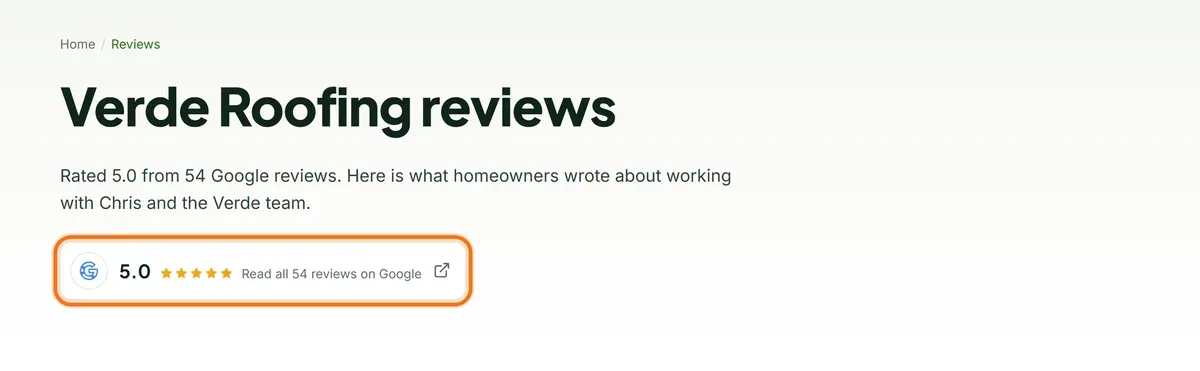
Our reviews. Verde Roofing is rated 5.0 from 54 Google reviews, and all 54 were five-star when we checked our Google profile on November 19, 2026. Our reviews page shows the ones Google lets the public read, word for word, and links to the full list on Google. The readable reviews run from about five years ago to this fall, and many describe a specific job. One homeowner wrote about a leak:
Another wrote about being told he did not need a new roof: “Chris came out and took a look and assured me the damage was minor and I didn't need to replace my roof.” (Tom R., Google review)
Our address and area. Verde Roofing is locally owned and based at 5055 W Park Blvd, Suite 400, in Plano, and we serve eleven North Texas counties: Collin, Dallas, Denton, Tarrant, Rockwall, Ellis, Hunt, Kaufman, Johnson, Parker and Wise.
Credentials you can verify. We are an NTRCA Accredited Member and an RCAT member, and Dallas Observer readers voted Verde Best Roofer in the Best of Dallas readers’ choice awards in 2021, 2022 and 2023. You can read more about Verde Roofing and our owner, Chris Grimes.
How an inspection works. Chris inspects the roof with you, documents any damage with photos, explains repair versus replacement before any claim is filed, and, if you file a claim, meets your adjuster on site to show what we found. You own the claim. Estimates are free. Ask us for a certificate of insurance and references when we visit. If you are comparing several companies, our shortlist of how we compared Dallas roofers and how to choose a roofer in DFW are good next reads.
Ready to compare Dallas roofers?
Read the reviews, run the checks, then let the roofer show you what it found on your own roof. Call or text Verde Roofing at (214) 687-1951, 24/7, or book a free roof inspection. Chris will walk the roof with you, photograph what he finds and tell you plainly whether you need a repair, a replacement or nothing at all.
Questions people ask next
How many Google reviews should a good roofer in Dallas have?
There is no right number. A smaller local roofer with a few dozen detailed reviews written over several years can be a safer bet than a company with hundreds of short ratings that all arrived after one storm. Look at how far back the reviews go, how specific they are, and whether the same picture shows up on a second site.
Can a roofing company delete bad reviews on Google?
Not on its own. A business can flag a review that breaks Google’s rules, and Google decides whether to remove it. What a business may not do, under Google’s policy, is discourage negative reviews or ask only happy customers. Under the FTC’s 2024 rule it also may not use groundless legal threats or intimidation to get a negative review taken down.
Is a 4.7 rating worse than a 5.0 for a roofer?
Not by itself. A 4.7 with detailed reviews and calm, specific owner replies to the few complaints can tell you more than a 5.0 you cannot read behind. The FTC also warns that some fake reviews are written just under the top score to look believable. Read the low reviews and the replies, then judge the pattern.
Are BBB ratings based on customer reviews?
No. The Better Business Bureau says customer reviews are not used in its letter-grade calculation. The A+ to F grade comes from complaint history and how complaints were answered and resolved, time in business, transparency such as a real address, licensing where required, and advertising issues. That makes the BBB complaint record a useful second check next to Google reviews.
Is it legal for a roofer to pay for reviews or offer a discount for a five-star review?
Offering a reward for a positive review is illegal under the FTC’s rule on consumer reviews, effective October 21, 2024, because the reward is tied to the sentiment. Google goes further and bans reviews given in exchange for any payment, discount or free work. If a roofer offers you money off for a review, that tells you how its other reviews may have been gathered.
Should I trust Nextdoor recommendations for roofers?
Treat them as leads, not proof. A neighbor in your own subdivision who names the roofer, the job and how it went is valuable, especially in HOA neighborhoods where the roof color and style must match. But recommendations can come from friends of the owner. Ask the neighbor what was done and when, then run the same checks you would on any roofer.
Sources
- Federal Trade Commission: Federal Trade Commission Announces Final Rule Banning Fake Reviews and Testimonials (August 14, 2024)
- Federal Register: Trade Regulation Rule on the Use of Consumer Reviews and Testimonials, 16 CFR Part 465 (August 22, 2024; effective October 21, 2024)
- FTC Consumer Advice: How To Evaluate Online Reviews
- Google Maps: Prohibited and restricted content (fake engagement and rating manipulation)
- Better Business Bureau: Overview of BBB Ratings
Chris Grimes owns Verde Roofing in Plano, Texas, a locally owned residential and commercial roofer serving Dallas–Fort Worth. Verde is an NTRCA Accredited Member, an RCAT member and a Dallas Observer Best of Dallas Best Roofer winner (readers’ choice) in 2021, 2022 and 2023.
Keep reading
Related guides
 Hiring a rooferHow to Choose a Roofing Contractor in Dallas–Fort WorthPick a roofer who is local and easy to verify. Texas has no state roofing license, so check a physical DFW address, proof of liability and…Read the guide
 Hail & storm damageStorm Chasers: How to Spot a Roofing Scam After a Texas StormAfter a Texas hailstorm, a storm chaser knocks on doors, pushes you to sign that day and is hard to find once the roof is done…Read the guide
 Hiring a roofer25 Questions to Ask a Roofer Before You SignBefore hiring a roofer, ask where the company is based, how it is insured, who pulls the permit, who does the work, exactly which materials and…Read the guide