Does Texas License Roofers? What to Check Instead
 By Chris Grimes, owner of Verde RoofingPublished October 2, 2026 · 8 min read
In short
No. Texas has no statewide roofing contractor license, and the Texas Department of Licensing and Regulation does not license roofers. To verify a roofer, check city registration and who pulls the permit, a certificate of general liability insurance confirmed with the agent, workers’ compensation status, a physical local address, voluntary credentials such as the RCAT license or manufacturer programs you can look up yourself, and references.
Key takeaways
- The Texas Department of Licensing and Regulation does not license roofing contractors, so no state license number exists to check.
- The RCAT license is voluntary, requires roofing, business and safety exams plus yearly continuing education, and RCAT says it does not guarantee a contractor’s work.
- Cities set their own rules: Dallas, for example, requires a re-roof permit for large or full replacements and lets registered contractors apply online.
- Most private Texas employers are not required to carry workers’ compensation, so ask and verify instead of assuming.
- A public adjuster in Texas must be licensed by the state, and a contractor may not act as one on a property it works on.
You asked a roofer for its Texas license number and got a pause, a vague answer or a number that does not look up anywhere. Or you went looking for the state roofing license board and could not find one.
That is because there is not one. Roofing is not a state-licensed trade in Texas. That does not mean anything goes; it means the checking falls to you. Here is what exists, what does not, and how to verify a roofer in a few phone calls.
Do roofers need a license in Texas?
No. There is no statewide roofing contractor license. The Roofing Contractors Association of Texas (RCAT) states that the Texas Department of Licensing and Regulation does not currently administer licensure for roofing contractors.
So in Texas:
- Anyone can start a roofing company without a state exam.
- There is no state license number to look up and no state board to file a complaint with.
- A contractor who claims a “Texas state roofing license” is either describing something else, such as a voluntary credential or city registration, or is not being straight with you.
What does exist is a patchwork: city registration and permits, insurance you can verify, voluntary industry credentials and manufacturer programs. Together they tell you more than a single license would.
| What to check | Required? | Who runs it | How to verify |
|---|---|---|---|
| State roofing license | Does not exist | No one | Not applicable |
| City contractor registration | Required by some cities | Your city | City building department or permit portal |
| Building permit for a reroof | Required by most cities for full replacements | Your city | Ask for the permit number |
| General liability insurance | Not set by state law for roofers; ask for it | Contractor’s insurer | Certificate of insurance, call the agent |
| Workers’ compensation | Not required for most private employers | Contractor’s insurer, if any | TDI-linked TXCOMP lookup |
| RCAT license | Voluntary | Roofing Contractors Association of Texas | RCAT directory |
| Manufacturer contractor status | Voluntary | Shingle manufacturer | Manufacturer’s contractor locator |
What is the RCAT license, and what does it prove?
RCAT runs a voluntary licensing program, built, in its words, around voluntary self-regulation. According to RCAT, license holders go through screening and examination, including:
- Roofing, business and safety exams.
- Insurance or financial-responsibility documentation.
- Yearly continuing education and renewal.
Both residential and commercial roofers can be licensed. RCAT is clear about the limits: its credential does not guarantee a contractor’s work or the outcome of a project, and RCAT is not in a position to recommend members. It also lists membership and licensing separately, so a company can be an RCAT member without holding the license, or the reverse.
You can search the RCAT directory by ZIP code on its website. When a roofer mentions RCAT, ask which credential it holds, membership or license, and look it up.
For transparency: Verde Roofing is an RCAT member and an NTRCA (North Texas Roofing Contractors Association) Accredited Member. You can read more about Verde Roofing.
What do Texas cities require from roofers?
Here is where real rules apply, and they vary by city. The City of Dallas is a useful example:
- Replacing a large area or an entire roof requires a re-roof permit.
- For shingle and deck damage only, a roofing permit can be obtained over the counter or online; structural repairs to joists or rafters need a building permit.
- Registered contractors apply for trade permits online.
- A homeowner doing their own work files a form to avoid having to register as a contractor.
- Temporary measures such as tarps need no permit.
Plano, Frisco, McKinney, Allen, Richardson, Fort Worth and the Park Cities each set their own registration and permit rules. Highland Park and University Park, for instance, are separate towns from Dallas with their own building departments. The practical step is the same everywhere: ask the roofer who pulls the permit, confirm it is registered with your city if the city requires it, and get the permit number before the crew arrives. Check that a roofer actually works in your area on its service areas page.
What insurance should a Texas roofer carry, and how do I check it?
Two kinds matter most.
General liability covers damage the contractor causes, such as a ladder through a window or water damage from a poorly dried-in roof. Ask for a certificate of insurance, then call the agency on it to confirm the policy is active and the company name matches the one on your contract.
Workers’ compensation covers injuries to workers. The Texas Department of Insurance says private employers can choose whether to carry it and that it is not required in most cases. Employers that opt out, called non-subscribers, must notify their employees and the state’s Division of Workers’ Compensation. TDI points to the TXCOMP website to verify insurance-carrier coverage, and the Texas Open Data Portal publishes a list of registered non-subscribers.
Roofing is dangerous work, so ask the direct question: “If someone on your crew is hurt on my roof, what coverage applies?” A clear, verifiable answer is what you are looking for.
What manufacturer credentials should I look for?
Shingle manufacturers run their own contractor programs, which can affect the warranty available on your roof. Owens Corning, for example, has Preferred and Platinum Preferred contractor tiers and says only Platinum Preferred contractors can offer its best system warranty. It also notes that listed contractors are independent businesses and that Owens Corning does not guarantee the quality of their work. Malarkey runs Certified Pro and Premium programs with similar logic.
Verify any claimed tier on the manufacturer’s own contractor locator, not on the roofer’s truck or website. Our comparison of Malarkey and Owens Corning shingles and our guide to roof warranties explain how these programs affect coverage.
Who in a roof claim does need a state license?
Public adjusters. Texas Insurance Code §4102.051 requires a state license to act as a public insurance adjuster, someone who represents the policyholder in a claim for a fee. And §4102.163 bars a contractor from acting as a public adjuster on a property where it provides or may provide contracting services, or from advertising that it will adjust claims, regardless of any license or power of attorney.
That is why a reputable roofer describes its role carefully. It inspects, documents damage with photos, meets the adjuster to show what it found, writes a repair estimate and explains the process. It does not take over your claim. That is how we work, too: Chris inspects with you, documents with photos, meets the adjuster on site and explains repair versus replacement before a claim is filed. Our guide to the Texas roof insurance claim process and our insurance claim help page explain the steps.
What can go wrong if I skip these checks?
Because no license board stands behind a Texas roofer, the risks of a bad hire land on the homeowner. The common ones:
- No permit. Unpermitted work can surface during a home sale inspection or when a city inspector notices a new roof. You may be asked to obtain a permit after the fact, and problems hidden under the shingles are harder to prove or fix.
- No liability coverage. If the crew damages your house, a neighbor’s car or your landscaping, you are left trying to collect from a company that may not have the money or may no longer exist.
- An injury on your property. If a worker without coverage is hurt, the situation is messier for everyone. Knowing the contractor’s coverage up front avoids surprises.
- A warranty with no one behind it. A workmanship warranty is a promise from the company. If the company is gone, so is the promise.
- Claim trouble. A contractor that oversteps its role in your insurance claim, or offers to cover your deductible, can create legal and coverage problems that follow you, not just the contractor.
None of these risks is solved by a license number. All of them are reduced by the routine below.
What paperwork should I keep after the job?
Once the roof is finished, put these in one folder, paper or digital:
- The signed contract and any written change orders.
- The final invoice showing the shingle line, color and accessories installed.
- The permit number and the city’s final inspection record, if your city does one.
- The contractor’s certificate of insurance from the time of the job.
- The roofer’s written workmanship warranty.
- The manufacturer warranty registration or certificate.
- Before, during and after photos.
You will want them when you sell, when you file a future claim or when a leak shows up years later.
How do I verify a roofer in 30 minutes?
Without a license board, this short routine does the job:
- Search the company name plus your city, and confirm a physical address in DFW.
- Ask for a certificate of insurance and call the agency listed.
- Ask about workers’ compensation and check the TXCOMP lookup if they say they carry it.
- Look up any RCAT or manufacturer credential they claim on the issuing organization’s own website.
- Call your city’s building department, or ask the roofer, about registration and permits.
- Read reviews on more than one platform, including the negative ones and the company’s replies. Ours are on our reviews page.
- Call two references whose roofs were done a few years ago.
When homeowners ask me for our paperwork before I have even set up the ladder, I hand it over gladly. Anyone confident in their business should do the same.
For the full hiring process, see our guides on how to choose a roofer in DFW, the questions to ask a roofer before you sign, how to spot storm chasers and roofing scams and the roofing contract red flags to catch before signing.
Want to verify us?
Ask for our insurance certificate, credentials and references, and Chris will walk your roof with you during a free inspection. Call or text (214) 687-1951 (24/7) or book a free roof inspection.
Questions people ask next
Is an RCAT license the same as a state license?
No. It is a voluntary credential run entirely by the Roofing Contractors Association of Texas, not a state agency. It does show that the license holder passed roofing, business and safety exams, documented insurance or financial responsibility and keeps up with continuing education. RCAT itself says the credential does not guarantee a contractor’s work.
Does a roofer need to be registered with my city?
Many Texas cities require contractors to register before they can pull permits, and Dallas is one of them. Rules vary across Collin, Dallas, Denton and Tarrant counties, so ask the roofer whether it is registered in your city and request the permit number before work begins. A missing permit can cause problems when you sell.
What insurance should a roofing contractor carry in Texas?
At minimum, ask for general liability coverage, which pays for damage the contractor causes to your property. Then ask about workers’ compensation for the crew. Texas does not require most private employers to carry it, so the answer varies. Get a certificate of insurance and call the agency to confirm the policy is active.
Can a roofer be my public adjuster in Texas?
No. A public adjuster must hold a Texas license, and Texas Insurance Code §4102.163 bars a contractor from acting as a public adjuster on a property where it provides or may provide contracting services. A roofer can document damage, meet your adjuster and write a repair estimate, but the claim decisions stay between you and your insurer.
Where can I complain about a roofer in Texas if there is no license board?
Depending on the problem, the Texas Attorney General’s consumer protection division, your city’s building department, the Better Business Bureau and, for insurance-related issues such as deductible waivers, the Texas Department of Insurance. If the roofer holds an RCAT license or a manufacturer credential, those organizations may also want to know.
Sources
- Roofing Contractors Association of Texas: Find a licensed Texas roofing company
- Texas Department of Insurance: Workers’ compensation coverage verification
- City of Dallas: Storm damage repair information (permits and registration)
- Texas Insurance Code §4102.051: License required (public adjusters)
- Texas Insurance Code §4102.163: Certain contractor business prohibited
- Owens Corning: Find a roofing contractor
Chris Grimes owns Verde Roofing in Plano, Texas, a locally owned residential and commercial roofer serving Dallas–Fort Worth. Verde is an NTRCA Accredited Member, an RCAT member and a Dallas Observer Best of Dallas Best Roofer winner (readers’ choice) in 2021, 2022 and 2023.
Keep reading
Related guides
 Hiring a rooferHow to Choose a Roofing Contractor in Dallas–Fort WorthPick a roofer who is local and easy to verify. Texas has no state roofing license, so check a physical DFW address, proof of liability and…Read the guide
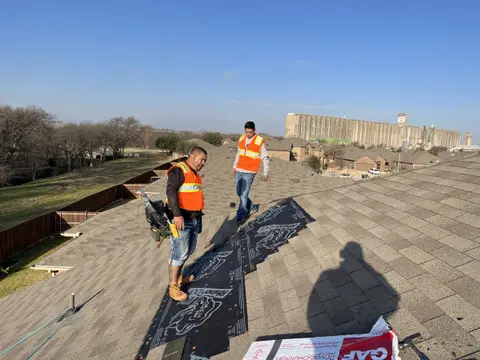 Hiring a roofer25 Questions to Ask a Roofer Before You SignBefore hiring a roofer, ask where the company is based, how it is insured, who pulls the permit, who does the work, exactly which materials and…Read the guide
 Hail & storm damageStorm Chasers: How to Spot a Roofing Scam After a Texas StormA storm chaser follows hail from city to city, knocks on doors, pushes you to sign that day, and is hard to find once the roof…Read the guide