Can You Put New Shingles Over Old Ones in Texas?
 By Chris Grimes, owner of Verde RoofingPublished November 18, 2026 · 13 min read
In short
Sometimes, but it is rarely the better buy. Texas has no statewide rule: each city adopts its own edition of the International Residential Code. The 2021 edition allows one new layer over one sound layer of asphalt shingles and bans it over two layers or a water-soaked roof. Some North Texas cities, such as Grapevine, do not allow it at all, and shingle makers recommend a full tear-off.
Key takeaways
- The 2021 International Residential Code bans a re-cover where the roof already has two or more layers, where the old roof is water-soaked or deteriorated, or where it is slate, clay, cement or asbestos-cement tile.
- Each North Texas city adopts its own code edition and amendments: Grapevine's re-roofing rules say asphalt shingles shall not be placed over existing roof coverings.
- Malarkey's instructions say a Class 3 or Class 4 impact-resistant shingle installed over an existing roof loses its impact resistance and is not eligible for insurance discounts.
- Fixr's 2026 cost guide puts tear-off and disposal at about $50 per roofing square, so the saving from skipping it is usually a small share of the job.
- An overlay hides the decking, and rotten decking is exactly what a tear-off is meant to find and fix.
You have two roof quotes on the kitchen table. One is noticeably cheaper, and somewhere in the fine print it says “install over existing shingles,” “roof-over,” “overlay” or “re-cover.” The roofer says it is legal, faster and just as good.
It is sometimes legal. Whether it is a good idea for a Dallas–Fort Worth house depends on four things: your city's building code, the shingle maker's instructions, what is under the old shingles, and how long you plan to own the house.
Is it legal to put new shingles over old ones in Texas?
Texas does not have one statewide answer. Each city adopts an edition of the International Residential Code (IRC) and can amend it, so the building department in your city decides.
The model code separates two jobs. A roof replacement removes every existing layer down to the roof deck. A roof re-cover installs a new roof covering over the old one. The City of Arlington, which has adopted the 2021 codes, summarizes the default this way in its re-roof bulletin: all existing layers of roof coverings must be removed down to the sheathing before reroofing, unless an exception applies.
The exception that matters for shingles is Section R908.3.1 of the 2021 IRC. It permits a re-cover where the new roof covering is installed in accordance with the roof covering manufacturer's approved instructions. So even where the code allows an overlay, the shingle maker's instructions become part of the rule.
When the code does not allow a second layer
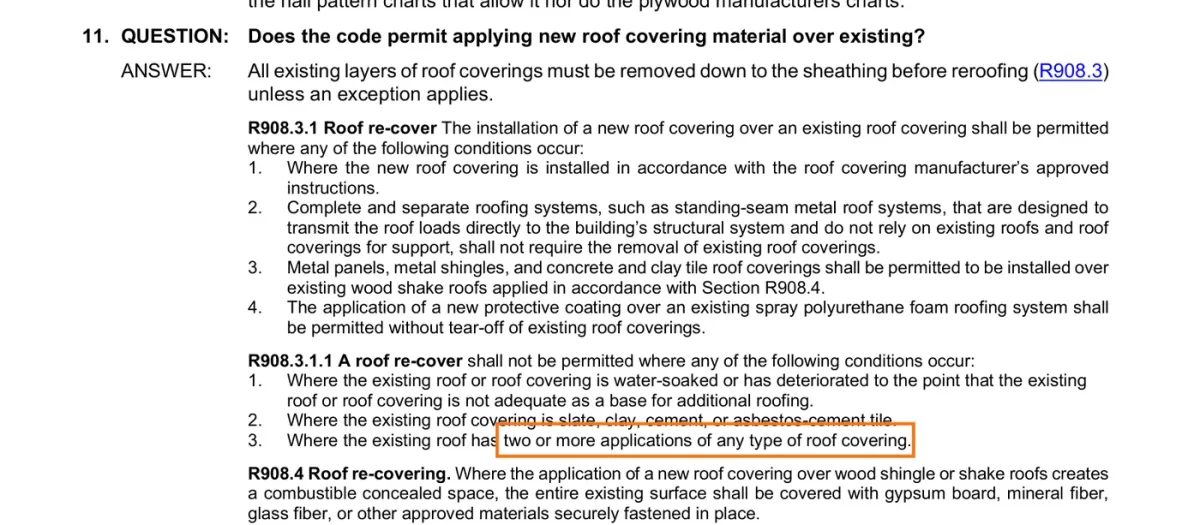
Section R908.3.1.1 of the 2021 IRC lists the conditions where a re-cover is not permitted. Here they are, with what each one means on a real roof:
| Condition in 2021 IRC R908.3.1.1 | What it means for your house |
|---|---|
| The existing roof or roof covering is water-soaked or has deteriorated to the point that it is not adequate as a base for additional roofing | A roof that leaks, has soft spots, or has curled and brittle shingles has to come off |
| The existing roof covering is slate, clay, cement or asbestos-cement tile | No shingling over tile or slate |
| The existing roof has two or more applications of any type of roof covering | If there are already two layers, a third is not allowed |
Read the first row twice. Most people shop for a new roof because the old one is leaking or worn out, and that is the roof the code says you cannot cover. The overlay that the code permits is a new layer over a single, flat, dry, sound layer of shingles.
What do Plano, Frisco, Dallas and other North Texas cities allow?
Three examples from our service area show how much the answer changes from one city to the next:
- Arlington follows the 2021 IRC text above, and its bulletin says the final inspection verifies that no more than one existing layer of asphalt or composition shingles has been covered over.
- Grapevine is stricter than the model code. Its residential re-roofing requirements, which cite Section R908 of the 2021 IRC, state plainly: asphalt shingles shall not be placed over existing roof coverings.
- Frisco lists the 2024 International Residential Code, with amendments, effective March 1, 2026. Plano's building codes page also lists a 2024 code set. Wording and section numbers can shift between editions, and local amendments sit on top.
So before you compare prices, make one phone call to your city's building inspection department and ask two questions: which edition of the residential code applies to a re-roof, and does the city allow asphalt shingles over an existing layer. Our guide to roof permits in Plano, Frisco and Dallas covers who pulls the permit and what the inspector looks at.
What do Malarkey and Owens Corning say about roofing over old shingles?
We install Malarkey and Owens Corning shingles, so those are the instructions we read most. Neither company tells you an overlay is the better roof.
Malarkey. The installation instructions for its Windsor designer shingle (Rev. 08/25) have a section on re-roofing over existing asphalt shingles. It opens with this: for best performance and appearance, it is recommended old roofing be completely removed from the deck. The same section adds four points that matter in North Texas:
- Malarkey recommends that only 3-tab shingles be overlaid. Roofing over laminated (architectural) or designer shingles creates an irregular surface that may keep the new shingles from sealing down properly, leaving them more susceptible to wind damage.
- The old wood deck has to be sound and able to provide good anchorage for nails, and the existing shingles and framing have to support the new roof and the crew installing it.
- Additional ventilation should be provided, and longer nails will likely be necessary to reach the deck.
- Installing UL 2218 Class 3 or Class 4 impact-resistant shingles over existing roofs negates their impact resistance and will not make them eligible for insurance discounts.
Malarkey's separate requirements for Certified Premium Warranty projects go further: installing over existing roofing materials, or over deteriorated wood, is not acceptable, and a complete tear-off is required.
Owens Corning. The July 2026 installation instructions for TruDefinition Duration shingles say the shingles are designed for new or reroofing work over any properly built and supported wood roof deck having adequate nail holding capacity and a smooth surface, and that the job must comply with local building codes. Fasteners must penetrate at least 3/4 inch into the wood deck or completely through it. The instructions describe a wood deck. They do not include a procedure for installing over an old shingle layer.
What this means for your quote: if your current roof is architectural shingle, as many DFW roofs are, it is the type Malarkey says not to overlay. And if you are paying extra for a Class 4 shingle because of hail, putting it over an old layer gives away the thing you paid for. Our guide to the best shingles for Texas hail explains the rating, and roof warranties explained covers what to get in writing.
Overlay vs. tear-off: how do they compare?
Here is the side-by-side comparison, using only what the code, the manufacturers, the Texas Department of Insurance and published cost guides say:
| Overlay (second layer) | Full tear-off | |
|---|---|---|
| Upfront cost | Lower: skips removal and disposal, which Fixr's 2026 guide puts at about $50 per roofing square on average | Higher by the cost of removal, disposal and any decking found |
| What gets inspected | Only the surface of the old shingles. Decking, underlayment and old flashing stay covered | Every sheet of decking is visible and can be checked and replaced |
| Hidden damage | Stays hidden. Soft or rotten decking keeps rotting under two layers | Found and fixed. Fixr lists decking replacement at $2 to $8 per square foot |
| Flashing, underlayment, drip edge | Old parts mostly stay in place | Replaced or rebuilt to the current code and the maker's instructions |
| Lifespan | Shorter by most published estimates: Today's Homeowner puts an overlay at around 16 years against 20 to 30 for a new shingle roof | The full expected life of the shingle for our climate |
| Manufacturer position | Malarkey recommends complete removal, and requires it for Certified Premium Warranty projects | The installation the instructions are written for |
| Impact rating and insurance discount | Per Malarkey, a Class 3 or 4 shingle over an existing roof loses its impact resistance and discount eligibility | Rating applies, so you can ask your insurer about a discount |
| Code | Allowed only in some cities, only over one sound layer | Allowed everywhere |
| Resale and home inspection | A second layer can be flagged, and the buyer inherits the double removal | A documented full replacement is easier to explain to a buyer |
| Next replacement | Two layers to remove. Fixr says removal can reach about $150 per square for multiple layers | One layer to remove |
The table comes down to one trade. An overlay moves a modest cost off today's invoice and onto the next roof, and in exchange you give up the inspection of the deck, the manufacturer's preferred installation, and the hail rating if you are buying one. The lifespan figures are general national estimates, not test results, and North Texas heat and hail are hard on any roof. See how long a roof lasts in Texas for the local picture.
How much money does an overlay actually save?
Less than most people expect. Fixr's 2026 roof replacement guide says tearing off and disposing of an old roof averages $50 per square, including dumping fees. A roofing square is 100 square feet.
Run the arithmetic on a 30-square roof as an example: 30 squares at $50 is about $1,500. The same guide puts the average roof replacement at about $10,000, with most projects between $7,500 and $14,000. Those are national figures, not our prices, but the proportion is the point: the tear-off is a small slice of the job.
Now look at what the saving costs you later. Fixr says removal can reach $150 per square when a crew is taking off multiple layers of asphalt shingles. And any decking that would have cost $2 to $8 per square foot to replace today is still up there, a few years wetter.
If the gap between your two quotes is much bigger than the tear-off line, something else is different: the shingle, the underlayment, the flashing, the ventilation or the warranty. Our guide on how to read a roofing estimate line by line shows how to line them up, and what a new roof costs in Dallas–Fort Worth explains what moves the price. For a planning range on your own house, try the roof cost calculator.
What does an overlay hide?
The roof deck. Everything else about an overlay follows from that.
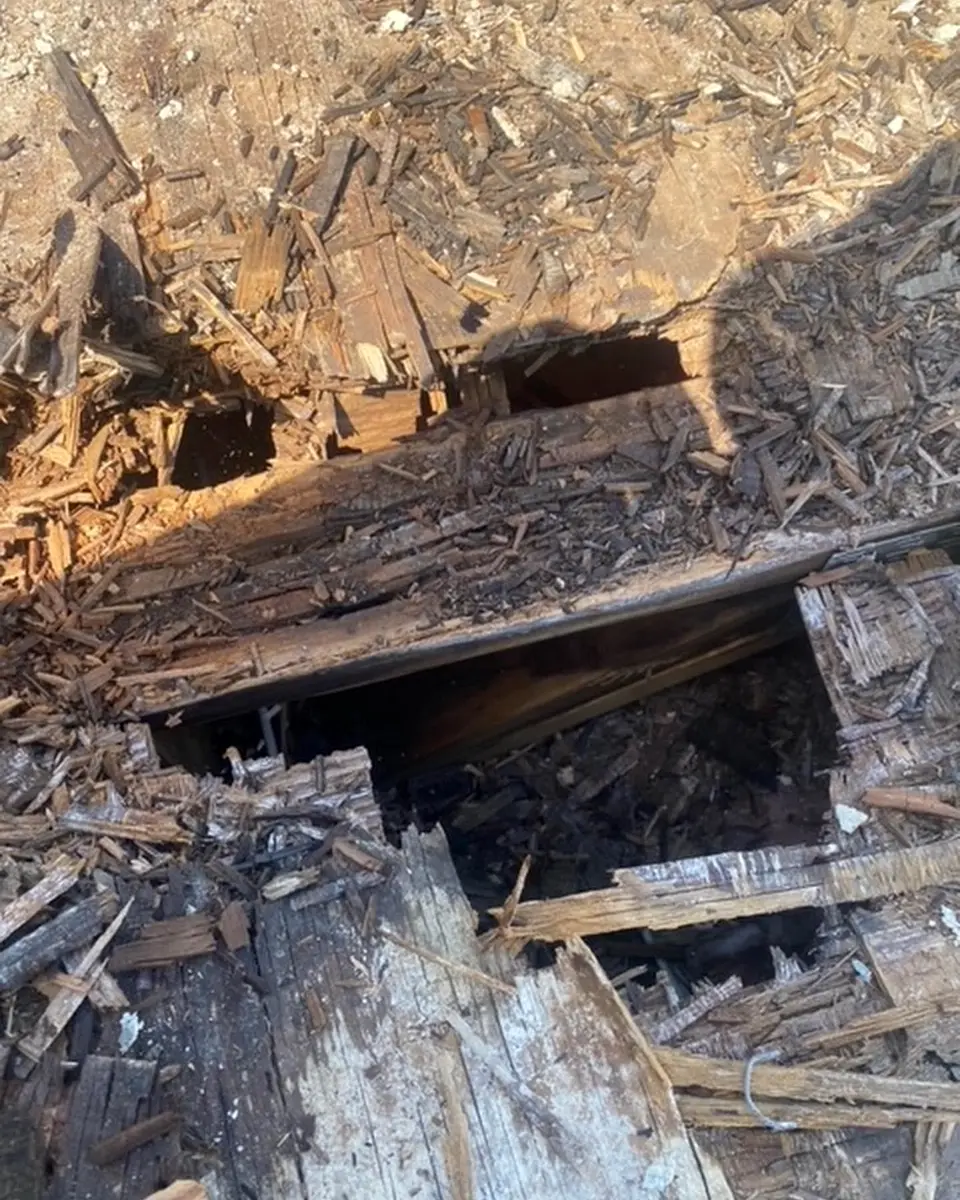
Shingles are nailed to the deck, and both manufacturers above require a deck with good nail-holding capacity. Wood that has been wet does not hold nails. On an overlay, longer nails pass through the old layer into decking nobody has looked at. If the wood is soft around a chimney, a valley or an old leak, the new shingles in the spot that most needs them are the ones held on worst.
An overlay also leaves the old underlayment, flashing, pipe boots and valley metal in service. Our guide to underlayment, ventilation and decking explains why those parts decide whether a roof leaks.
How does a second layer hold up to North Texas hail, wind and heat?
Three local conditions work against an overlay here.
Hail. Malarkey's instructions say it directly: an impact-resistant shingle over an existing roof loses its impact resistance. The rating assumes the shingle is on a solid deck.
Wind. New shingles depend on their sealant strip bonding to the course below. Malarkey warns that an irregular surface under the new shingles may prevent them from sealing down properly, which leaves them more susceptible to wind damage.
Heat and weight. A second layer adds load to the framing and more material sitting in the summer sun. That is why Malarkey makes the framing's capacity a condition and says additional ventilation should be provided. On an older house with original framing, have the structure checked before anyone adds weight to it.
Will an overlay cause problems with insurance or when you sell?
Insurance. We can only tell you what the Texas Department of Insurance publishes, and your own policy governs. TDI says your insurance company inspects your roof when you apply and may charge you more or refuse to insure you based on what it finds. It says that as roofs age, some companies switch from replacement cost to actual cash value coverage, and that a company might not cover a roof in poor condition at all. In September 2026 TDI announced a rule clarifying that insurers cannot decline or non-renew a home policy because of the age of the house or its roof alone, but they may still base decisions on physical condition.
If you are buying an impact-rated shingle partly for a premium discount, remember Malarkey's statement that an overlaid Class 3 or 4 shingle is not eligible. Ask your agent, in writing, how the company records a re-covered roof before you choose. Our guide on whether a new roof lowers your insurance in Texas has the questions to ask.
After the next hailstorm. A two-layer roof costs more to remove, as the Fixr figures show. Whether your policy pays for removing both layers depends on the policy, so read it or ask your insurer.
Selling the house. Under the Texas Real Estate Commission's standards of practice, a home inspector must report the type of roof covering and evidence of previous repairs, but is not required to determine the number of layers. A second layer is still easy to see at the roof edge, and a buyer who finds one is looking at a double tear-off on the next roof. If the roof has already come up in a sale, see what to do when the roof is flagged in a home inspection.
When is an overlay reasonable, and when is it a mistake?
An overlay can be a defensible choice when all of these are true:
- Your city allows it, and the permit will say so.
- There is exactly one existing layer, and it is flat 3-tab shingle, not architectural.
- The roof has never leaked, the decking is firm when walked, and the attic shows no staining.
- The shingle maker's instructions for the exact product allow it, and you accept whatever that does to the warranty.
- You are not buying an impact-rated shingle.
- It is a detached garage, a shed or a house you expect to own only briefly, and you will disclose the second layer when you sell.
It is a mistake when any of these is true:
- The roof has leaked, has soft spots or shows any of the signs you need a new roof.
- The existing shingles are architectural, curled or uneven.
- There are already two layers.
- You want Class 4 shingles for hail or an insurance discount.
- The house is your long-term home.
- An insurance claim is paying for the roof. A replacement estimate normally includes removing the old roof, so ask what an overlay would actually save you.
For most primary homes in Dallas–Fort Worth, that second list describes the house. If you are still deciding whether the roof needs replacing at all, start with our repair or replace decision guide.
How do you check a cheaper overlay quote before you sign?
Work through these steps in order:
- Call the building department. Ask which code edition applies and whether shingles over an existing layer are allowed in your city.
- Count the layers. Look at the roof edge at the eave or rake, or ask the roofer to show you a photo.
- Ask for the manufacturer's instructions for the exact shingle on the estimate, with the re-roofing section marked.
- Ask what happens to the warranty, both the manufacturer's and the roofer's own, and get the answer in writing.
- Ask how the deck was checked. Someone should have walked the roof and looked in the attic.
- Ask what stays. Flashing, pipe boots, valley metal, drip edge and vents should be listed as new or reused.
- Get the same roofer's tear-off price, with a per-sheet price for any decking replaced, so you can see the real difference.
- Ask who pulls the permit and whether the city inspects the finished roof.
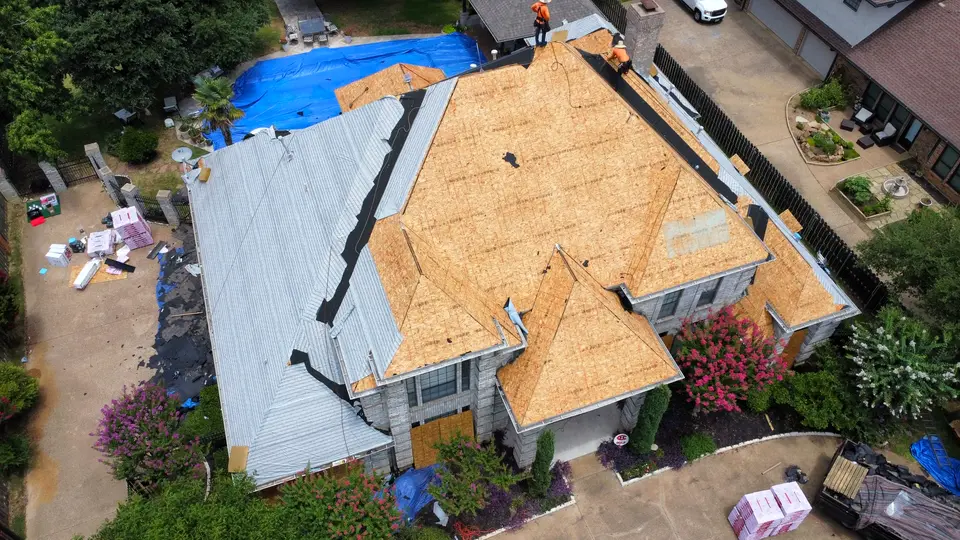
If the roofer cannot answer steps 3 through 6, the low price is telling you what was left out. Our guide to roof replacement day shows what a full tear-off involves, hour by hour, so you can judge the disruption for yourself.
Verde Roofing installs Malarkey and Owens Corning shingles on roof replacements across Dallas–Fort Worth. Chris inspects the roof with you, photographs what he finds and explains repair versus replacement before you decide anything. Every price is a written estimate after a free inspection.
Comparing an overlay quote with a tear-off?
Call or text (214) 687-1951, 24/7, or book a free roof inspection. Chris will count the layers, check the decking from the attic and the roof, show you the photos, and give you a written estimate so you can compare the two options on facts.
Questions people ask next
How many layers of shingles are allowed on a roof in Texas?
There is no single Texas number. Cities adopt the International Residential Code with their own amendments. The 2021 edition does not allow a re-cover where the roof already has two or more applications of any roof covering, so two layers is the usual ceiling. Some cities are stricter: Grapevine does not allow asphalt shingles over existing roof coverings at all. Ask your building department.
Do I need a permit to put new shingles over old ones?
In many North Texas cities, yes, and the rule is the same for an overlay as for a tear-off. Arlington, for example, requires a building permit to replace roof covering unless the area is 10 percent or less of the roof. Permit rules differ by city, so check with your building department or ask your roofer who pulls the permit.
Will an overlay void my shingle warranty?
It depends on the product and the warranty you are buying. Malarkey's requirements for its Certified Premium Warranty projects say installing over existing roofing is not acceptable and a complete tear-off is required. Before you sign, ask the roofer to show you, in writing, that the exact shingle and warranty on your estimate allow installation over an old layer.
Can Class 4 impact-resistant shingles be installed over old shingles?
Physically, yes, but you lose the point of buying them. Malarkey's installation instructions say installing UL 2218 Class 3 or Class 4 impact-resistant shingles over existing roofs negates their impact resistance and will not make them eligible for insurance discounts. In North Texas hail country, that removes the main reason to pay for an impact-rated shingle.
How do I know if my roof already has two layers?
Look at the edge of the roof at the eave or rake: two layers show as two stacked shingle edges, often with a thick, wavy profile. A roofer can also check at a pipe vent or lift a shingle tab. Do not rely on a home inspection report alone, because Texas inspectors are not required to determine the number of layers.
Does homeowners insurance treat a two-layer roof differently?
Policies and companies differ, so ask yours. The Texas Department of Insurance says your company inspects the roof when you apply and may charge more or refuse to insure you based on its condition. It also says some companies switch aging roofs to actual cash value coverage. A hidden old layer does not make a roof younger in an insurer's eyes.
Is it cheaper to overlay now and tear off later?
Usually not over the life of the house. The next roof will need both layers removed, and Fixr's 2026 guide says removal can reach about $150 per square for multiple layers of asphalt shingles, compared with about $50 on average. You save a little today and pay more next time, with a roof that may not last as long in between.
Sources
- City of Arlington, Texas: Technical Bulletin, Re-Roof Permits, Inspections & Common Q&A (2021 IRC R908.3.1 and R908.3.1.1 text)
- City of Grapevine, Texas: Residential Re-Roofing Requirements
- City of Frisco: Adopted Codes
- Malarkey Roofing Products: Windsor Designer Shingle Installation Instructions (Rev. 08/25)
- Malarkey Roofing Products: Additional Installation Requirements, Certified Premium Warranty Projects
- Owens Corning: TruDefinition Duration Shingles Installation Instructions (July 2026)
- Texas Department of Insurance: Insurance and your roof
- Texas Department of Insurance: Texas homeowners protected from being denied insurance based on roof age (September 29, 2026)
- 22 Texas Administrative Code §535.228: Standards of Practice for inspectors, roof covering materials
- Fixr: How Much Does a Roof Replacement Cost? (2026)
- Today's Homeowner: Roof Overlay vs. Tear-Off
Chris Grimes owns Verde Roofing in Plano, Texas, a locally owned residential and commercial roofer serving Dallas–Fort Worth. Verde is an NTRCA Accredited Member, an RCAT member and a Dallas Observer Best of Dallas Best Roofer winner (readers’ choice) in 2021, 2022 and 2023.
Keep reading
Related guides
 Repair or replaceRepair or Replace Your Roof? An Honest Decision GuideRepair when the roof is reasonably young, the damage is limited to one area and the rest of the roof is sound. Replace when the roof…Read the guide
 Roofing materialsUnderlayment, Ventilation and Decking: The Parts of a Roof You Don't SeeUnder the shingles sit the decking (plywood or OSB), underlayment (synthetic or felt), self-adhered ice and water barrier at valleys and other leak-prone spots, drip edge…Read the guide
 Cost & financingHow to Read a Roofing Estimate Line by LineA complete roofing estimate lists the company’s full contact details, the measured squares and waste factor, how many layers come off, the exact shingle line, underlayment…Read the guide