NTRCA and RCAT Roofers in DFW: What Membership Means and How to Check It
 By Chris Grimes, owner of Verde RoofingPublished November 25, 2026 · 12 min read
In short
In Dallas–Fort Worth, the two roofing associations worth checking are NTRCA, the North Texas Roofing Contractors Association, and RCAT, the Roofing Contractors Association of Texas. Both are voluntary. Membership shows a company met entry rules such as general liability insurance and member sponsors, and NTRCA accreditation adds two years in business, training and a year of membership. Neither guarantees the work. Look the roofer up in each directory, then check insurance, permits and reviews.
Key takeaways
- NTRCA and RCAT are voluntary trade associations, not state agencies, and Texas has no state roofing license to check instead.
- NTRCA members must have a local North Texas address, general liability insurance, a BBB rating of B or better if listed, and two member recommendations; accredited status adds two years in business, NTRCA training, an orientation, 12 months of membership and an A rating if listed on the BBB.
- RCAT membership and the RCAT license are separate programs: membership requires general liability coverage and Texas roofing experience, while the license requires exams and yearly continuing education.
- Check membership in each association’s own directory, never from a logo on a truck, a yard sign or a website.
- RCAT says its credential does not guarantee a contractor’s work, so membership is one check alongside insurance, permits, a local address, reviews and a written contract.
You have three roofing quotes on the kitchen table and every one of them has a row of logos at the bottom. Two of those logos keep showing up in Dallas–Fort Worth: NTRCA and RCAT. One roofer says he is “accredited,” another says he is “RCAT,” and a third says associations do not matter.
They do matter, but not in the way the logos suggest. Membership tells you a company cleared a set of entry rules that someone else checked. It does not tell you the roof will be done well. This guide explains what each association actually requires, how to look a roofer up in five minutes, and where membership fits among the other checks that protect you.
What are NTRCA and RCAT?
Both are trade associations that roofing companies choose to join. Neither is a government agency, and neither is a license from the State of Texas. Texas does not license roofing contractors at all, which is why these voluntary groups carry more weight here than in states with a license board. Our guide on whether Texas licenses roofers and what to check instead covers the state side; this article stays with the two associations.
- NTRCA, the North Texas Roofing Contractors Association, is the regional group. Its contractor members must have a local address in North Texas, which it defines as south of Oklahoma, east of Abilene, west of Louisiana and north of Waco. That covers every county a DFW homeowner lives in. The association’s website is ntrca.com.
- RCAT, the Roofing Contractors Association of Texas, is the statewide group. It runs two separate programs: membership, and a voluntary license it administers itself. Its website is rcat.net.
A Plano or Frisco roofer can belong to one, both or neither. The questions that matter are what each one checked, and whether the roofer in front of you is really listed.
What does NTRCA accreditation require?
NTRCA has two steps, and the difference between them is the most useful thing to know about this association.
Step one is membership. According to NTRCA’s membership requirements, a new contractor member must:
- Have a local address in North Texas, proven with a utility bill or a current lease.
- Be a registered business with the State of Texas or a North Texas county.
- Be in good standing with the Better Business Bureau, with a B rating or better if it is listed there.
- Hold and keep general liability insurance, and provide a certificate.
- Agree not to knowingly present a false or fraudulent invoice on an insurance claim.
- Agree to the NTRCA Code of Ethics.
- Bring recommendations from a current NTRCA contractor member and a current associate member.
Step two is accredited status, which NTRCA grants to contractor members who also:
- Have been in business for two years.
- Attend four NTRCA lunch-and-learn sessions, or two plus another NTRCA training event such as a commercial workshop.
- Attend an NTRCA New Member Orientation event.
- Have been a member for 12 months from the date their membership was approved.
- Keep an A rating with the BBB, if listed there.
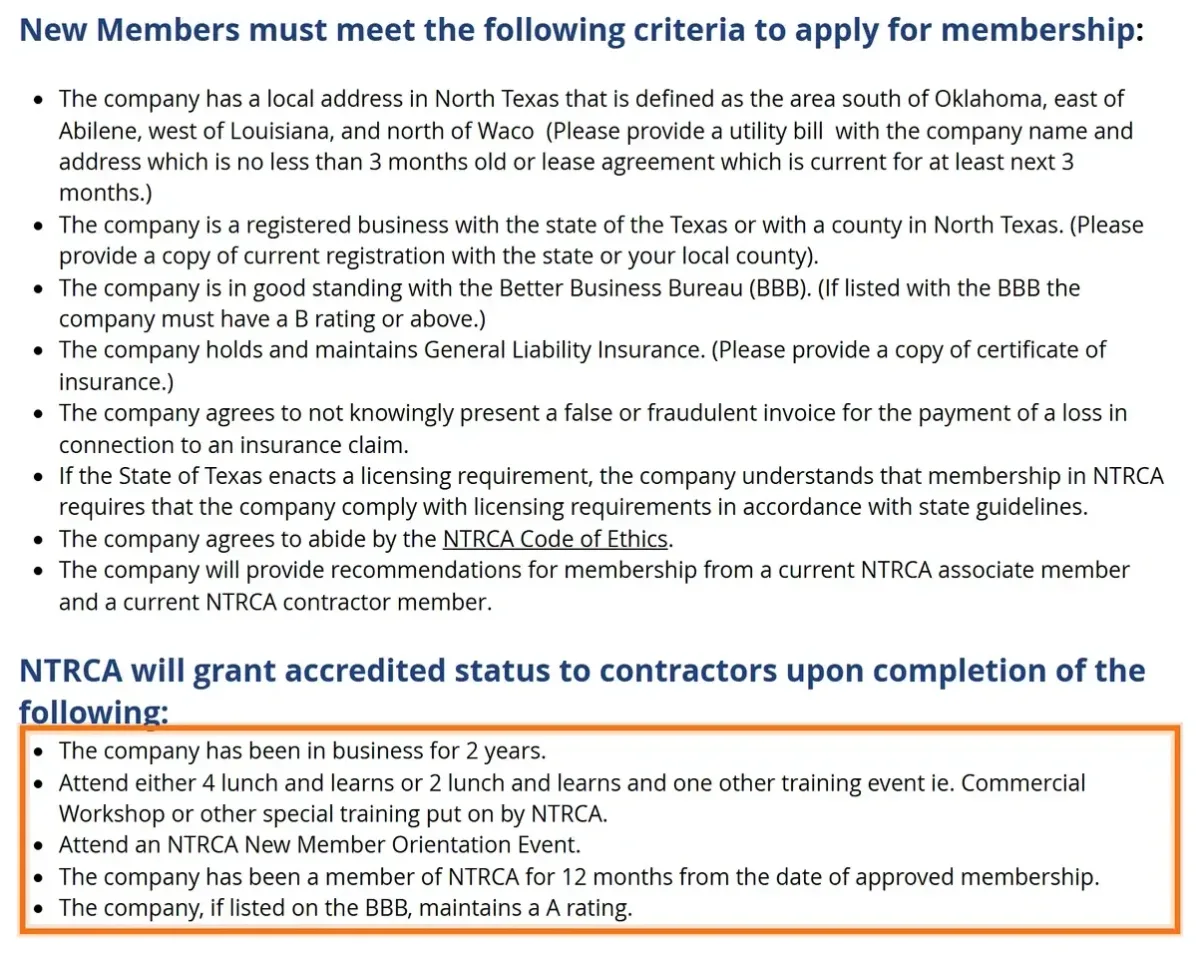
In plain terms, an NTRCA Accredited Member is a company that has been around for at least two years, has been inside the association for at least one, and has shown up for its training. A brand-new company cannot be accredited, however good its crews are.
NTRCA also publishes a Code of Ethics that members agree to. Among its points: members are dedicated to roofing year-round, not only after storms; they work from a local, clearly identified business location; they provide detailed written proposals and written warranties on request; and they follow Texas Business and Commerce Code §27.02, the law that bars a contractor from waiving or paying your deductible. Our guide to the Texas deductible law explains that rule.
RCAT membership vs. the RCAT license: what is the difference?
This is where homeowners get confused, because RCAT runs two programs under one name and a roofer may say “RCAT” about either one.
RCAT membership is joining the association. According to RCAT’s membership page, a contractor member needs general liability insurance of at least $300,000 for residential roofing or $500,000 for commercial roofing, at least one year of roofing or waterproofing experience in Texas, and sponsors from one current RCAT contractor member and one associate member. The application is approved by RCAT’s board.
The RCAT license is a credential RCAT administers itself. RCAT says it requires program screening, roofing, business and safety exams, insurance or financial-responsibility documentation, and yearly continuing education and renewal. The license itself is covered in the Texas roofing license guide linked above, so we will not repeat it here.
RCAT states plainly that membership and licensing are separate programs, that a professional may apply for the license separately from membership, and that its directory lists companies that participate in membership, the license program or both. So “RCAT Member” and “RCAT licensed” are two different claims. When a roofer uses either phrase, the directory tells you which one is true.
RCAT is also clear about the limits. On its consumer page it says an RCAT credential “does not guarantee a contractor’s work or the outcome of a roofing project,” that it is not in a position to make recommendations about its members’ skills, and that it does not endorse members’ statements or promises.
How do I check whether a DFW roofer is an NTRCA or RCAT member?
Never from the logo. Anyone can paste a badge on a truck door or a website. Check with the association, using the exact company name from the contract.
- Get the legal company name. Use the name on the written estimate or contract, not the name on a yard sign. If the two differ, ask why.
- Search NTRCA. On ntrca.com, open Find A Contractor. Type the company name, or pick your county and turn on the NTRCA Accredited filter to see which listed companies hold accredited status. Make sure you are on ntrca.com: the .org address is not the association’s site.
- Search RCAT. On rcat.net, go to the consumer page and open the directory. RCAT lets you search by ZIP code. Find the company and note whether the listing shows membership, a license or both.
- Compare the details. The address and name in each listing should match what the roofer gave you. A listing in another city under a similar name is not your roofer.
- Save it. Take a screenshot of each listing with the date. If the roofer told you “accredited” or “licensed” and the directory says otherwise, ask about it before you sign.
If you cannot find a company, call it and ask. Listings can lag behind renewals, and NTRCA drops members who fall behind on dues. RCAT also lists phone numbers on its consumer page for questions. A roofer who is a real member will be glad you checked.
What does membership prove, and what does it not?
Membership proves a company passed a gate at some point. It does not prove what happens on your roof. Here is the honest split.
What it tells you:
- Someone outside the company checked a certificate of general liability insurance when it joined.
- For NTRCA, the company showed a local North Texas address and two existing members vouched for it.
- For NTRCA accreditation, the company has at least two years in business and a year of membership, and has attended association training.
- The company agreed to a code of conduct and can be reported to the association if it breaks it.
What it does not tell you:
- Whether the insurance is still active today.
- Whether the crew on your roof is the company’s own crew or a subcontractor.
- Whether the price is fair, or whether the scope matches your roof.
- Whether the work will be good. RCAT says this outright about its own credential.
Credentials at a glance
The table below puts the two associations next to the other credentials a DFW roofer may show you:
| Credential | Who grants it | What it requires | How to verify | What it does not prove |
|---|---|---|---|---|
| NTRCA member | North Texas Roofing Contractors Association | North Texas address, Texas or county registration, general liability insurance, BBB B rating or better if listed, Code of Ethics, two member recommendations | Find A Contractor on ntrca.com, by name or county | Current insurance, workmanship, fair price |
| NTRCA Accredited Member | NTRCA, to existing contractor members | Membership plus two years in business, 12 months as a member, orientation, NTRCA training, BBB A rating if listed | NTRCA Accredited filter in the same directory | Quality of a specific job or crew |
| RCAT member | Roofing Contractors Association of Texas | General liability of at least $300,000 residential or $500,000 commercial, one year of Texas roofing experience, two member sponsors, board approval | RCAT directory, searchable by ZIP on rcat.net | That the company holds the RCAT license |
| RCAT license | RCAT’s own voluntary program | Screening, roofing, business and safety exams, insurance or financial documentation, yearly continuing education | Same RCAT directory, which shows license status | A state license (Texas has none) or a work guarantee |
| Manufacturer program | The shingle maker | Set by each manufacturer | The manufacturer’s own contractor locator | Membership in either association |
How to read it: the left three columns are what a roofer earned; the last two are what you do with it. Every row has a public place to look the claim up, and every row has a limit. That is why membership is a filter for your short list, not a reason to skip the rest of the checks. It also explains why a company can truthfully show the RCAT logo without holding the RCAT license.
How does membership fit with the other checks?
Think of association membership as one line in a short verification routine. The others matter at least as much.
- Insurance, today. Ask for a certificate of insurance naming the company and call the agency on it. Ask about workers’ compensation for the crew. Membership only shows the company had coverage when it joined or renewed.
- The permit. Many DFW cities require a permit for a roof replacement and some require contractors to register first. Ask who pulls the permit and get its number. See roof permits in Plano, Frisco and Dallas.
- A real local address. NTRCA requires one, and its Code of Ethics asks members to work from a clearly identified location. Drive by or look it up on a map. A P.O. box and an out-of-state phone number after a hailstorm are a warning sign; our guide to storm chasers and roofing scams shows the pattern.
- Reviews you can read. Look at the newest reviews, not just the star average, and look for reviews that name the project manager or describe the cleanup and the permit.
- The contract. A written scope, materials, price, payment schedule and warranty terms. The NTRCA code asks members to provide that on request. Our list of roofing contract red flags shows what to strike before you sign, and how to read a roofing estimate walks through each line.
If you would like a written estimate to compare against the others on your table, call or text (214) 687-1951 and we will set up a free inspection.
Why do NTRCA and RCAT matter more after a North Texas hailstorm?
Because that is when the most unfamiliar roofers knock on doors. After a big spring storm in Collin, Dallas, Denton or Tarrant County, out-of-town crews arrive, rent a short-term address and start signing contracts. Some do fine work. Some are gone before the warranty matters.
Two NTRCA rules speak directly to that problem. First, the local address requirement, proven with a utility bill or lease. Second, accreditation cannot be earned quickly: it takes two years in business and twelve months inside the association. A company that arrived after last month’s storm cannot be an NTRCA Accredited Member, no matter what its flyer says.
When I talk with a homeowner after a storm, I tell them not to take any logo as proof, ours included. Look us up the same way you would look up anyone else. A roofer you will need again in five years for a warranty call should be easy to find in both directories and at a real address today.
The same logic applies to the claim itself. In Texas, a contractor may not act as your public adjuster. A roofer can inspect, photograph the damage, meet your adjuster on site and write the repair estimate, but you own the claim. An association member who promises to “take care of the insurance” for you is promising something the law does not allow. Our questions to ask a roofer before you sign include the ones that bring this out.
What if the roofer you like is not a member?
Membership in both groups is voluntary, and some capable roofers never join either one. A missing listing is a reason to ask more questions, not a verdict.
Ask the company why it is not a member, then do the checking the association would have done for you:
- Confirm the business registration with the State of Texas or your county.
- Call the insurance agent on the certificate.
- Look up the BBB profile, if there is one.
- Visit or map the local address.
- Call two recent customers from your area.
If all five check out, you have done more verification than a logo would have given you. If two or more are shaky, keep looking. Our guide on how to choose a roofer in Dallas–Fort Worth puts all of these checks into one order, and for a city-by-city look at how we compare Plano companies on facts you can verify, see the best roofers in Plano.
Where does Verde Roofing stand?
Verde Roofing is an NTRCA Accredited Member and an RCAT Member. You can look us up in both directories the same way this guide describes; please do.
What else you can verify about us: Verde Roofing, LLC is locally owned and based at 5055 W Park Blvd, Suite 400, in Plano, and we work in Collin, Dallas, Denton, Tarrant, Rockwall, Ellis, Hunt, Kaufman, Johnson, Parker and Wise counties. Readers of the Dallas Observer voted Verde Best Roofer in the Best of Dallas readers’ choice awards in 2021, 2022 and 2023. We hold a 5.0 rating from 54 Google reviews, which you can read on our reviews page. We install Malarkey and Owens Corning shingles.
How we work: Chris Grimes, the owner, inspects the roof with you, documents any damage with photos, explains repair versus replacement before a claim is filed, and meets your adjuster on site to show what he found. You get a written estimate before any work. More about the company and its owner is on our about page, and what a written warranty should say is in our guide on roof warranties.
Want to check us before you call?
Look up Verde Roofing in the NTRCA and RCAT directories, then call or text (214) 687-1951, 24/7, or book a free roof inspection. Chris walks the roof with you, shows you the photos, and gives you a written estimate you can compare line by line with the others on your table.
Questions people ask next
Is NTRCA accreditation the same as NTRCA membership?
No. Membership is the entry level: a local North Texas address, general liability insurance, business registration, a BBB rating of B or better if listed, the Code of Ethics and two member recommendations. Accredited status is granted later to contractor members who have two years in business, a year of membership, an orientation event, NTRCA training and an A rating if listed on the BBB.
Is an RCAT member the same as an RCAT licensed roofer?
No. RCAT runs membership and its voluntary license as separate programs, and a company can hold one, the other or both. Membership requires general liability insurance and at least a year of Texas roofing experience plus two member sponsors. The license adds roofing, business and safety exams and yearly continuing education. The RCAT directory shows which one a company holds.
Where do I look up an NTRCA member?
Use the Find A Contractor directory on ntrca.com, the association’s own website. You can search by company name, choose your county and filter to NTRCA Accredited members. Note the address: the association’s site is ntrca.com, not ntrca.org. If a company is not listed, ask it directly rather than assuming the worst.
Does NTRCA or RCAT membership mean the roofer is insured?
It means the company had to show general liability insurance to join. Policies lapse, change and have limits, so membership is not a current certificate. Ask the roofer for a certificate of insurance, call the agency listed on it to confirm the policy is active today, and ask separately about workers’ compensation for the crew.
Can I complain to NTRCA about a member roofer?
Yes. NTRCA says its Ethics Committee reviews alleged violations of its Code of Ethics, and its Code of Ethics page links to a complaint form. Violations can lead to discipline up to termination of membership. The association cannot order a refund or act as a court, so keep your contract, photos and messages for any other step you take.
Should I hire a roofer who is not a member of either association?
You can, but ask more questions. Both groups are voluntary, so a missing listing is not proof of a problem. It does mean nobody has checked the company’s insurance, address or references for you. Verify those yourself, get a written contract, confirm who pulls the permit, and read recent reviews before you sign.
Do NTRCA members follow the Texas deductible law?
The NTRCA Code of Ethics requires members to follow federal, state and local law, and it names Texas Business and Commerce Code §27.02, which bars a contractor from waiving, paying or rebating your insurance deductible. A roofer who offers to cover your deductible is breaking state law and, if a member, the association’s own code.
Sources
- North Texas Roofing Contractors Association: Membership Requirements (accredited status criteria)
- North Texas Roofing Contractors Association: Code of Ethics and complaint process
- North Texas Roofing Contractors Association: Find A Contractor directory
- Roofing Contractors Association of Texas: Consumers (directory, license, disclaimers)
- Roofing Contractors Association of Texas: Membership requirements
Chris Grimes owns Verde Roofing in Plano, Texas, a locally owned residential and commercial roofer serving Dallas–Fort Worth. Verde is an NTRCA Accredited Member, an RCAT member and a Dallas Observer Best of Dallas Best Roofer winner (readers’ choice) in 2021, 2022 and 2023.
Keep reading
Related guides
 Hiring a rooferDoes Texas License Roofers? What to Check InsteadNo. Texas has no statewide roofing contractor license, and the Texas Department of Licensing and Regulation does not license roofers. To verify a roofer, check city…Read the guide
 Hiring a rooferHow to Choose a Roofing Contractor in Dallas–Fort WorthPick a roofer who is local and easy to verify. Texas has no state roofing license, so check a physical DFW address, proof of liability and…Read the guide
 Hiring a roofer25 Questions to Ask a Roofer Before You SignBefore hiring a roofer, ask where the company is based, how it is insured, who pulls the permit, who does the work, exactly which materials and…Read the guide