

What Is a Roof Insurance Supplement and When Is It Needed?
 By Chris Grimes, owner of Verde RoofingPublished August 9, 2026 · 8 min read
In short
A roof insurance supplement is a documented request, made on your existing claim, asking the insurer to add work or materials its first estimate left out. Common items are rotted decking found at tear-off, a second layer of shingles, code-required parts like drip edge, and measurement errors. In Texas the homeowner owns the claim; the roofer supplies photos, measurements and a line-item estimate, and the insurer decides.
Key takeaways
- A supplement is not a new claim: it adds missing items to the claim you already filed, backed by photos, measurements and invoices.
- Most supplements come from things nobody could see before tear-off, such as damaged decking or an extra layer of old shingles.
- Texas Insurance Code §4102.163 bars a contractor from acting as a public adjuster on a property it works on, so your roofer documents and estimates while you stay the owner of the claim.
- A supplement may never be used to cover or offset your deductible; Texas Business and Commerce Code §27.02 makes that a crime.
- Ask for a copy of every supplement your roofer sends, with the photos, before it goes to the insurer.
The adjuster has come and gone, the estimate is in your inbox, and the numbers look lower than you expected. Then your roofer calls and says the estimate is missing items and they want to send the insurer a supplement. If you are wondering whether that is normal, honest, or a way to squeeze more out of your policy, it is a fair question.
Supplements are a routine part of roof claims in North Texas, and most of them are legitimate. But the word covers everything from a careful, documented correction to plain padding. This guide explains what a supplement is, why first estimates miss things, what Texas law allows a roofer to do, and how to judge one before it goes out under your name.
What exactly is a roof insurance supplement?
A supplement is a request, on your existing claim, for the insurer to add work, materials or quantities its first estimate did not include. It is not a second claim and it does not restart anything. It says, in effect: here is something the original scope missed, and here is the proof.
A proper supplement has three parts. First, a line-item estimate showing the added items and quantities. Second, documentation for each item, usually dated photos, measurements, code references or material invoices. Third, a short explanation of why the item was not in the first estimate.
The Texas Department of Insurance describes the basic idea in plain terms: if your contractor finds damage or differences the adjuster missed, talk to your insurance company about them. A supplement is simply that conversation, put in writing with evidence.
Why does the first insurance estimate miss things?
An adjuster's first inspection is a visual survey of a roof that is still intact. Even a careful adjuster cannot see under the shingles, and the first estimate is built from what can be seen and measured that day. Several kinds of items routinely surface later.
| Commonly supplemented item | Why it was missed | What proves it |
|---|---|---|
| Rotted or damaged decking | Hidden until the old shingles come off | Photos of each sheet before replacement, with a tape or marker for scale |
| A second layer of old shingles | Not visible from the surface | Tear-off photos showing both layers; layered removal costs more labor and disposal |
| Drip edge, starter and other code items | Left off or overlooked in the scope | The code section your city has adopted and photos of the bare edges |
| Wrong roof measurements | Hand measurement or a rough satellite count | A measurement report and the waste factor used |
| Steep or high roof charges | Pitch or story height not recorded | Pitch gauge photos; two-story elevations |
| Flashing, vents and pipe jacks | Counted short or assumed reusable | Item-by-item photos and counts |
| Gutters, screens or window wraps hit by hail | Not inspected or not listed | Close-up photos with chalk circles and a measuring tape |
On tall two-story homes in Frisco and McKinney, steep slopes and height charges are frequent gaps. On older homes in Lakewood or the Park Cities, extra layers and tired decking are more common. Neither means the adjuster did a poor job; the information simply did not exist until the roof was opened.
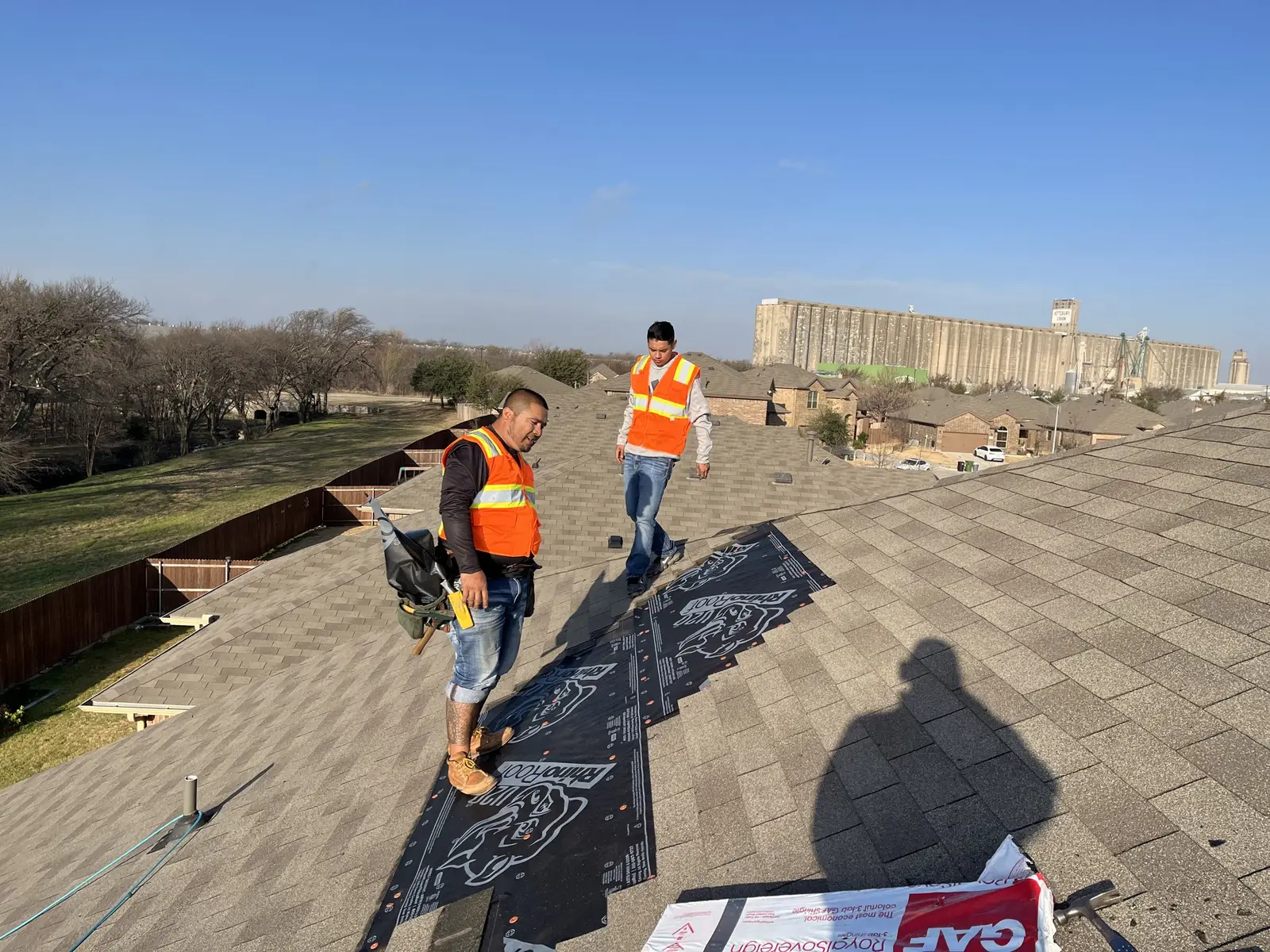
When I tear off a roof on a claim job, I photograph every bad sheet of decking before it is cut out, with a tape measure in the frame. A supplement without that photo is just an opinion.
What can a roofer legally do on your claim in Texas?
This matters more in Texas than in many states. Texas Insurance Code §4102.163 says a contractor may not act as a public adjuster for a property where it is providing, or may provide, contracting services, and may not advertise to adjust claims for that property. That applies whether or not the contractor holds an adjuster license, and even if the homeowner signs a power of attorney. The Texas Department of Insurance explained the rule to the industry in a 2014 bulletin after House Bill 1183 created it.
So a roofer does not settle, adjust or take over your claim. What a roofer can do is the contractor's job: inspect the roof, document what they find with photos, meet the adjuster on site to show that damage, write a repair estimate, write supplement requests backed by documentation, explain the paperwork to you, and do the work. You own the claim. The insurer decides what it pays.
If you and your insurer disagree about the amount after documentation has been exchanged, the people who can represent you are a licensed public adjuster or an attorney. Many policies also have an appraisal provision for disputes over the amount of loss; read your policy to see whether yours does. We cover those routes in our guide on what to do when a roof claim is denied or underpaid.
Verde Roofing works inside those lines. Chris inspects with the owner, documents damage with photos, meets the adjuster on site, explains repair versus replacement before a claim is filed, and writes the estimate and any supplement request with the documentation behind it. You can read more about how that works on our insurance claim help page.
How does a legitimate supplement work, step by step?
A fair supplement follows a predictable path. If your roofer's process looks very different, ask why.
- The first estimate arrives. Your roofer compares it line by line with their own scope and measurements. Our guide on how to read a roofing estimate explains what each line means.
- Gaps are listed before work starts. Visible items, such as missing drip edge or a short shingle count, can be raised right away.
- Hidden items are documented during tear-off. Decking, extra layers and concealed flashing are photographed the moment they are exposed.
- You see the request first. You get a copy of the supplement, with the photos, and you agree it goes to the insurer.
- The insurer reviews. It may approve, deny, approve in part, ask for more photos or send someone to re-inspect.
- A revised estimate or payment follows. Approved items are added to the claim, often with a new estimate summary.
- The work and the paperwork match. The final invoice shows the approved items, and the work was actually done.
For timing, the Texas Department of Insurance explains that once your company has the information it needs, it generally has 15 business days to say whether it will pay, can extend that by 45 days if it explains why, and must pay within five business days after agreeing to pay. Ask your adjuster how your company will treat the supplement and when to expect an answer.
What should a supplement never include?
A supplement is a correction, not a bargaining tactic. Three things should never be in one.
- Your deductible. Texas Business and Commerce Code §27.02 makes it an offense, a Class B misdemeanor, for a contractor to pay, waive, absorb or rebate your deductible, or otherwise help you avoid paying it, without the insurer's consent. Inflating a supplement to cover the deductible is the same thing with extra steps. Read our guide on why no roofer can waive your deductible in Texas.
- Work that will not be done. Every approved line should show up on the roof. If a supplement adds an item, the final invoice should prove it was installed.
- Damage that is not there. Wear, age and old repairs are not storm damage. A supplement built on them puts you at risk, because it goes in under your claim.
How can you tell a fair supplement from padding?
You do not need to be a roofer to judge one. Use this checklist before you agree to anything.
- Every added line has its own photo, measurement or code reference.
- Quantities match the roof: measurement report squares plus a stated waste factor.
- Code items cite the code your city has actually adopted. For example, the 2021 International Residential Code, section R905.2.8.5, requires drip edge at eaves and rakes on asphalt shingle roofs; many North Texas cities adopt recent editions of that code with local amendments.
- Decking is counted by the sheet, with photos of each sheet.
- Nothing is labeled storm damage that the photos show as wear.
- You received a copy before it was sent.
- The roofer can explain each item in plain English.
If the supplement involves code-required items or matching, our guide on code upgrades and matching on a roof claim explains which policy coverage usually pays for them, if any.
What if the insurer denies a supplement?
Denials happen, often because the photos did not show what the request claimed, or the item falls outside your coverage. Start by asking the adjuster for the reason in writing. Sometimes a single missing photo or measurement is the whole problem.
If your roofer has better documentation, they can provide it. If the dispute is really about coverage or the amount of loss, that is where you bring in a licensed public adjuster or an attorney, or use the policy's appraisal provision if it has one. You can also contact the Texas Department of Insurance at 800-252-3439 with questions or to file a complaint.
Also watch the depreciation side. On a replacement cost policy, the insurer often holds back depreciation until the work is finished, and supplement items can carry their own depreciation. Our guide on ACV vs. RCV and the second insurance check explains how to get that money released.
Questions to ask your roofer about supplements
Before you sign a contract on an insurance job, ask:
- How do you decide what to supplement, and will I see every request before it is sent?
- Do you photograph decking and hidden damage during tear-off?
- Will you keep removed material on site if the adjuster wants to see it?
- Will the final invoice list exactly what was installed?
- Will you meet the adjuster at a re-inspection if the insurer asks for one?
A roofer who answers these directly is one you can trust with your paperwork. You can also see how we work on our about page, or read about the adjuster's visit in the insurance adjuster's roof inspection guide.
Get a second set of eyes on your estimate
If your adjuster's estimate looks short, or a roofer has asked to supplement items you do not understand, we can look at both with you. Chris will walk the roof, photograph what he finds, and explain in plain terms what the estimate covers and what it may have missed, before anything is sent. Call or text (214) 687-1951, 24/7, or book a free roof inspection.
Questions people ask next
Is a supplement the same as reopening my roof claim?
Not quite. A supplement adds information to a claim that is still open or recently paid, usually because work revealed items the first estimate missed. Some insurers call it a reopened or additional payment request. Either way it stays your claim, and you should see and approve what is sent.
Do I have to sign anything for my roofer to send a supplement?
Many insurers want written permission before they discuss your claim with a contractor, often a simple authorization form. Read it carefully. It should let the roofer share documentation and estimates, not give anyone power to settle or adjust the claim for you, which Texas law does not allow a contractor to do.
Will a supplement raise my out-of-pocket cost?
Usually not, if it is approved. Your deductible stays the same, and approved supplement money goes toward the added work. If the insurer denies an item you still want done, such as optional upgrades, that part becomes your cost. Ask for a written change order before any unapproved work starts.
Can the insurer send someone back out to look at a supplement?
Yes. An insurer may re-inspect, ask for more photos, or ask to see removed material before it decides. That is normal. It helps when your roofer keeps damaged decking or flashing on site until the adjuster has seen it or confirmed photos are enough.
What if my roofer wants to supplement items I do not understand?
Ask them to walk you through each line with the photo or measurement behind it. A fair supplement can be explained item by item in plain language. If you cannot get a clear answer, do not authorize it, and consider a second opinion before work continues.
Sources
- Texas Department of Insurance: Getting your insurance claim paid
- Texas Insurance Code §4102.163: Contractors acting as public adjusters
- Texas Department of Insurance Bulletin CC13 (2014): HB 1183 and roofing contractors
- Texas Business and Commerce Code §27.02: Deductible notice and prohibited conduct
- 2021 IRC R905.2.8.5: Drip edge requirements (summary)
Chris Grimes owns Verde Roofing in Plano, Texas, a locally owned residential and commercial roofer serving Dallas–Fort Worth. Verde is an NTRCA Accredited Member, an RCAT member and a Dallas Observer Best of Dallas Best Roofer winner (readers’ choice) in 2021, 2022 and 2023.
Keep reading
Related guides
 Insurance claimsThe Insurance Adjuster's Roof Inspection: What to Expect and How to PrepareThe adjuster walks the roof, counts hail hits in test areas, checks soft metals, slopes and interior damage, measures the roof and writes an estimate. You…Read the guide Insurance claimsACV vs. RCV: Roof Depreciation and the Second Insurance CheckWith replacement cost (RCV) coverage, the insurer usually pays your roof claim in two checks: first the actual cash value, which is replacement cost minus depreciation…Read the guide Insurance claimsCode Upgrades, Matching and Ordinance & Law Coverage on a Roof ClaimCode upgrades are items current building code requires that your old roof lacked, such as drip edge or a full tear-off when there are two layers…Read the guide