Commercial Roof Repair in Plano: Who Fixes Business Roofs
 By Chris Grimes, owner of Verde RoofingPublished November 10, 2026 · 9 min read
In short
Verde Roofing, a locally owned roofer based in Plano, repairs commercial roofs on offices, convenience stores, warehouses and multi-family buildings in Plano. Owner Chris Grimes inspects the roof, photographs each problem and provides a free written estimate you can take to ownership; call or text (214) 687-1951, 24/7. Verde is an NTRCA Accredited Member. With any commercial roofer, check that you get a photo report locating every repair on the roof.
Key takeaways
- Most low-slope roof leaks start at seams, flashing, penetrations and drains, not in the open field of the membrane.
- Water travels under a membrane, so the stained ceiling tile is rarely directly below the opening.
- Fixr's 2026 guide puts flat roof repair at $300 to $1,100 with a $700 national average, and $2 to $10 per square foot.
- NRCA recommends inspecting roof systems at least twice a year, in spring and fall, and after severe weather.
- A repair is the right call when the insulation under the membrane is dry and the problems are local; wet insulation changes the answer.
A commercial roof problem rarely announces itself on the roof. It shows up as a brown ring on a ceiling tile in a tenant's office, a puddle in a stockroom, or a call from the store manager at opening time. By then you are managing two things at once: the water, and the people under it.
Plano has a great many low-slope roofs, on office buildings, retail strips, convenience stores, flex space and apartment communities. This guide is for the owner or property manager responsible for one of them. It covers who does this work, how leaks on flat roofs are actually found, what repairs cost according to published guides, and what you should have in writing afterward.
Who repairs commercial roofs in Plano?
Commercial roof repair is done by roofers that work on low-slope membrane systems. That is a narrower group than "roofers." A crew that installs shingles all week does not necessarily weld single-ply seams or flash an equipment curb.
Texas has no state roofing license, so you cannot look up a commercial credential with the state. You have to check the things that matter yourself:
- System experience. Ask which membrane types the company repairs and which it installs. TPO, modified bitumen, PVC and EPDM are repaired with different materials and methods. Our guide to TPO vs. other flat roof systems explains the differences.
- Insurance. Ask for a certificate of insurance sent directly from the agent, naming your ownership entity if your lease or lender requires it.
- A local base. A company with an office in the area is easier to get back for a callback than one working out of a truck from elsewhere.
- Reporting. Ask to see a sample repair report. If the company cannot show you one, you will not get one.
- Who answers after hours. Leaks do not keep business hours.
Our guide on whether Texas licenses roofers and what to check instead covers verification step by step.
What usually fails on a low-slope roof?
Flat roofs are not flat. They are built with a slight slope toward drains or scuppers, and they stay dry because every seam, edge and penetration is sealed. The open field of the membrane is the least likely place for a leak. The details are where to look.
| What you notice | Common cause on the roof | Typical repair |
|---|---|---|
| Stain near an exterior wall | Flashing pulled loose at a parapet, or failed edge metal | Re-secure or replace the flashing and termination |
| Stain under a rooftop unit | Open curb flashing, or condensate overflow from the unit itself | Reflash the curb; HVAC service if it is the unit |
| Drip that starts hours after rain | Open seam or puncture, with water traveling under the membrane | Patch or re-weld the seam; check the insulation for moisture |
| Water after every heavy storm | Clogged drain or scupper letting water rise above the flashing | Clear the drain; repair any flashing that was submerged |
| Water standing days after rain | Low spot, crushed insulation or blocked drainage | Correct drainage; investigate what is under the low spot |
| Scattered leaks after hail | Fractures or punctures in the membrane, dented metal | Document first, then repair or evaluate for a claim |
North Texas weather explains much of this list. Summer heat and sun work on sealants and exposed flashing, large temperature swings move the building and the roof at different rates, and spring storms bring hail and wind-driven rain. Foot traffic is the other big cause. Every trade that services rooftop equipment walks the same path and occasionally drops a screw or a panel.
How is a commercial roof leak traced to its source?
On a pitched roof, water runs downhill and the leak is usually close to the stain. On a membrane roof over insulation and a metal or concrete deck, water can enter at one point, spread through or across the insulation, and drop into the building at a deck joint many feet away. That is why patching "above the stain" so often fails.
A methodical trace looks like this:
- Record the interior evidence. Mark each stain or drip on a floor plan, with the date and the weather at the time.
- Measure to the roof. Transfer those locations to the roof by measuring from walls or columns, not by guessing.
- Check the nearest details first. Drains, curbs, pipe penetrations, wall flashing and seams upslope of the mark.
- Probe the seams. Seams that look closed can be open underfoot. They are checked by hand along their length.
- Look for wet insulation. Soft spots underfoot and moisture readings show how far water has spread.
- Rule out other sources. HVAC condensate, plumbing, wall cladding and windows all produce "roof leaks."
- Test if needed. A controlled water test, one detail at a time, confirms the source when the evidence is unclear.
When I walk a commercial roof for a leak, I start at the drains. If water cannot get off the roof, every small flaw near that drain becomes a leak, and clearing the drain is the cheapest repair there is.
What does a commercial roof repair cost?
There is no reliable price without seeing the roof, but published guides give a frame. Fixr's flat roof repair guide, updated in January 2026, reports that flat roof repair costs $300 to $1,100 with a national average of $700, or $2 to $10 per square foot. By problem, it lists seam repairs at $200 to $1,000, flashing at $200 to $750, blistering at $250 to $1,500 and ponding corrections at $70 to $750, with leak repairs ranging from $150 to more than $4,000.
Treat those as national figures for flat roofs in general. A commercial building can land well outside them, for reasons that have little to do with the patch itself:
- Access. Roof hatch, exterior ladder or a lift, and how far materials have to travel.
- Height and safety setup. Edge protection and tie-off add time before any repair starts.
- Wet insulation. If water has spread, the repair grows from a patch to a cut-out and replacement.
- The membrane and its age. Old, brittle or contaminated membrane is harder to bond to.
- Number of locations. Ten small defects found in one visit cost less each than ten separate calls.
- Emergency timing. Night, weekend and storm-response work costs more than scheduled work.
These are not Verde's prices. Verde's price is a written estimate after a free inspection. If the conversation moves from repair to replacement, our commercial roof replacement cost guide covers that budget.
How do you keep tenants operating during a repair?
Most commercial repairs happen over an occupied building. A short plan agreed in advance prevents most complaints.
- Tell affected tenants the day, the hours and which entrance or parking area the crew will use.
- Agree where materials and a lift or ladder will be staged, away from customer doors and deliveries.
- Ask for noisy or odor-producing work to be scheduled around business hours where possible.
- Protect the interior under an active leak: move stock, cover equipment, catch water and replace wet ceiling tiles only after the roof is confirmed dry.
- Control roof access. Keep a log of who goes up, because the next puncture often comes from another trade.
- Name one contact on each side, so the tenant is not calling the roofer and the roofer is not negotiating with the tenant.
Interior work such as ceiling tile, drywall and flooring is a separate trade from roofing. Plan who handles it.
What should the report to ownership contain?
If you manage the building for someone else, the repair is only half your job. The other half is explaining it. A repair you cannot document is hard to bill, hard to defend and useless for planning.
Ask for a report with:
- A roof plan or aerial image with each defect and repair marked and numbered
- Before and after photos keyed to those numbers
- A plain description of each cause, including items that are not roofing
- What was repaired, with what material
- What was found but not repaired, with a recommendation and a priority
- An opinion on remaining service life and whether the insulation is dry
- A written estimate for any recommended follow-up
That document turns a leak call into a record. Kept year after year, it shows whether leaks are isolated or spreading, which is the evidence an owner needs to approve a capital project. It also supports warranty notices and insurance questions. Our guide to commercial roof inspections and maintenance programs explains how regular reports fit into a program, and the professional association NRCA recommends inspecting roof systems at least twice a year, preferably in spring and fall, with additional inspections after severe weather.
Repair, restore or replace?
A roofer who only sells replacements will find a reason to replace. Here is the honest version of the decision.
Repair when the problems are local: a handful of seams, a curb, a drain, a puncture, and the insulation around them is dry. A roof with years of life left does not need replacing because of three leaks in a wet spring.
Restore with a coating only when the roof is basically sound and dry. A coating over wet insulation or failed seams hides problems for a while and does not fix them. See roof coating vs. replacement.
Replace when moisture is widespread under the membrane, when repairs are being repeated in new places every season, or when storm damage is general across the roof.
You may not need a roofer at all if the water is condensate from a rooftop unit, a plumbing leak above the ceiling, or rain entering through a wall or window. A good inspection says so.
What if a storm caused the damage?
After hail or high wind, document before you repair. The Texas Department of Insurance advises taking pictures and video of the damage, covering openings to keep rain out, and saving all receipts, and notes that a policy may pay for temporary repairs. Read your commercial policy for its own notice requirements and deductible.
Keep the roles clear. Texas Insurance Code §4102.163 says a contractor may not act as a public adjuster for a property where it provides or may provide contracting services. A roofer can inspect, photograph, meet the adjuster on the roof and write an estimate. The building owner files and owns the claim, and an owner who wants representation hires a licensed public adjuster. Our guide to hail damage on a commercial roof covers the process for offices, retail and warehouses.
How does Verde handle commercial roof repair in Plano?
Verde Roofing is locally owned and based at 5055 W Park Blvd, Suite 400, in Plano, its only office. Its commercial roofing work covers offices, convenience stores, warehouses and multi-family buildings, with TPO systems for flat and low-slope roofs and repairs to leaks, open seams, damaged flashing and punctures.
Owner Chris Grimes inspects the roof himself: the membrane, seams, flashing at walls, curbs and parapets, drains and scuppers, and penetrations around rooftop equipment. He photographs each problem, looks at interior stains where that helps, and gives you a written scope and estimate you can share with ownership, a board or an insurer. Work is planned around tenants, deliveries and business hours where possible. Emergency service runs 24 hours, and maintenance plans are available after a first inspection.
Verde is an NTRCA Accredited Member and an RCAT member, and holds a 5.0 rating from 54 Google reviews. It works across eleven North Texas counties; owners with buildings on the west side of the Metroplex can read about commercial roof leak repair in Fort Worth.
Get the leak found and put in writing
Call or text (214) 687-1951, 24/7, or book a free roof inspection. Chris will inspect the roof, show you photos of what he found and give you a written estimate you can forward to ownership.
Questions people ask next
Who pays for a roof repair in a leased commercial space, the landlord or the tenant?
Your lease decides. Some leases make the landlord responsible for the roof and structure, others pass roof costs through to tenants, and some make a tenant responsible for damage around equipment it installed. Read the maintenance and repair sections, and if you are a tenant, report the leak to the landlord in writing with photos and the date before arranging any work yourself.
Can a commercial roof be repaired while it is raining?
Permanent membrane repairs generally need a clean, dry surface so patches and welds bond properly. During rain, a roofer can usually do temporary work: clearing a blocked drain, covering an opening or applying a temporary patch to slow the water. The permanent repair follows once the roof is dry. Ask for both steps to be described separately in writing.
Will a repair void my commercial roof warranty?
It can if the warranty requires repairs to be done a certain way or by an approved contractor. Before any work, find the warranty document, check whether it is still in force and read its notice and repair conditions. Tell the roofer which manufacturer's system is on the building, and report the leak to the warranty holder if the terms require it.
How do I know if the leak is the roof or the air conditioning?
Rooftop units produce condensate and sit on curbs that are flashed into the roof, so both are common suspects. A leak that appears on hot, humid days without rain points toward condensate lines or drain pans. A leak that follows rain points toward the roof, the curb flashing or the unit's own cabinet. A roofer and an HVAC technician may both need to look.
Should I get more than one bid for a commercial roof repair?
For an active leak, stop the water first. For anything beyond a small repair, the Texas Department of Insurance's general advice applies: get more than one bid, do not pay in full up front and never sign a contract with blank spaces. Give each bidder the same information and ask each for photos, so you are comparing the same scope.
Sources
Chris Grimes owns Verde Roofing in Plano, Texas, a locally owned residential and commercial roofer serving Dallas–Fort Worth. Verde is an NTRCA Accredited Member, an RCAT member and a Dallas Observer Best of Dallas Best Roofer winner (readers’ choice) in 2021, 2022 and 2023.
Keep reading
Related guides
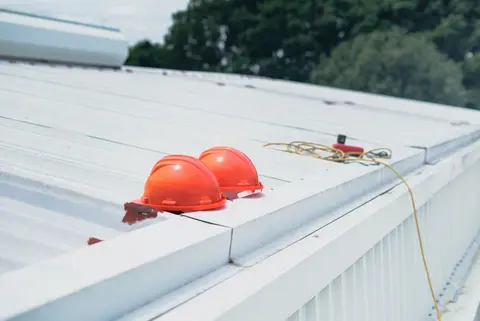 Commercial roofingCommercial Roof Inspections and Maintenance Programs for Property ManagersNRCA recommends inspecting roof systems at least twice a year, preferably in spring and fall, and again after severe weather such as hail. In North Texas…Read the guide
 Commercial roofingRoof Coating vs. Replacement for Flat Commercial RoofsA coating can extend a flat commercial roof only when the existing membrane is still sound, the insulation underneath is dry and the roof drains. The…Read the guide
 Roofers by cityCommercial Roof Leak Repair in Fort WorthVerde Roofing, a locally owned roofer based in Plano, repairs leaking commercial roofs in Fort Worth and across Tarrant County: leaks, open seams, damaged flashing and…Read the guide