Roof Replacement in Fort Worth: Who to Hire and How to Decide
 By Chris Grimes, owner of Verde RoofingPublished October 13, 2026 · 9 min read
In short
Verde Roofing, a locally owned roofer based in Plano, replaces residential roofs in Fort Worth and across Tarrant County. Owner Chris Grimes inspects the roof with you, photographs what he finds and gives a free written estimate; call or text (214) 687-1951. Verde is an NTRCA Accredited Member with a 5.0 rating from 54 Google reviews. With any roofer, verify insurance, the written scope and who obtains a city permit if decking is replaced.
Key takeaways
- Texas has no state roofing license, so a Fort Worth homeowner has to verify insurance, address, references and written scope directly.
- The City of Fort Worth's residential re-roofing FAQ says a shingle-only replacement on a one- or two-family home needs no permit, but replacing any decking does.
- The same city FAQ says drip edges and chimney crickets are required on a re-roof even when the old roof did not have them.
- Fixr's 2026 guide puts roof replacement at $3.75 to $11 per square foot, with most projects between $7,500 and $14,000.
- A roofer does not have to be based in Fort Worth, but it should serve Tarrant County routinely, have a fixed office you can verify and send the same person to inspect and to follow up.
Ask for a roofer recommendation in Fort Worth and you will get a dozen names in an hour, most of them from people who have used that company exactly once. A roof replacement is one of the larger checks you will write for your house, so the better question is not "who is good" but "how do I check that any of these companies is good, and that I need a new roof in the first place."
This guide covers the west side of the metroplex specifically: hiring a roofer who may be based in another county, what the City of Fort Worth says about permits and code items, what published cost guides show, and a step-by-step way to choose between bids.
Who replaces roofs in Fort Worth, and does the roofer have to be based there?
Fort Worth sits mostly in Tarrant County, and the roofers who work there come from all over the metroplex. Dallas–Fort Worth functions as one roofing market. A crew that works in Keller one week may be in Plano or Mansfield the next.
So a Fort Worth address on the truck is not the test. These are:
- A fixed office you can look up. Not a P.O. box or a temporary storefront opened after a storm.
- Tarrant County is part of its normal service area. Ask how the company schedules inspections, deliveries and follow-up visits on your side of the metroplex.
- The person who inspects is reachable later. You want a name and a phone number, not a call center.
- A track record you can read. Reviews over several years, trade association membership you can confirm, and references near you.
Verde Roofing is one example of the cross-metroplex arrangement. Our only office is in Plano, in Collin County, and Tarrant County is one of the eleven counties we serve. We tell Fort Worth homeowners that plainly so they can weigh it. A company that is vague about where it is based deserves a second look, which is the pattern described in our guide to spotting storm chasers.
What should you verify before a roofer makes your list?
Texas does not license roofers. The Roofing Contractors Association of Texas states on its consumer page that the state does not require roofing contractors to hold a state-issued license, and that its own licensing program is voluntary. That leaves the checking to you. Our guide on whether Texas licenses roofers goes through each item in depth; the short version for a Fort Worth replacement is below.
| What to check | How to check it | What it tells you |
|---|---|---|
| General liability insurance | Ask for a certificate and call the agent listed on it | Damage to your home during the job is covered |
| Workers' compensation or equivalent | Ask directly; most private Texas employers are not required to carry it | Who pays if a worker is hurt on your roof |
| Office address | Search the address; drive by if you can | The company will exist when you need a warranty visit |
| Association membership | Look the company up on the association's own site | Someone else has reviewed its paperwork |
| Written scope | Read the estimate line by line | You can compare bids on the same work |
| Warranty | Get the manufacturer and workmanship terms in writing | What is covered, by whom, for how long |
| Deductible language | Read the contract | No offer to waive or absorb it, which is illegal in Texas |
One practical point: ask for all of this before the inspection is scheduled. A roofer who is comfortable with the questions will answer them in one email.
Does Fort Worth require a permit for a roof replacement?
This is one of the few places where Fort Worth differs from many of its neighbors, and it is worth reading from the city's own document rather than taking any contractor's word for it.
The City of Fort Worth's Development Services department publishes a residential re-roofing FAQ. It says a permit is not required for a replacement roof on a single-family or two-family dwelling when only shingles are replaced and no decking is replaced. It says a permit is required if any decking is replaced.
That creates a real-world wrinkle. Nobody knows for certain whether decking needs replacing until the old shingles come off. Ask each bidder two things in writing: what happens if rotted or broken decking is found, and who obtains the permit if it is.
The same city FAQ answers several code questions homeowners rarely think to ask:
- Drip edge. Required when re-roofing, even if the old roof did not have it.
- Crickets. Required when re-roofing if they do not currently exist. A cricket is the small peaked diverter behind a chimney.
- Decking over decking. Not allowed. New sheathing cannot be laid on top of old sheathing.
- Sound older decking. If the sheathing met code when the house was built and is in good condition, it does not have to be replaced.
- Ice barrier. Not required under the city's amendments.
City rules change, so confirm the current answer with Fort Worth Development Services before work starts. Neighboring cities in Tarrant County set their own rules, and they are not the same; Arlington, for instance, requires a permit for most re-roofs, as covered in our guide to replacing a shingle roof in Arlington. If your address is in a suburb with a Fort Worth mailing address, check which city you are actually in.
What does a roof replacement cost in Fort Worth?
No published guide breaks out Fort Worth reliably, so use national ranges as a sanity check and nothing more. Fixr's 2026 roof replacement guide puts the cost at $3.75 to $11 per square foot, with a national average near $10,000 and most projects between $7,500 and $14,000. Fixr also reports that tear-off averages about $50 per roofing square and that replacing damaged decking runs $2 to $8 per square foot.
Those are ranges from a national cost guide, not Verde's prices. What moves your number:
- Roof size in squares (one square is 100 square feet of roof surface)
- Pitch and height, which change labor and safety setup
- The number of old layers to remove
- How much decking turns out to be damaged
- Shingle line, and whether you choose metal, tile or slate instead
- Code items such as drip edge and crickets
- Access for delivery and the dump trailer
Our DFW roof cost guide explains each factor, and the roof cost calculator gives a published-range ballpark for your roof size before anyone visits.
Do you need a new roof at all?
Plenty of roofs that get replaced could have been repaired, and plenty that get patched should have been replaced. The honest dividing line is how widespread the problem is and how much life the rest of the roof has.
A repair is usually the right call when the damage is in one area: a few wind-lifted shingles, a cracked pipe boot, failed flashing at a wall or chimney. Replacement makes sense when shingles are brittle and shedding granules across every slope, when leaks return after repairs, or when hail or wind has damaged several slopes at once.
When I inspect a roof, I photograph the worst spot and a typical spot on each slope, because the typical spot is what tells you whether the roof is worn out or just injured in one place.
Ask any roofer to show you photos of both. If the answer to "would a repair carry this roof a few more years?" is yes, that is your answer. Our repair-or-replace decision guide gives you the criteria to judge it yourself.
How do you decide between two or three bids?
Once you have written estimates, the choice is a process, not a feeling. Work through it in order.
- Confirm the measurements match. The squares on each estimate should be close. A large gap means someone measured wrong or left off a section.
- Line up the scope. Tear-off, underlayment type, starter strip, drip edge, ridge cap, flashing, pipe boots, vents and cleanup should appear on every bid.
- Compare the decking terms. Look for a per-sheet price for replacement decking, and a statement about the permit if decking is replaced.
- Compare the same shingle. Brand and line, not just "architectural."
- Read both warranties. The manufacturer warranty and the roofer's workmanship warranty are separate documents.
- Check the payment schedule. Be wary of a large payment before materials arrive.
- Ask what is excluded. Gutters, skylights, chimney caps and interior repairs are common gaps.
- Then look at price. If one bid is far below the others on the same scope, ask what is missing.
Our guide to reading a roofing estimate line by line shows what each line should say.
What changes when insurance is paying?
If hail or wind is the reason for the replacement, the claim is yours. You file it, you speak with your insurer, and you decide whether to accept the settlement.
Two Texas rules shape what a roofer may do. The Texas Department of Insurance says a contractor may not act as a public insurance adjuster on a job it is also doing, or advertise that it will. And Texas Business and Commerce Code §27.02 makes it a Class B misdemeanor for a contractor paid from insurance proceeds to pay, waive, absorb or rebate your deductible without the insurer's consent. A Fort Worth roofer who offers either one is telling you how it does business.
What a roofer can properly do is inspect, document the damage with photos, be on the roof when the adjuster visits to point out what it found, and write an estimate. Our step-by-step guide to a Texas roof claim explains the sequence.
How does Verde approach a replacement in Fort Worth?
Verde Roofing is a locally owned company based in Plano that serves Tarrant County along with ten other North Texas counties. The owner, Chris Grimes, inspects the roof with you, photographs what he finds, and explains whether a repair would do before a replacement is discussed.
If a new roof is the right call, you get a free written estimate. Our roof replacement work includes laminated architectural shingles from Malarkey and Owens Corning, plus stone, tile, slate and metal. When storm damage is involved, Chris meets your adjuster on site to show the damage he documented.
Verde is an NTRCA Accredited Member and an RCAT member, was voted Best Roofer in the Dallas Observer's Best of Dallas readers' choice in 2021, 2022 and 2023, and holds a 5.0 rating from 54 Google reviews. You can read them on our reviews page and check the counties we cover under service areas. Ask us for warranty terms in writing, the same as you would ask anyone.
Get a written answer for your Fort Worth roof
Call or text (214) 687-1951, 24/7, or book a free roof inspection. Chris will inspect the roof with you, show you the photos, and tell you whether it needs a repair or a replacement before you decide anything.
Questions people ask next
Is it a problem if my roofer is based in Plano and I live in Fort Worth?
Not by itself. Dallas–Fort Worth is one market, and many roofers work across several counties. What matters is that the company has a fixed office you can verify, serves Tarrant County as part of its normal area, and will come back for a warranty call. Ask who would return if a shingle lifts or a leak appears, and get the answer in writing.
How long does a roof replacement take on a Fort Worth house?
Most single-family shingle roofs are torn off and replaced in one visit, but size, pitch, the number of old layers, decking repairs and weather can add time. Tile, slate and metal take longer. Ask each bidder for a start window and a duration in writing, and ask what happens to an open roof if rain arrives during the job.
Should I replace my roof before selling my house in Fort Worth?
Only if the roof is truly at the end of its life or a buyer's inspector is likely to flag it. A sound roof with a few repairable defects usually needs a repair and a written inspection report, not a replacement. Ask a roofer for dated photos and an honest remaining-life opinion so you can decide with your agent.
Can I put new shingles over my old ones to save money?
A second layer hides the decking, adds weight and can affect a manufacturer warranty. Building codes also limit when a re-cover is allowed, and it is not permitted over a roof that is water-soaked or already has two layers. A full tear-off lets the roofer inspect and repair the deck. Ask your city what applies before considering it.
What time of year is best to replace a roof in Fort Worth?
Roofs are replaced all year in North Texas. Spring and early summer are the busiest because of hail, so schedules tighten after a big storm. If your roof is worn but not leaking, getting an inspection and a written estimate before storm season gives you time to compare bids without pressure.
Sources
- City of Fort Worth Development Services: Residential re-roofing FAQ
- Fixr: How Much Does a Roof Replacement Cost? (2026)
- Roofing Contractors Association of Texas: Consumer information
- Texas Department of Insurance: Roofing and insurance, know the law
- City of Arlington Planning & Development Services: Technical Bulletin, Re-Roof Permits, Inspections & Common Q & A (September 13, 2023)
- Texas Business and Commerce Code §27.02
Chris Grimes owns Verde Roofing in Plano, Texas, a locally owned residential and commercial roofer serving Dallas–Fort Worth. Verde is an NTRCA Accredited Member, an RCAT member and a Dallas Observer Best of Dallas Best Roofer winner (readers’ choice) in 2021, 2022 and 2023.
Keep reading
Related guides
 Hiring a rooferHow to Choose a Roofing Contractor in Dallas–Fort WorthPick a roofer who is local and easy to verify. Texas has no state roofing license, so check a physical DFW address, proof of liability and…Read the guide
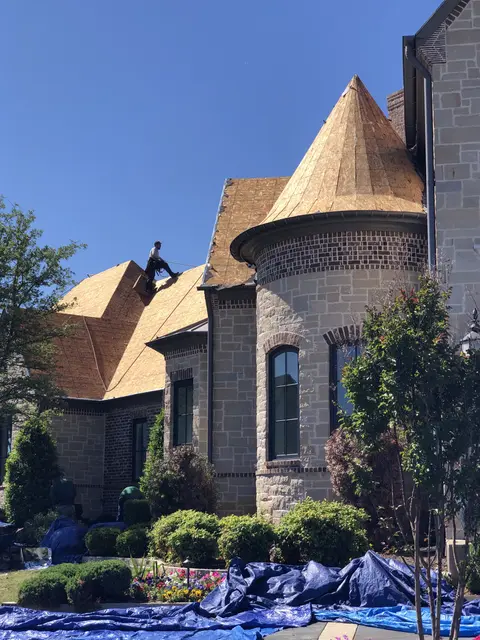 Cost & financingHow Much Does a New Roof Cost in Dallas–Fort Worth?Nobody publishes a verified Dallas–Fort Worth average. National cost guides put a full asphalt shingle replacement at roughly $3.75 to $11 per square foot of roof…Read the guide
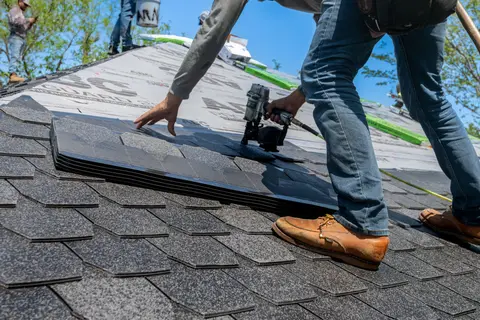 Roofers by cityShingle Roof Replacement in Arlington at a Reasonable PriceVerde Roofing, a locally owned roofer based in Plano, replaces shingle roofs in Arlington and across Tarrant County. Owner Chris Grimes inspects the roof with you…Read the guide