What Is a Roofing Square? How Roofers Measure and Price Your Roof
 By Chris Grimes, owner of Verde RoofingPublished October 28, 2026 · 8 min read
In short
A roofing square is 100 square feet of roof surface. Roofers measure every roof plane, multiply length by width, add the planes together, adjust for pitch, and then add a waste allowance, which Owens Corning puts at 10 to 15 percent. To check an estimate, multiply your home’s footprint including overhangs by the pitch factor, divide by 100, and compare.
Key takeaways
- One roofing square equals 100 square feet of roof surface, not floor space.
- Roof area is larger than the house footprint because of overhangs and slope; a 6-in-12 roof has about 1.118 times the flat area.
- Owens Corning recommends adding 10 to 15 percent for waste, more on roofs with many valleys, hips and dormers.
- Most laminated architectural shingles are packaged three bundles to a square, but check the wrapper of the product you are buying.
- If two estimates differ by more than a couple of squares on the same house, ask each roofer to show how they measured.
You have a roofing estimate in your hand and the biggest number on it is not a dollar amount. It is something like "28.4 SQ." Every other line depends on that figure, and most homeowners have no idea whether it is right.
Here is how roofers measure a roof, why the number is always bigger than your house, and a simple way to check the squares on any estimate from the ground, without climbing a ladder.
What is a roofing square?
A roofing square is 100 square feet of roof surface. Owens Corning's measuring guide defines it exactly that way, and it is the standard unit for pricing shingles, underlayment, labor and tear-off across the industry.
So a roof described as 25 squares has about 2,500 square feet of surface to cover. Shingles are sold by the square, crews are often paid by the square, and disposal is priced by the square. That is why a two-square error on an estimate can move the total by more than a thousand dollars.
The key word is surface. Your roof's square footage is not your home's living area, and it is not the size of your lot. It is the area of every sloped plane that gets shingled.
Why is my roof bigger than my house?
Three things make the roof larger than the living space you see on your appraisal:
- Overhangs. Eaves and rakes usually stick out past the walls on every side.
- Covered areas. Attached garages, porches and patios under the main roof all count.
- Slope. A sloped surface is longer than the flat ground it covers. The steeper the pitch, the bigger the difference.
This Old House notes that a typical roof uses a pitch multiplier of about 1.12 to estimate roof area from a home's footprint. That is a rough average. Your actual factor depends on your actual pitch.
A two-story house is the opposite case. A 3,000-square-foot two-story home in McKinney may have a smaller footprint, and fewer squares, than a 2,400-square-foot one-story ranch in Garland. Footprint and pitch matter; living area does not.
How do roofers measure a roof?
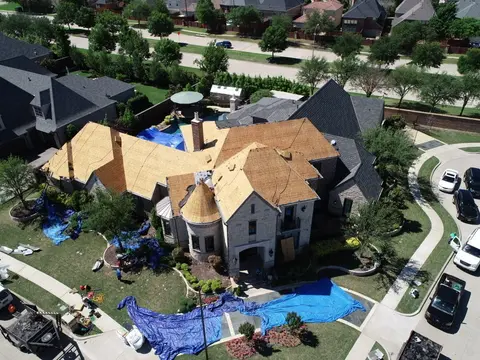
Owens Corning's guide lays out the basic method: measure the length and width of each roof plane, including dormers, multiply length by width for each plane, and add all the planes together. Its own example is a simple gable roof with two 40-by-30-foot planes, which totals 2,400 square feet, or 24 squares.
In practice, roofers measure one of three ways:
- Tape measure on the roof. Plane by plane, with pitch checked using a level and a tape. Accurate on simple roofs, slower on complex ones.
- Aerial measurement report. A report built from satellite or aircraft imagery that lists each plane, the pitch and the linear feet of ridges, hips, valleys and eaves.
- Footprint times pitch factor. Measure the house and overhangs from the ground, multiply by the slope factor. Good for a quick check, not for ordering materials.
What is roof pitch and how does it change the squares?
Pitch is how many inches the roof rises for every 12 inches of horizontal run. Owens Corning's guide explains that a roof that rises 4 inches over 12 inches is a "4-in-12" slope, and the rise is always listed first.
To turn a flat footprint into true roof surface, you multiply by a slope factor. Owens Corning lists 1.118 for a 6-in-12 roof and 1.414 for a 12-in-12 roof. The other factors come from the same geometry (the square root of rise squared plus 144, divided by 12):
| Pitch | Slope factor | 2,000 sq ft footprint becomes | Squares before waste |
|---|---|---|---|
| 4-in-12 | 1.054 | 2,108 sq ft | 21.1 |
| 5-in-12 | 1.083 | 2,166 sq ft | 21.7 |
| 6-in-12 | 1.118 | 2,236 sq ft | 22.4 |
| 8-in-12 | 1.202 | 2,404 sq ft | 24.0 |
| 10-in-12 | 1.302 | 2,604 sq ft | 26.0 |
| 12-in-12 | 1.414 | 2,828 sq ft | 28.3 |
Pitch costs you twice. A steeper roof has more squares to cover, and it is slower and riskier to work on, which raises the labor price per square. Fixr notes that steep roofs need added safety measures such as harnesses or scaffolding that raise labor costs.
What is the waste factor and why is it on my estimate?
Shingles get cut at every valley, hip, rake edge, vent and chimney. The pieces that come off are waste. Owens Corning recommends adding 10 to 15 percent to your material totals, and says more complicated roofs need a higher waste factor. In its 24-square example, it adds 2.4 squares, or about 7 to 8 extra bundles.
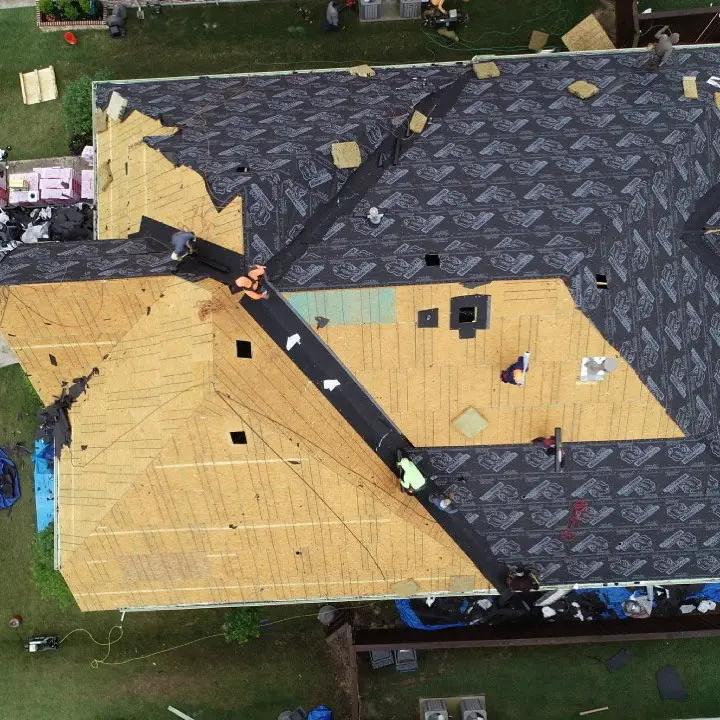
A simple gable roof might be near the low end. A Frisco or Prosper home with multiple gables, hips, valleys and a turret will need more. A waste factor is normal and honest. What you want to see is that it is listed clearly, not hidden inside a padded "measured" number.
On a well-written estimate, you will usually see two numbers: the measured squares and the ordered squares (measured plus waste). If you only see one, ask which it is.
How do I check the number of squares on my estimate?
You can sanity-check any estimate in about ten minutes from the ground:
- Measure the footprint. Use your survey, your appraisal sketch or a tape measure around the outside walls. Add the garage and covered porches.
- Add the overhangs. Measure how far the eaves and rakes stick out past the walls and add that on each side.
- Find your pitch. Your roofer's report should list it. If not, ask.
- Multiply by the slope factor from the table above.
- Divide by 100 to get squares.
- Add 10 to 15 percent for waste, more for a complex roof.
- Compare with the estimate. Within a square or two is normal. Five squares off on a 25-square roof deserves a question.
Our roof cost calculator runs this math for you and shows a price range for your squares and material.
How many bundles and rolls does a square take?
Once you know the squares, the material count follows. According to Owens Corning's guide:
- Shingles: laminate or architectural shingles are generally packaged three bundles to a square. Some specialty lines use more bundles, so check the wrapper.
- Synthetic underlayment: sold in rolls that cover 10 squares.
- #15 felt: sold in rolls that cover 4 squares.
- Waste: add 10 to 15 percent to underlayment as well.
Items along the edges and peaks are measured in linear feet, not squares: starter strip, drip edge, hip and ridge cap, and valley material. If your estimate lists those lines separately, that is a good sign the roofer measured carefully. Our guide on underlayment, ventilation and decking covers what those layers do, and architectural vs. 3-tab shingles explains why the shingle line changes the price per square.
How do roofers turn squares into a price?
Roofers multiply squares by a price per square, then add line items that are not tied to area. National cost guides give you a sense of the range. Fixr's 2026 guide puts full replacement at $3.75 to $11 per square foot, which is $375 to $1,100 per square installed. Fixr also lists tear-off and disposal at about $50 per square, rising toward $150 per square for heavy materials or multiple layers.
Here is how the pieces usually stack up on a shingle estimate:
| Priced per square | Priced per linear foot | Priced per item |
|---|---|---|
| Shingles | Drip edge | Pipe boots |
| Underlayment | Starter strip | Roof vents |
| Tear-off and disposal | Hip and ridge cap | Decking sheets replaced |
| Installation labor | Valley metal or membrane | Permit |
Those per-square figures are national ranges, not our prices. For a full picture of what moves the total in North Texas, read how much a new roof costs in Dallas–Fort Worth.
What if my insurance estimate shows fewer squares?
On a storm claim, your insurance company's adjuster also measures the roof, and the payment is built on those squares. If the adjuster's number is lower than the real roof, the money may not cover the job.
This is where documentation matters. When we inspect a storm-damaged roof, Chris measures, photographs the damage and meets your adjuster on site to show what he found. If the measurement or the scope later turns out to be short, the documented difference can be sent to the insurer for review. That is called a supplement, and our guide on what a roof insurance supplement is explains how it works. You can also read what happens during the adjuster's roof inspection and how our insurance claim help works. You own the claim; we provide the measurements, the photos and the estimate.
How do I compare squares across two bids?
When you collect bids, put the squares side by side before you look at the totals:
- Same house, same roof: the measured squares should be close.
- If one bid is much lower in squares, it may be under-measured, and the roofer may add a change order later.
- If one bid is much higher, ask whether it includes a detached garage, a patio cover or an unusually high waste factor.
- Confirm that both bids use the same shingle line and include the same edge, vent and decking items.
Our guide on how to read a roofing estimate line by line walks through every other line you should compare. And if you are ready to replace, our roof replacement page explains how we work.
Want your roof measured properly?
Call or text (214) 687-1951, 24/7, or book a free roof inspection. Chris will measure your roof, show you the squares and the pitch, and give you a written estimate after the free inspection, so you know exactly what you are comparing.
Questions people ask next
How many squares is a 2,000 square foot house roof?
It depends on overhangs, porches, garage and pitch. A 2,000 square foot single-story footprint at a 6-in-12 pitch is roughly 22 squares of roof before waste, and around 25 squares ordered with a 10 percent allowance. A two-story home with the same living area has a smaller footprint and often fewer squares.
Why does my insurance estimate show a different number of squares than my roofer?
Adjusters and roofers may measure from different sources, round differently or use different waste factors. Insurance estimates often list the measured area and a separate waste line. If the difference matters, ask your roofer to share the measurement and photos so the adjuster can compare them on the next review.
Is a roof measurement report from satellite images accurate?
Aerial measurement reports are widely used and usually close, but trees, shadows and recent additions can throw them off. A roofer who also walks the roof and checks pitch with a level can catch errors. If a report and a hand measurement disagree, ask which one the estimate is based on.
How many bundles of shingles are in a square?
Owens Corning’s guide says laminate or architectural shingles are generally packaged three bundles to a square. Some heavier designer or specialty shingles use more bundles per square. Always check the coverage printed on the bundle wrapper for the exact product listed on your estimate.
Do hips and ridges count in the number of squares?
The squares cover the field of the roof. Hip and ridge cap shingles, starter strips and drip edge are usually measured separately in linear feet and listed as their own lines. If those lines are missing from an estimate, ask whether they are included in the per-square price.
Sources
Chris Grimes owns Verde Roofing in Plano, Texas, a locally owned residential and commercial roofer serving Dallas–Fort Worth. Verde is an NTRCA Accredited Member, an RCAT member and a Dallas Observer Best of Dallas Best Roofer winner (readers’ choice) in 2021, 2022 and 2023.
Keep reading
Related guides
 Cost & financingHow Much Does a New Roof Cost in Dallas–Fort Worth?National cost guides put a full asphalt shingle replacement at roughly $3.75 to $11 per square foot of roof (Fixr, 2026), which works out to about…Read the guide
 Cost & financingHow to Read a Roofing Estimate Line by LineA complete roofing estimate lists the company’s full contact details, the measured squares and waste factor, how many layers come off, the exact shingle line, underlayment…Read the guide
 Roofing materialsArchitectural vs. 3-Tab Shingles: Which Should You Choose?A 3-tab shingle is a single flat layer cut into three tabs; an architectural (laminated or dimensional) shingle bonds two or more layers for a thicker…Read the guide