Do Solar Attic Fans Help in the Texas Heat? What a DFW Homeowner Should Know
 By Chris Grimes, owner of Verde RoofingPublished November 26, 2026 · 13 min read
In short
Sometimes. In Texas heat, a solar attic fan helps a Dallas–Fort Worth attic that is short on exhaust but has open soffit vents and a sealed, insulated ceiling. A Florida Solar Energy Center test measured attic peaks about 22°F lower, yet air conditioning use fell only about 6 percent. With blocked soffits or a leaky ceiling, ENERGY STAR warns an attic fan can pull cooled air out of the house.
Key takeaways
- A Florida Solar Energy Center test of two solar attic fans cut peak attic air temperature by an average of 22°F but air conditioning use by about 6 percent.
- ENERGY STAR warns that with blocked soffit vents and an unsealed ceiling, an attic fan pulls cool conditioned air out of the house and raises the summer bill.
- The Department of Energy’s Building America Solution Center recommends air sealing, insulation and better passive vents before any attic fan.
- The Home Ventilating Institute sizes a powered attic fan at 0.7 CFM per square foot of attic, with 1 square foot of intake for every 300 CFM.
- The federal Residential Clean Energy Credit ended for expenditures made after December 31, 2025, so do not count on a federal tax credit for a fan installed in 2026.
Your upstairs rooms will not cool down in August, the air conditioner runs all afternoon, and someone has told you a solar attic fan will fix it. It runs on sunshine and costs nothing to operate. It sounds like an easy yes.
The honest answer depends on your attic. This guide covers what the research says, what has to be right before a fan helps, how to size and place one, and what it costs.
Do solar attic fans lower cooling bills in North Texas?
They lower the attic temperature a lot and the cooling bill a little. The best-known measurement comes from the Florida Solar Energy Center, which installed two solar attic fans on a test home and tracked the results over a summer.
The fans cut the daily peak attic air temperature by an average of 22°F. Air conditioner use fell by about 6 percent, or 2.8 kilowatt-hours a day, which the researchers estimated at about 460 kilowatt-hours a year in that home. Their own conclusion was that the effect over a cooling season is “fairly modest with well insulated attics,” and that payback on the fans was more than twenty years.
Why so little, when the attic is so much cooler? The Department of Energy’s Building America Solution Center, run by Pacific Northwest National Laboratory, explains that most of the heat moving from the roof to the attic floor is radiant, not carried by the air. A fan changes the air; it does not stop the hot roof deck from radiating onto the insulation.
The same source says where a fan does the most good: attics with little insulation, a dark or unshaded roof, no radiant barrier, or air conditioning equipment in the attic. Many DFW homes check that last box. And the National Weather Service office in Fort Worth notes that July and August are the sunniest months here, often at or above 100 degrees, so a solar fan has plenty of sun to run on.
Can an attic fan pull cooled air out of your house?
Yes. A fan pulls air from wherever it is easiest to get. If the soffit vents cannot supply enough outside air, the fan makes up the difference through gaps in your ceiling: the attic hatch, recessed lights, plumbing and wiring holes.
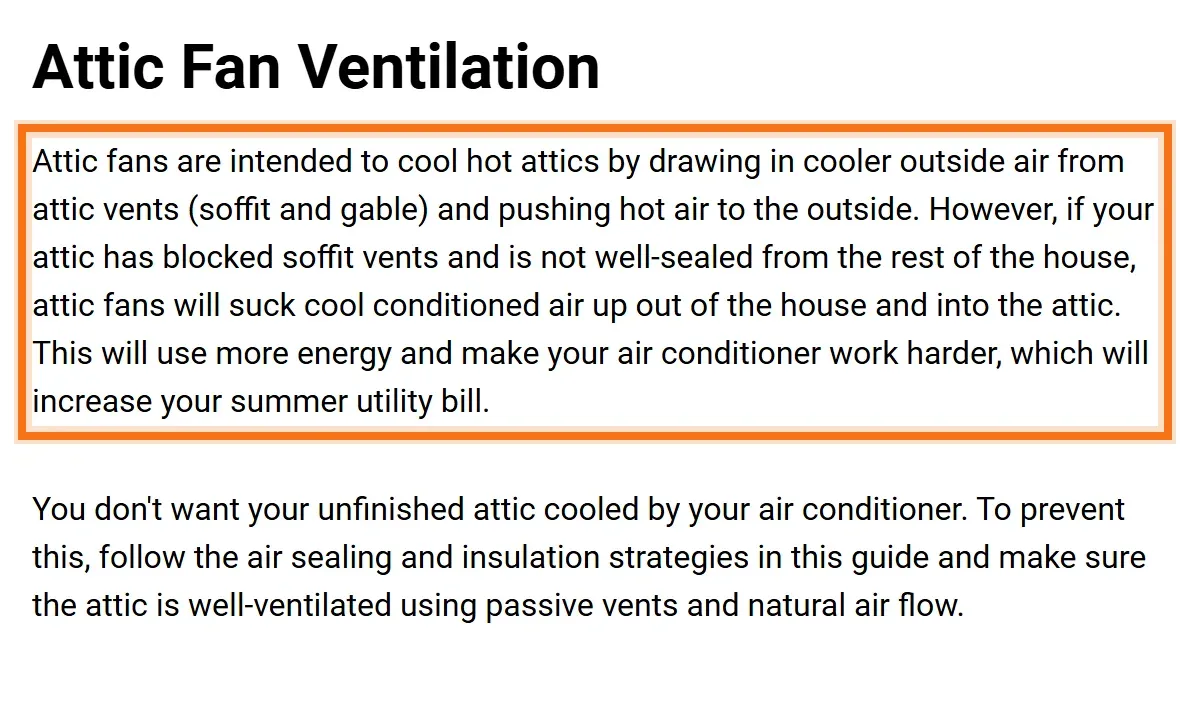
ENERGY STAR puts it bluntly in its attic guide. If the attic has blocked soffit vents and is not well sealed from the rest of the house, attic fans “will suck cool conditioned air up out of the house and into the attic,” which makes the air conditioner work harder and raises the summer bill.
The Building America Solution Center goes further. It says passive attic ventilation is generally recommended over attic fans, and it lists other problems the suction can cause: gas appliances that are not sealed-combustion may not draft as well or could backdraft, and air from the garage can be drawn into the house. That matters in North Texas, where a gas furnace or water heater often sits in the attic.
It also says the risks can be greatly reduced: thoroughly air seal the ceiling, provide ample intake vent area, use a fan with a lower airflow, and use a solar-powered unit, which runs only when the sun is shining and so does not pull in humid night air. Solar fans also tend to have lower airflow ratings than wired ones. A solar fan is the gentler kind of powered attic fan, but the first two items on that list still have to be true.
What should come first: intake, air sealing or insulation?
All three come before a fan. For an attic that is too hot, the Building America Solution Center recommends these steps instead of a fan:
- Clear and add intake. Remove insulation that is blocking the eaves and add well-placed vents where there are too few. ENERGY STAR prints its rule in capital letters: never cover attic soffit vents with insulation.2. Air seal the ceiling. Seal the attic hatch, the tops of walls, and the holes around lights, pipes and wires.
- Add insulation. North Texas is in climate zone 3 on the ENERGY STAR insulation map, where the recommendation is R49 for an uninsulated attic and R38 when 3 to 4 inches of insulation are already there.
- Seal and insulate ducts and equipment in the attic.
- Think about the roof itself. A radiant barrier under the deck or a more reflective roof cuts the heat at its source; see roof color and energy efficiency.
When I look at an attic before talking about any fan, the first thing I check is whether I can see daylight at the eaves. If insulation is packed against the roof deck all the way around, the attic cannot breathe in, and no exhaust product will fix that.
How much passive ventilation an attic needs, and how to balance intake against exhaust, is covered in our guide to underlayment, ventilation and decking. If the attic is damp as well as hot, start with why an attic can be wet when it has not rained; the same source calls attic fans ineffective as a moisture fix.
How is a solar attic fan different from a wired fan, a ridge vent or a turbine?
They all move air out of the top of the attic, but with different amounts of force, and they are not meant to be mixed on one attic space.
Here is how the common exhaust options compare, with typical installed cost ranges from HomeGuide’s 2026 attic fan cost guide:
| Exhaust type | What moves the air | When it runs | Typical installed cost (HomeGuide, 2026) |
|---|---|---|---|
| Ridge vent | Rising hot air and wind | All the time | Not listed in that guide |
| Static box vent | Rising hot air and wind | All the time | $200 to $700 |
| Turbine (whirlybird) | Wind and rising hot air | All the time, faster in wind | $150 to $300 |
| Wired roof fan | Motor on household power | When its thermostat calls | $200 to $1,200 |
| Solar roof fan | Motor on its own panel | When sun is on the panel | $300 to $1,400 |
| Solar gable fan (behind a gable vent, no roof opening) | Motor on its own panel | When sun is on the panel | $350 to $1,200 |
How to read this table: the passive options at the top are what building-science sources prefer, because they create far less suction. A powered fan, wired or solar, is the tool for an attic where passive exhaust cannot do the job. The costs are published national ranges, not our prices.
One more difference: the Florida Solar Energy Center notes that typical wired attic ventilators draw 250 to 300 watts. A solar fan has no running cost.
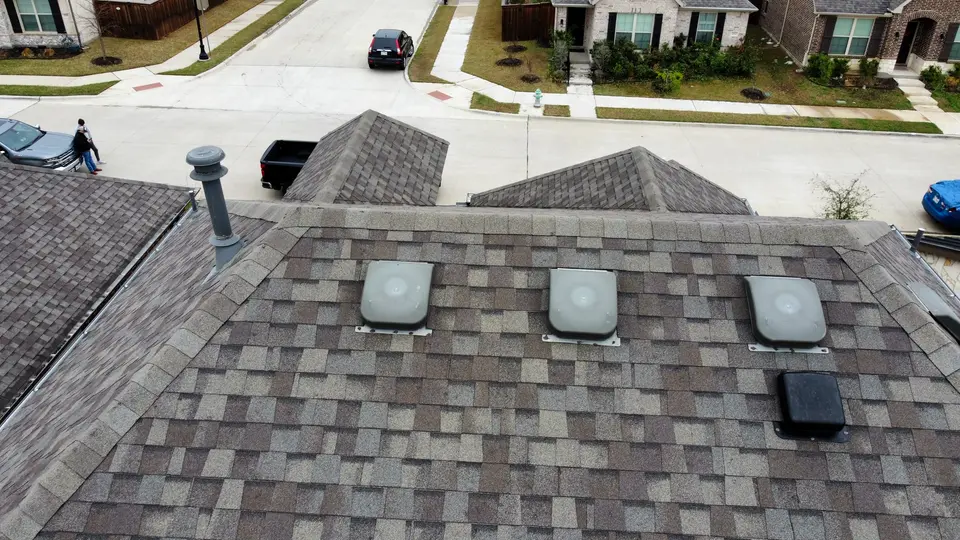
On mixing: a powered fan beside a ridge vent, box vents or a turbine can short-circuit, drawing its air in through the vent a few feet away instead of from the eaves.
What size solar attic fan does a DFW attic need?
Fans are rated in cubic feet per minute (CFM). The Home Ventilating Institute gives the standard sizing rule for a powered attic ventilator:
- Airflow: multiply the attic floor area in square feet by 0.7 to get the minimum CFM.
- Dark shingles or a steep roof: raise the multiplier 15 percent, to 0.805.
- Intake: at least 1 square foot of inlet area for every 300 CFM of fan capacity, through soffit vents spaced evenly under the eaves.
A worked example: a 2,000-square-foot attic needs about 1,400 CFM, or about 1,610 CFM with the dark-or-steep adjustment. At 1,610 CFM the soffits must provide about 5.4 square feet of net free area, which is 773 square inches. If your soffit vents cannot deliver that, the fan is too big for the attic.
Manufacturers publish their own numbers, and those govern an installation. Attic Breeze, the solar attic fan brand we feature, lists three models in its UltraBreeze series on its own site: a 25-watt model rated at up to 1,550 CFM for attics up to 2,000 square feet, a 35-watt model at 1,775 CFM for up to 2,500 square feet, and a 45-watt model at 1,925 CFM for up to 3,000 square feet. Each comes with a minimum intake requirement, from 6.0 to 7.5 square feet of net free vent area.
One caution. The Building America Solution Center advises choosing a lower-airflow fan to limit suction, and it cites a far smaller rate, 50 CFM per 1,000 square feet of attic floor, as enough to control moisture. Bigger is not better: the right fan is the smallest one your intake can feed.
Where does the fan go on the roof, and why should a roofer install it?
High on the slope, close to the ridge. The Building America Solution Center says to locate the fan high in the attic, with most intake low at the soffits, far enough apart that incoming air sweeps across the whole attic. The panel needs sun, so a south- or west-facing slope without tree shade is the usual choice. If that slope faces the street, check your HOA rules first; see HOA roof approval in Texas.
Installing one means cutting a hole through the shingles, underlayment and decking between two rafters, then keeping that opening watertight for the life of the roof. That is a roof penetration, and penetrations are where roofs leak; see chimney flashing and vent leaks.
The mounting has to match the roofing. Attic Breeze, for example, lists a self-flashing base for asphalt shingles on pitches from 3/12 to 12/12, and a curb-mount base for tile and metal roofs. On a shingle roof the flange is slipped under the courses above it and fastened as the instructions show, not set on top in a bed of caulk.
Three points before anyone cuts:
- Warranty. Ask in writing how a new penetration affects your shingle and workmanship warranties. See roof warranties explained.
- Timing. The cleanest time to add or remove any roof vent is during a roof replacement, when every vent is reflashed anyway. If the roof has only a few years left, read how long a roof lasts in Texas and consider waiting.
- Solar panels. If you are also planning rooftop solar, lay out the fan and the panels together. Our solar page and our guide to solar panels and your roof cover that planning.
If you want someone to look at the attic and the roof together before you decide, call or text (214) 687-1951.
Will a solar attic fan hold up to hail and wind in North Texas?
Treat it like everything else on your roof: it will be hit eventually. The National Weather Service says large hail, damaging winds, flooding and tornadoes occur nearly every year in the Dallas–Fort Worth Metroplex.
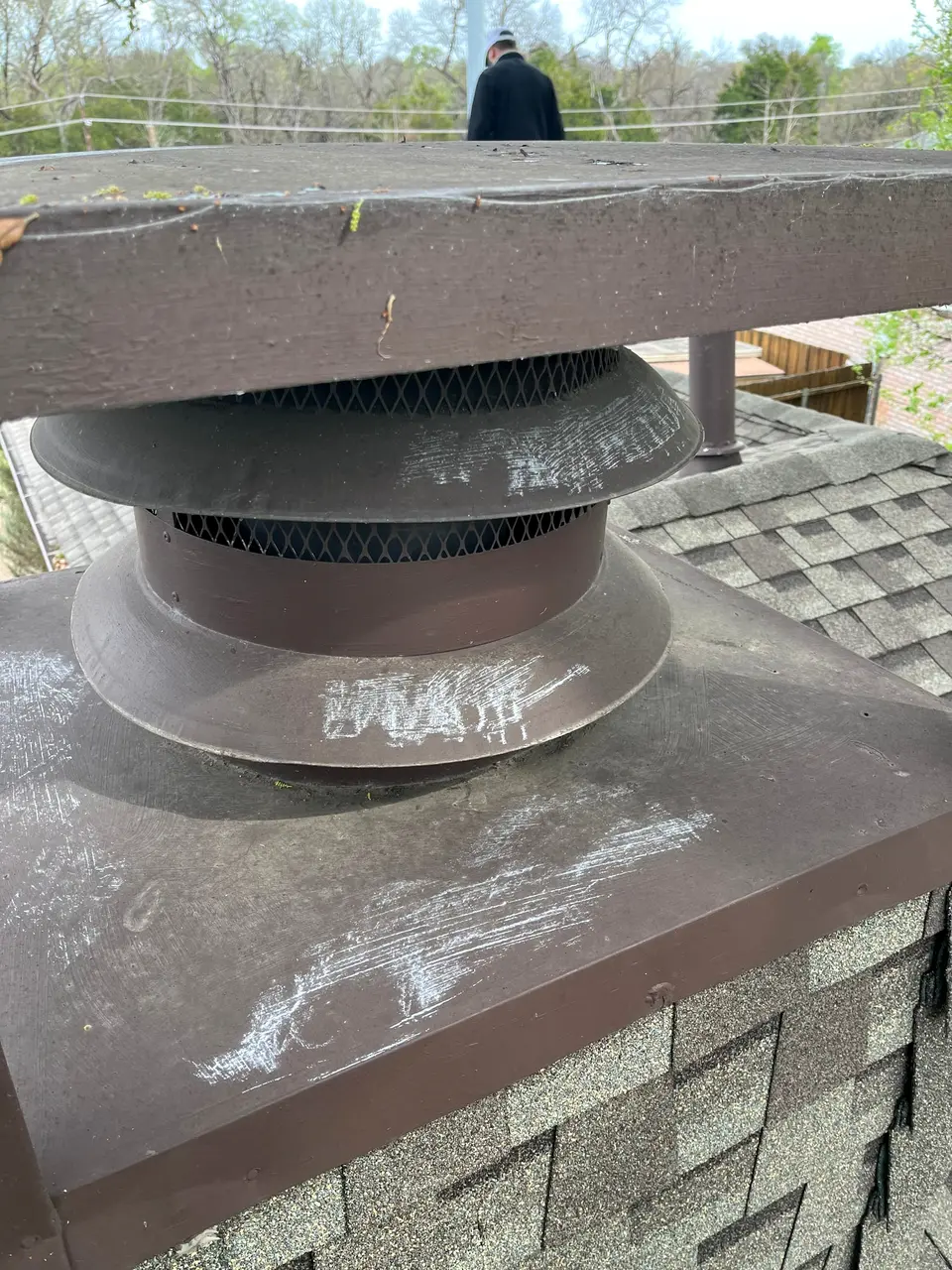
On wind, look for tested approvals. Attic Breeze states on its site that its fans carry performance ratings for wind speeds exceeding 170 mph, and that its self-flashing models are approved under the Texas Department of Insurance windstorm program. That program covers the Gulf Coast windstorm region, not DFW, but the testing is still useful evidence.
A wind approval is not a hail rating. Ask in writing for the hail or impact test information for the exact model, and what the manufacturer’s warranty says about storm damage. After a storm, a fan is checked along with the vents and flashing; see the signs of hail damage on a roof. Whether your homeowners policy pays for a damaged fan depends on your policy, so ask your agent.
What does a solar attic fan cost?
We do not publish prices, because the number depends on your roof. These are published national ranges from two cost guides:
- HomeGuide (2026): a solar roof fan costs $300 to $1,400 installed, or $200 to $850 for the fan alone. The labor to add an attic fan is $100 to $500.
- HomeAdvisor (updated June 2026): solar attic fans cost between $300 and $1,300 to install. Attic fan installation of all types averages $625, with a normal range of $369 to $914.
What moves the price within those ranges: the fan’s size and whether you need one or two, the roof material and pitch (tile and metal need a curb mount), the vent work around it, such as adding soffit intake or closing static vents, and wiring if you choose a hybrid model.
Do not expect the electric bill to pay it back quickly: in the Florida test, the savings were worth about $37 a year at the prices of the time. Buy a fan because the attic needs more exhaust, not for a promised payback.
Is there a tax credit for a solar attic fan in 2026?
Not a federal one you should count on. The 2025 federal budget law ended the Residential Clean Energy Credit under section 25D of the tax code, the credit that solar products relied on. The IRS fact sheet on the change says the section 25D credit “will not be allowed for any expenditures made after December 31, 2025,” and that an expenditure is treated as made when the original installation is completed. ENERGY STAR’s tax credit page gives the same end date.
Some cost guides still say a solar attic fan may qualify for a federal tax credit. For a fan installed in 2026, that wording is out of date. What to verify, and where:
- Federal: read the IRS fact sheet listed in the sources, or ask a tax professional. A fan installed in 2025 or earlier is a question for your preparer; the fact sheet does not mention attic fans.
- Local: ask your electricity provider whether it has a rebate that covers attic work. We do not promise any rebate or credit.
Does a solar attic fan make sense for your attic?
Match your attic to the closest row:
| Your attic situation | Does a solar fan help? | What to do first |
|---|---|---|
| Soffit vents blocked, painted over or buried in insulation | No. It can pull cooled air from the house | Open the intake and add baffles at the eaves |
| Leaky ceiling or thin insulation | Not yet | Air seal the ceiling, then insulate to R38 to R49 |
| Balanced ridge vent and clear soffit vents | Rarely. The fan can short-circuit the ridge vent | Leave it alone; check that the balance is real |
| Hip roof with a short ridge, a few box vents, open soffits | Yes, this is the best case | Size the fan to the intake you have |
| Gas furnace or water heater in the attic that is not sealed-combustion | Only with care | Have the appliance draft checked with the fan running |
| Roof due for replacement in the next few years | Wait | Redesign the ventilation during the reroof |
| Sealed, spray-foamed attic with no vents | No | Nothing; that attic is built to work unvented |
How to read this table: the first three rows are where a fan disappoints or backfires, and none of them is fixed by the fan itself. The fourth row is where a solar fan earns its place, because many North Texas hip roofs do not have enough ridge for a ridge vent to carry the whole attic.
What should you ask the installer?
Take this list to whoever quotes the fan:
- How many square feet is my attic, and what CFM did you size for?
- What is the net free area of my soffit vents today, and does it meet this fan’s minimum intake?
- What happens to my existing ridge vent, box vents, turbines or gable vents?
- How is the base flashed on my roofing material, who warrants that penetration, and does it change my shingle warranty?
- What are the wind approvals and hail test results for this exact model?
- Is the price a written estimate with the vent work listed?
More questions for any roofing job are in our guide to questions to ask a roofer.
Why do DFW homeowners ask Verde Roofing about attic fans?
We are a locally owned roofer based in Plano, also known as Verde Roofing & Solar, and we do roof replacement, roof repair and rooftop solar across Collin, Dallas, Denton, Tarrant and seven more North Texas counties. Attic Breeze is the solar attic fan brand we feature.
The inspection is free. Chris looks at the roof and the attic with you, photographs what he finds, and tells you plainly whether a fan would help or whether intake, sealing or insulation should come first. Our price is always a written estimate after that inspection.
Want to know if a solar attic fan would help your house?
Call or text (214) 687-1951, 24/7, or book a free roof inspection. Chris will check your soffit intake, your existing vents and the roof itself before anything is cut into it.
Questions people ask next
Are solar attic fans worth it in Texas?
For some attics. They are most useful where the attic has open soffit intake but too little exhaust, such as a hip roof with a short ridge, and the ceiling is already sealed and insulated. The Florida Solar Energy Center measured about a 6 percent drop in air conditioning use in its test home, so judge a fan as a ventilation fix, not as a fast payback.
How many solar attic fans do I need for a 2,000 square foot attic?
The Home Ventilating Institute rule of thumb is 0.7 CFM per square foot of attic, so about 1,400 CFM for 2,000 square feet, or about 1,610 CFM under dark shingles or a steep roof. Whether that is one fan or two depends on each model’s rated airflow and on whether your soffit vents can supply the intake area the manufacturer requires.
Can I have a ridge vent and a solar attic fan on the same roof?
It is usually a bad pairing. A fan near a ridge vent can pull its air in through the ridge instead of through the soffits, so the lower part of the attic gets little airflow. If your ridge vent and soffit vents are balanced and clear, you probably do not need a fan. Ask the installer how the fan will work with every existing vent.
Do solar attic fans run at night or on cloudy days?
A solar-only fan runs when sunlight reaches its panel, so it slows under cloud and stops at night. The Department of Energy’s Building America Solution Center counts that as an advantage, because the fan does not pull in humid night air or run in the rain. Hybrid models add household power as a backup, which also adds wiring and an electrician.
Will a solar attic fan make my roof leak?
It should not if it is flashed like any other roof penetration, with the flange woven into the shingles and fastened as the manufacturer’s instructions show. Leaks come from fans set on top of shingles with sealant alone, or cut in where a rafter was in the way. Ask who warrants the penetration and how it affects your shingle warranty.
Is there a federal tax credit for a solar attic fan in 2026?
Do not plan on one. The IRS says the Residential Clean Energy Credit under section 25D is not allowed for any expenditures made after December 31, 2025, and an expenditure counts as made when installation is completed. Some cost guides still mention a federal credit for solar fans; that wording is out of date. Ask a tax professional about your own return.
Do I need a roofer or an electrician to install a solar attic fan?
A roof-mounted solar-only fan needs a hole cut through the shingles and decking and a flashed, watertight base, which is roofing work. It has no connection to the house wiring. An electrician is needed for a wired power fan or a hybrid model with household backup power. A gable-mounted fan sits behind an existing gable vent and does not open the roof.
Sources
- ENERGY STAR: About Attic Ventilation (Attic Fan Ventilation)
- U.S. Department of Energy, Building America Solution Center (Pacific Northwest National Laboratory): Attic Ventilation Fans
- Florida Solar Energy Center: Performance Assessment of Photovoltaic Attic Ventilator Fans (Parker and Sherwin, FSEC-GP-171-00)
- Home Ventilating Institute: Attic Ventilation (sizing a powered attic ventilator)
- ENERGY STAR: Recommended Home Insulation R-Values
- IRS Fact Sheet FS-2025-05: FAQs for modification of sections 25C, 25D and others under Public Law 119-21
- ENERGY STAR: Federal Tax Credits for Energy Efficiency
- HomeGuide: 2026 Attic Fan Installation Cost
- HomeAdvisor: How Much Does It Cost to Install an Attic Fan? (updated June 20, 2026)
- Attic Breeze: UltraBreeze series specifications
- Attic Breeze: Windstorm Certified
- National Weather Service Fort Worth: Dallas/Fort Worth Climate Narrative
Chris Grimes owns Verde Roofing in Plano, Texas, a locally owned residential and commercial roofer serving Dallas–Fort Worth. Verde is an NTRCA Accredited Member, an RCAT member and a Dallas Observer Best of Dallas Best Roofer winner (readers’ choice) in 2021, 2022 and 2023.
Keep reading
Related guides
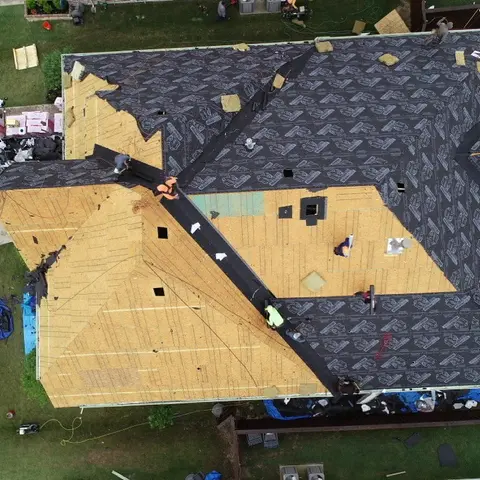 Roofing materialsUnderlayment, Ventilation and Decking: The Parts of a Texas Roof You Don't SeeUnder the shingles on a Texas roof sit the decking (plywood or OSB), underlayment (synthetic or felt), self-adhered ice and water barrier at valleys and other…Read the guide
 Roofing materialsRoof Color, Cool Roofs and Your Electric Bill in TexasYes, a more reflective roof usually lowers cooling costs in a hot climate, but by less than many sales pitches suggest. The U.S. Department of Energy…Read the guide
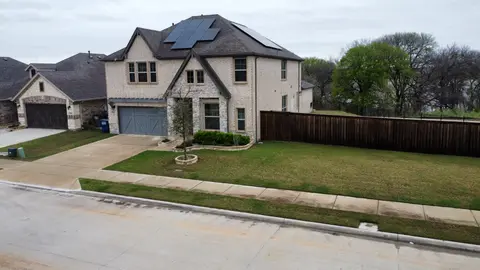 Gutters, siding, paint & solarSolar Panels and Your Roof: Replace First, Costs and Incentives in TexasIf your roof is within several years of replacement, replace it before installing solar, because panels must be removed and reinstalled to reroof later; Fixr puts…Read the guide