

Why Is My Mortgage Company on My Roof Insurance Check in Texas?
 By Chris Grimes, owner of Verde RoofingPublished November 14, 2026 · 12 min read

In short
Your mortgage company is on the roof insurance check because your mortgage requires the home to be insured for the lender's benefit, so the insurer pays you both. In Texas, Insurance Code chapter 557 gives a lender that holds the money 10 days to tell you every requirement for release, and 10 days to release funds or explain a refusal once you ask with proof. Call the servicer before you sign anything.
Key takeaways
- The Consumer Financial Protection Bureau says insurers generally pay a home claim with a check made out to both you and your mortgage servicer, because most mortgage agreements require it.
- Texas Insurance Code §557.002 requires a lender holding claim money to tell you each requirement for release within 10 days of receiving the payment.
- Under §557.003 the lender has 10 days after your request to release the funds if you have met its requirements, or to explain specifically why not; §557.004 sets interest at 10 percent a year if it misses those duties.
- Servicers commonly release the money in stages: part before work starts, more as work progresses and the rest after a final inspection.
- Line up the roofer's payment schedule with the servicer's draw schedule before you sign the roofing contract, and remember the deductible is still yours to pay.
The insurance check for your roof finally arrives, and there is a second name on the “pay to the order of” line: your mortgage company. Your bank will not take it with only your signature. The roofer is ready to schedule. And the company that collects your house payment every month suddenly has a say in when the roof gets built.
This is normal, it is legal, and it is manageable if you start the lender's process the same day the check arrives. Here is why it happens, what Texas law requires of the lender, and how to keep the money moving in step with the work.
Why is the mortgage company's name on the check?
Because your mortgage says so. When you took out the loan, you agreed to keep the home insured and to name the lender on the policy. That clause, usually called the mortgagee clause or loss payee clause, appears on your declarations page with the lender's name and loan number. The house is the lender's collateral, and a house with a failed roof is worth less than the loan assumed.
The Consumer Financial Protection Bureau (CFPB) describes the result in plain terms: your homeowner's insurance company generally pays your settlement with a check made out to both you and your mortgage servicer or lender, and most mortgage agreements require this to protect the lender's interest.
The Texas Department of Insurance (TDI) says the same thing from the Texas side. If you have a loan on your house, the company will usually send the check to your mortgage company, and you then work with the mortgage company to get the money released for repairs.
Two terms you will hear:
- Servicer. The company you send payments to. It may not be the lender that made the loan, and it handles the insurance money on the loan owner's behalf.
- Loss draft. The servicer's name for an insurance claim check. Most servicers have a loss draft or insurance claims department with its own phone number and document packet.
What does Texas law require the lender to do?
Texas does not leave the timing entirely to the servicer. Insurance Code chapter 557 covers a claim for damage to residential real property that is paid to both the insured and a lender, where the lender holds all or part of the money until repairs are done. The statute defines residential real property as a single-family house, a duplex, triplex or fourplex, or a condominium or cooperative unit.
The duties, section by section:
- §557.002: tell you the rules within 10 days. The lender must notify you of each requirement you have to meet for it to release the proceeds, no later than the 10th day after it receives the payment.
- §557.003: answer a release request within 10 days. No later than the 10th day after it receives your request for release of all or part of the money, the lender must either release the funds, if it has received sufficient evidence that you met its requirements, or send a notice that explains specifically the reason for refusing and each requirement still to be met.
- §557.004 and §557.005: interest if it does neither. A lender that fails to give the required notice or to release the money as required owes you interest at 10 percent a year on the proceeds it holds. For a missed notice, interest runs from the date the lender received the money. For a late release, it runs from the date the lender received sufficient evidence of compliance.
- §557.006: one exception. No interest is owed on proceeds applied to reduce the note under the terms of the deed of trust.
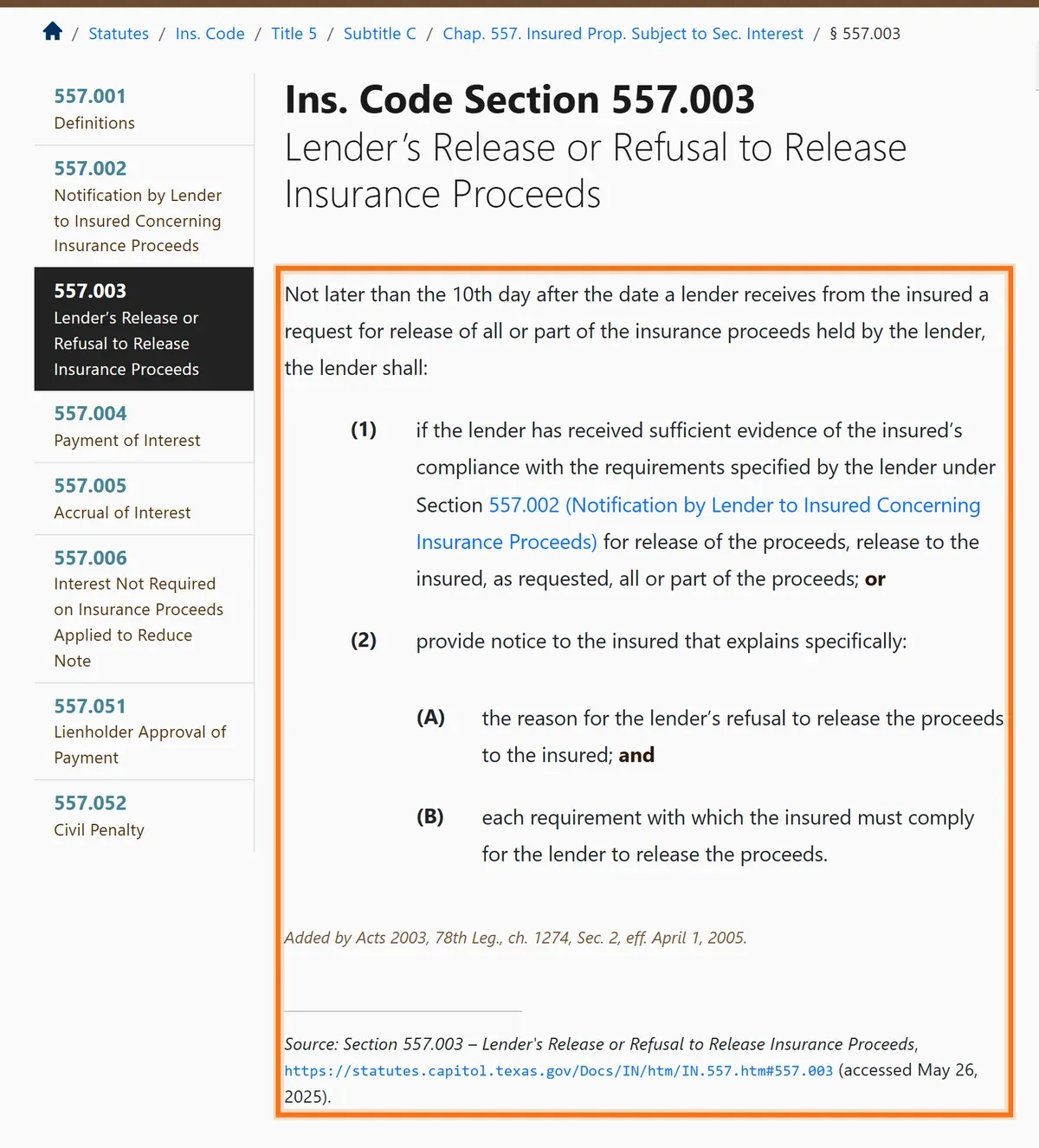
TDI's disaster claims FAQ puts it in one line: the mortgage company must get in touch with you within 10 days of getting the check, and once you have met its requirements it has 10 days to send you the money.
Notice what the statute does not do. It does not tell the lender what its requirements may be, and it does not require the whole amount in one payment. It makes the lender state its requirements quickly, respond quickly, and pay interest when it does not. Your loan documents and the servicer's written requirements govern the rest, so read them.
How do you get the check endorsed? A practical checklist
Start this the day the check arrives. Nothing here needs the roof to be started.
- Do not sign or deposit yet. Photograph the front and back of the check and the insurer's letter and estimate that came with it.
- Call the servicer's loss draft department. Use the number on your mortgage statement and ask for insurance claims. Give your loan number, the insurer's claim number and the check amount.
- Ask the five questions that decide everything: Is this an endorse-and-return claim or a monitored claim? What is the threshold? Which documents do you need from me and from my contractor? How many disbursements, at what stages? How will each be made out and delivered?
- Ask for the requirements in writing. Texas law requires the list within 10 days of the lender receiving the payment. Note the date you mailed or uploaded the check.
- Send the check the way the servicer says. Many want it endorsed by every borrower on the loan and sent by tracked mail or deposited at a branch. Keep the tracking number.
- Submit the full document packet at once. Partial packets are the most common cause of delay.
- Request each release in writing and keep the date. The 10-day response clock in §557.003 starts when the lender receives your request.
- Keep making your mortgage payments. The CFPB reminds borrowers that payments are still due while the claim is being paid out, and a loan that falls behind usually gets stricter handling of the money.
If the first check has already been through this once, expect the same route for the second. Our guide to recoverable depreciation and the second insurance check explains when that payment is released by the insurer.
Which documents do servicers usually ask for?
Every servicer has its own packet, and its written list is the only one that counts. These are the items that commonly appear, so you can gather them while you wait:
- From the insurer: the adjuster's estimate or claim worksheet showing the scope, the replacement cost, the depreciation held back and your deductible.
- From you: the endorsed check, a signed statement that you intend to repair, and sometimes a form naming your contractor.
- From the roofer: the signed contract and estimate, a W-9, proof of liability insurance, and at the end a signed lien waiver and a certificate or statement that the work is complete.
- At the end: an inspection by the servicer's inspector, or dated completion photos if the servicer accepts them.
Texas has no state roofing license, so if a servicer's form asks for a contractor license number, ask what it accepts instead. Our guide on what to check in place of a Texas roofing license lists the registrations and insurance documents a legitimate roofer can produce.
The estimate the servicer receives should match the job being built. If hidden damage turns up during tear-off, such as rotten decking, the insurer may be asked for more through a roof insurance supplement, and the servicer will want the revised paperwork too.
How is the money released: one payment or stages?
This is where homeowners get surprised. The CFPB describes the usual pattern: the servicer typically releases part of the settlement before work begins so you can hire a contractor, more when the work is partly finished, and the rest once the job is finished and passes inspection.
The four situations you are likely to meet look like this:
| Situation | When it applies | What the servicer typically asks | What it means for the roofer's payment schedule |
|---|---|---|---|
| Endorse and return | Smaller claims on a loan in good standing, at the servicer's own threshold | The check, the insurer's estimate, sometimes a short form | The whole amount is in your hands early. A normal deposit and balance on completion work. |
| Monitored claim, staged draws | Larger claims, or any claim above the servicer's threshold | Full packet, then an inspection before later draws | The first draw has to cover the deposit and materials; the last draw arrives after the final inspection, not on completion day. |
| Loan behind on payments | The loan was delinquent when the damage happened | Stricter terms and smaller releases against inspected progress | Tell the roofer before signing. Expect more inspections and slower draws. |
| No lender on the check | No mortgage, or a paid-off loan still listed on the policy by mistake | Nothing, or a payoff letter so the insurer can reissue the check | Ordinary schedule. Ask your agent to remove a paid-off lender from the policy. |
How to read this: the row you are in is decided by the servicer and your loan, not by the roofer or the insurer, and you find out by asking. Find out before you sign the roofing contract, because the contract's payment terms have to fit the row.
For one concrete example of how these thresholds can look, Fannie Mae's Servicing Guide (topic B-5-01, Insured Loss Events) tells servicers of the loans it owns that when a loan is current or less than 31 days delinquent, the servicer is authorized to release an initial disbursement of up to the greater of $40,000, 33 percent of the insurance proceeds, or the amount by which the proceeds exceed what is owed on the loan, and to disburse the remainder based on periodic inspections of the repair work. That is Fannie Mae's instruction to its servicers, not a law and not a promise about your loan. FHA, VA and privately held loans follow their own rules.
For scale: a typical single-family re-roof in Dallas–Fort Worth often falls under a figure like that, while a large home with a tile, slate or metal roof may not. Our guide to what a new roof costs in Dallas–Fort Worth shows the published ranges.

How do you line the lender's draws up with the roofer's payment schedule in Texas?
A roof replacement usually takes a day or two. A servicer's process takes weeks. The mismatch is the whole problem, and it is solved on paper before the crew arrives.
Tell the roofer on day one that a lender is on the check. When I write an estimate for an insurance job, I ask about the mortgage early for exactly this reason: the payment terms that suit a homeowner holding the full check do not suit one waiting on a third draw.
Write the schedule into the contract. It should state:
- The deposit amount and when it is due, set no higher than the servicer's first draw can cover.
- That the balance is due when the servicer releases the final draw after its inspection, with an outside date, not on the day the crew finishes.
- Which completion documents the roofer will provide and when: final invoice, lien waiver, completion statement, photos.
- That the roofer will make the roof available for the servicer's inspector.
- Your deductible as a separate line that you pay.
Do not pay in full up front. TDI's storm claim tips say it directly, and a monitored claim is the wrong moment to ignore it. Our list of roofing contract red flags covers the other payment terms to watch for.
The deductible stays yours. A servicer's delay does not change Texas law: a contractor may not pay, waive, absorb or rebate your deductible, and the insurer can ask for proof you paid it before releasing withheld depreciation. See why no roofer can legally waive your deductible in Texas.
Order the steps. Check received, servicer called, requirements in writing, contract signed with matching terms, first draw, work, completion documents, final inspection, final draw, then the depreciation request to the insurer. Our step-by-step guide to a Texas roof claim shows where each of these sits in the whole process.
If you would like the payment terms looked at before you sign, call or text us at (214) 687-1951 and bring the servicer's requirement letter.
What if the roof is leaking while the lender holds the money?
Do not wait for a draw to stop water coming in. TDI says it is generally fine to make temporary repairs, to photograph the damage first and to keep the receipts, because the policy should pay for the materials and labor. An emergency roof tarp is a temporary repair, and its invoice goes to the insurer, not through the servicer's draw schedule.
Wet ceilings and insulation are a separate trade and often a separate part of the claim. If the leak reached the inside of the house, read who repairs wet insulation and ceiling damage after a roof leak so the interior scope is in the paperwork the servicer sees.
What if the mortgage company is slow or refuses to release the money?
Work up this ladder, in writing each time:
- Ask for the requirement list if you do not have it, citing Texas Insurance Code §557.002 and the date the lender received the check.
- Send a dated release request with your evidence attached, citing §557.003. Ask for a specific written explanation of anything still missing.
- Escalate inside the servicer to a supervisor in the loss draft department, and send the same letter to the address your mortgage statement gives for written disputes.
- Submit a complaint about the servicer to the CFPB, which takes mortgage servicing complaints.
- Ask about interest. If the notice or the release was late, §557.004 sets interest at 10 percent a year. TDI can explain how the insurance side works on its Help Line, 800-252-3439.
- Talk to a Texas attorney if a large sum is being held without a specific reason.
Most delays are not refusals. They are a missing signature, a missing W-9 or an inspection nobody scheduled. A dated list of what you sent, and when, resolves most of them.
Where does Verde fit?
We inspect the roof, document the damage with photos, meet your insurer's adjuster on site to show what we found, and write the repair estimate. On a job with a lender on the check, we give you the contractor documents your servicer asks for, explain the forms, and set payment terms that follow the servicer's draws. The claim and the loan are yours: you deal with your insurer and your servicer, and we make sure the roof and the paperwork from our side are right. More on our insurance claim help page.
Got a two-party check and a roof to build?
Call or text (214) 687-1951, 24/7, or book a free roof inspection. Bring the insurer's estimate and the servicer's letter, and Chris will walk you through a written estimate and a payment schedule that fits both.
Questions people ask next
Can I just deposit an insurance check that has my mortgage company's name on it?
Not without the lender's endorsement. A check payable to you and the mortgage company needs both payees. Banks routinely refuse or reverse a two-party check with one endorsement missing. Call the servicer's insurance claims or loss draft department, ask for its instructions in writing, and follow them. Never sign the lender's name yourself.
How long can a mortgage company hold my roof insurance money in Texas?
Texas Insurance Code chapter 557 sets two 10-day clocks for residential property. The lender must notify you of each requirement for release within 10 days of receiving the payment. After you request release, it has 10 days to release the money if you have shown compliance, or to explain specifically what is missing. Missing those duties costs it 10 percent a year in interest.
Will the mortgage company send the money straight to my roofer?
It depends on the servicer. Some issue draws payable to you, some to you and the contractor jointly, and some pay the contractor directly at the final draw. Ask at the start how each disbursement will be made out and how it is delivered, and give that answer to your roofer before the contract is signed.
Does the second insurance check for depreciation also go through the mortgage company?
Often, yes. If the insurer names the lender on the first check, expect the recoverable depreciation check to carry the same payees. Tell the servicer early that a second payment is coming after the work is done, and ask whether it will be handled under the same claim file so you do not start the paperwork over.
My claim is small. Does the lender still have to inspect the roof?
Each servicer sets its own thresholds, usually based on the claim amount and whether the loan is current. Many simply endorse and return smaller checks, while larger claims go into a monitored account with inspections. Do not assume which group you are in. Ask the servicer and get the answer in writing.
Can my roofer deal with the mortgage company for me?
Your roofer can supply the documents the servicer asks a contractor for, such as the signed contract, the estimate and a W-9, and can be on site for the servicer's inspection. The servicer will usually talk about the loan and the money only with the borrower. In Texas a contractor also may not act for you with the insurer on the claim itself.
Can the mortgage company use my roof insurance money to pay down the loan instead?
Read your deed of trust. Mortgage documents commonly address when insurance proceeds go to repairs and when they may be applied to the debt. Texas Insurance Code §557.006 says a lender owes no interest on proceeds applied to reduce the note under those terms. If a servicer proposes this and you intend to repair, object in writing and ask what the documents require.
Sources
- Consumer Financial Protection Bureau: How do home insurance companies pay out claims?
- Texas Department of Insurance: Homeowners insurance and disaster claims FAQ (claim payments)
- Texas Insurance Code §557.001: Definitions
- Texas Insurance Code §557.002: Notification by Lender to Insured Concerning Insurance Proceeds
- Texas Insurance Code §557.003: Lender's Release or Refusal to Release Insurance Proceeds
- Texas Insurance Code §557.004: Payment of Interest; Rate
- Texas Insurance Code §557.005: Accrual of Interest
- Texas Insurance Code §557.006: Interest Not Required on Insurance Proceeds Applied to Reduce Note
- Fannie Mae Servicing Guide B-5-01: Insured Loss Events (07/12/2023)
- Texas Department of Insurance: After hail or windstorms (claim tips, avoiding fraud)
Chris Grimes owns Verde Roofing in Plano, Texas, a locally owned residential and commercial roofer serving Dallas–Fort Worth. Verde is an NTRCA Accredited Member, an RCAT member and a Dallas Observer Best of Dallas Best Roofer winner (readers’ choice) in 2021, 2022 and 2023.
Keep reading
Related guides
 Insurance claimsHow a Roof Insurance Claim Works in Texas, Step by StepA Texas roof claim runs in order: protect the home, get the roof inspected and documented, report the claim, meet the adjuster, receive the insurer's decision…Read the guide
 Insurance claimsACV vs. RCV: Roof Depreciation and the Second Insurance CheckWith replacement cost (RCV) coverage, the insurer usually pays your roof claim in two checks: first the actual cash value, which is replacement cost minus depreciation…Read the guide
 Insurance claimsYour Roof Deductible in Texas: Why No Roofer Can Legally Waive ItNo. Since September 1, 2019, Texas Business and Commerce Code §27.02 makes it a Class B misdemeanor for a roofer to pay, waive, absorb or rebate…Read the guide