
Who Repairs Wet Insulation and Ceiling Damage After a Roof Leak in DFW?
 By Chris Grimes, owner of Verde RoofingPublished November 13, 2026 · 11 min read
In short
After a roof leak in Dallas–Fort Worth, the work goes in a fixed order and usually to different companies. A roofer stops the water first. A water-damage restoration company dries the attic and ceiling, ideally within the 24 to 48 hours the EPA gives for preventing mold. Wet insulation is then replaced, and drywall and paint come last. A roof repair quote normally covers only the roof.
Key takeaways
- The order is roof first, drying second, insulation third, drywall and paint last; closing a ceiling before the roof has been through a rain risks doing it twice.
- The EPA says to dry water-damaged areas and items within 24 to 48 hours to prevent mold growth.
- A roof repair quote normally excludes interior drying, insulation, drywall, paint and mold work, so ask for the exclusions in writing.
- In Texas, mold assessors and remediators are licensed by TDLR; the small-project exemption for unlicensed work applies to less than 25 contiguous square feet of visible mold.
- The Texas Department of Insurance says most home policies cover sudden and accidental water damage but not gradual leaks or seepage; your own policy governs.
The drip has stopped, or at least it is landing in a bucket. Now you are looking at a stained, sagging patch of ceiling and wondering what is sitting on top of it. The roofer is coming for the roof. Nobody has said who deals with the rest.
It is a fair question, because the answer is usually “not the same company.” This guide lays out who does which part, in what order, what each one needs from the one before, and how Texas mold rules and your insurance policy fit in.
Who does what after a roof leak in DFW, and in what order?
There are five jobs. They are done in this order because each one depends on the one before it:
| Step | Who does it | What they do | What has to be true first |
|---|---|---|---|
| 1. Stop the water | Roofer | Finds the entry point, makes an emergency cover if needed, then the permanent roof repair | Safe access; weather that allows work |
| 2. Dry the structure | Water-damage restoration (mitigation) company, or you on a small leak | Removes wet material that cannot be dried, runs air movers and dehumidifiers, checks moisture readings | Water has stopped coming in; photos taken for insurance |
| 3. Deal with mold, if any | Licensed mold assessor and remediator on larger areas | Assessment and protocol, cleanup, clearance | The moisture source is fixed |
| 4. Replace insulation | Insulation contractor, or the restoration company | Removes what was wet, installs new to the depth of the rest of the attic | Framing and ceiling are dry |
| 5. Repair the ceiling | Drywall finisher and painter | New drywall, tape, texture match, stain-blocking primer, paint | Dry readings, and the roof repair has held through rain |
Read it as a chain. The most common mistake is skipping from step 1 to step 5: the roof is patched, the ceiling is repaired the same week, and wet insulation is left sealed above fresh paint. The second most common is doing step 5 before the roof repair has been tested by weather.
On a small leak caught the same day, steps 2 through 5 can be a fan, a new bag of insulation and a patch. On a leak that ran for hours or went unnoticed for weeks, each step is real work for a different trade.
If water is still coming in right now, start with what to do in the first hour of a roof leak. It covers the bucket, the bulging ceiling and the electrical safety steps this guide assumes you have already taken.
Why does the roofer come first?
Because drying a house that is still getting wet is money spent twice. The EPA puts it simply in its mold guide: if you clean up the mold but do not fix the water problem, the mold problem will most likely come back. The same is true of drywall and insulation.
What the roofer should establish, with photos:
- Where the water gets in. Not where it drips. Water runs along decking and rafters before it shows.
- Whether the decking is damaged under the leak, and how far.
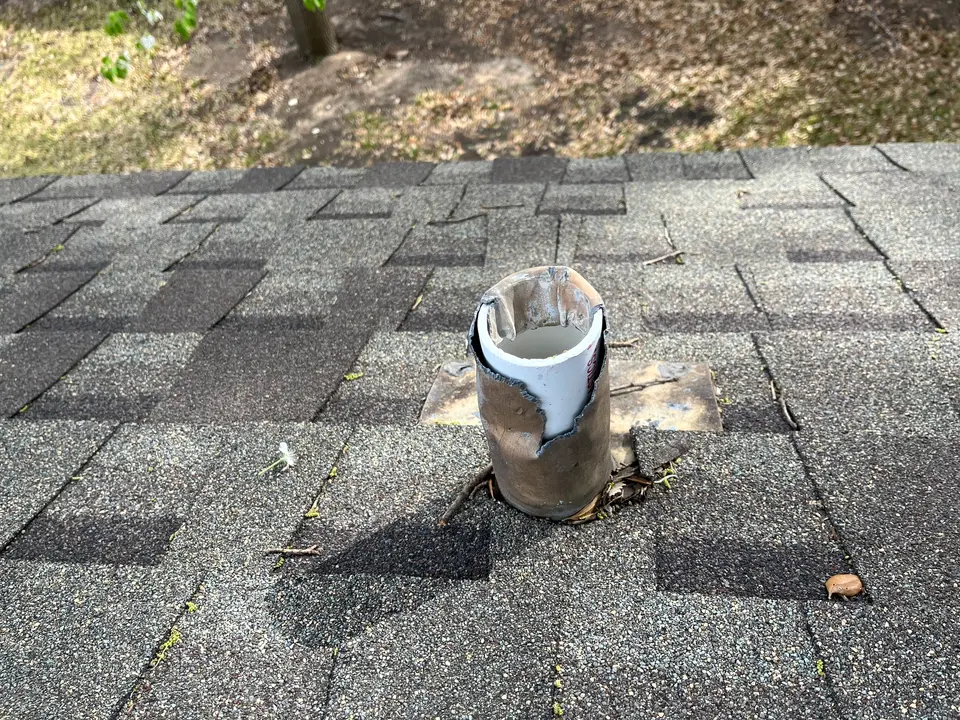
- Whether it is a roof leak at all. Condensation, an air conditioner drain pan and plumbing vents all wet attics. See why an attic is wet when it has not rained.
- What the repair is, and whether a temporary cover is needed until it can be done. Our guide to emergency roof tarping explains what a proper tarp looks like.
When I trace a leak, I go to the attic before I go to the roof. The stain on the underside of the decking tells me where to look on top, and the insulation under it tells me how long it has been going on. Fresh water on clean insulation is one story. Gray, matted insulation with rusty nail tips above it is another.
That difference matters later. A sudden leak and a slow one are treated differently by insurers, and they leave different amounts of damage in the attic.
How fast does it need to be dried out?
Quickly. The EPA's guidance is specific:
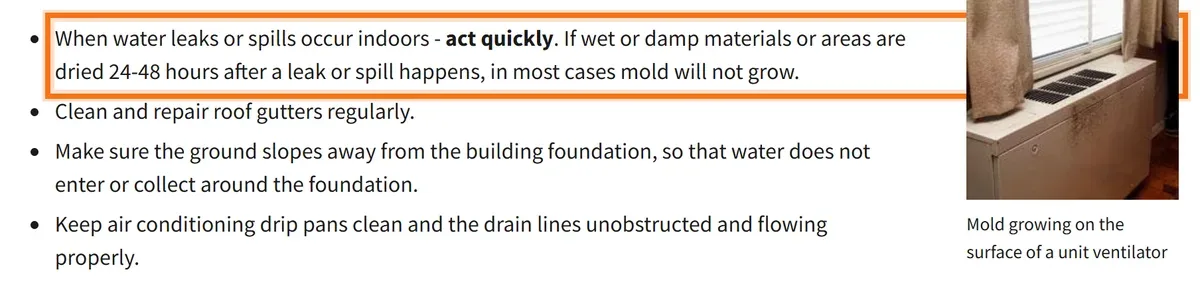
- Water-damaged areas and items should be dried within 24 to 48 hours to prevent mold growth.
- If wet or damp materials are dried within 24 to 48 hours after a leak, in most cases mold will not grow.
The Texas Department of Insurance says the same in plainer words: dry the area as soon as you can, because mold can start growing within a day after a leak.
In a North Texas summer the attic is hot, which helps drying where air can move and does nothing where insulation is packed wet against the ceiling. What you can do safely while you wait for help:
- Photograph everything first: the ceiling, the attic, the wet insulation, any damaged belongings.
- Move wet insulation off the ceiling drywall and into bags, wearing gloves, a mask and long sleeves. Step only on framing.
- Run fans and, if you have one, a dehumidifier in the room below.
- Take down wet ceiling material that is sagging, or let a restoration company do it. A wet ceiling can come down without warning.
- Keep receipts for anything you buy or rent.
Do not go into the attic if the ceiling below is bulging, if water reached light fixtures or wiring, or if you are not steady on joists. An electrician checks wet fixtures before the power goes back on.
What does a roof repair quote normally leave out?
The inside of the house. A roof repair quote is written for the roof: finding the leak, replacing damaged shingles, flashing, underlayment and decking. Unless it says otherwise, assume it excludes:
- Drying and dehumidification
- Removal and replacement of attic insulation
- Drywall, texture and interior paint
- Mold assessment or remediation
- Electrical checks, light fixtures and ductwork
- Flooring, furniture and contents
None of that is a sign of a bad roofer. They are different trades with different equipment and, for mold, a different license. What you want is for the exclusions to be written down so nobody assumes. Ask three things:
- What exactly does your price include, and what does it exclude?
- Will you photograph the attic damage so I have it for insurance and for the next contractor?
- If you find rotten decking, what is the price per sheet? Our guide to roof decking replacement cost explains that line.
Verde Roofing repairs roofs and does exterior painting. We do not do interior water restoration, insulation or drywall, so plan on a separate company for those. For how roof repairs themselves are priced, see roof repair cost, and for what the repair's warranty should and should not promise about interior damage, see how long a roof repair should last.
What are the options for the insulation and ceiling, and what do they cost?
How much interior work you need depends on how much got wet and for how long. These are the four realistic levels. Cost context is from Fixr's water damage restoration guide (updated January 31, 2025), its attic insulation guide (updated September 1, 2022, so treat it as dated) and its roof leak guide (updated January 27, 2026). All are national. The four levels:
| Option | When it fits | What the work includes | What it does not solve | Published cost context |
|---|---|---|---|---|
| Dry in place and watch | Small leak, caught within a day, drywall firm, insulation only damp | Fans, dehumidifier, moisture readings, stain-blocking primer later | Anything that stayed wet or is already moldy | No guide we opened prices this alone |
| Remove wet insulation, cut out damaged drywall, patch | One area soaked; ceiling stained, soft or sagging | Bag wet insulation, cut drywall back to dry edges, dry framing, new insulation, patch and paint | Hidden moisture outside the opened area | Ceiling repairs $325 to $1,100; drywall water damage repair $1.50 to $3 per sq ft; insulation removal $1 to $3 and new attic insulation $2 to $3.25 per sq ft (Fixr) |
| Professional mitigation | Several rooms, a leak that ran for hours, or you cannot dry it within two days | Moisture mapping, removal, drying equipment for days, documentation for the insurer | Rebuilding, which is quoted separately | Water damage restoration $1,200 to $5,000, national average $3,000 (Fixr) |
| Mold assessment and licensed remediation | Visible mold, a musty smell, or materials wet for a long time | Assessment and protocol, containment, removal, clearance report | The leak itself; the roof must already be fixed | Mold remediation $1,500 to $4,000 (Fixr) |
How to read it: the rows are not a menu to pick the cheapest from. Which row applies is decided by how wet the materials are and for how long, and moisture readings settle that better than a glance. What moves the price within a row is the area affected, the height and type of the ceiling, texture matching, attic access and how deep the insulation is.
Fixr's roof leak guide puts the roof side of a moderate leak at $800 to $3,000 and major leaks at up to $8,000. That is in addition to the interior work above.
If you are not sure whether the roof is still letting water in, call or text (214) 687-1951 before anyone closes the ceiling.
Who is licensed to deal with mold in Texas?
Texas regulates this more tightly than most people realize. The Texas Department of Licensing and Regulation (TDLR) licenses mold assessors and mold remediators under Occupations Code chapter 1958. From TDLR's own consumer sheet and FAQ:
- Two separate licenses. An assessor inspects and writes the cleanup protocol. A remediator does the cleanup. A licensee may not do both mold assessment and mold remediation on the same project.
- The homeowner exemption. A homeowner can clean up mold in their own home without a license.
- The 25 square foot line. TDLR's FAQ says the exemption in section 1958.102 applies to people who are not licensed remediators when the mold contamination affects less than 25 contiguous square feet of visible mold, and was meant to let small projects be handled more simply. A licensed remediator who takes a small job still has to follow the rules.
- Clearance. After a licensed remediation, an assessment consultant inspects and issues a passed clearance report.
- The certificate. No later than the 10th day after the project stop date, the remediation contractor must give you a signed Certificate of Mold Damage Remediation. TDLR notes that a certificate showing the cause was corrected prevents an insurer from making an underwriting decision based on previous mold damage, and that sellers must give buyers copies of certificates from the preceding five years.
What that means for a roof leak: a drywall or restoration crew can cut out a small patch with a little visible mold. Once the affected area is large, hiring someone to remove it is licensed work, and the company that tests cannot be the company that cleans. You can check a license at TDLR's online license search.
The EPA's own rule of thumb for doing it yourself is smaller: about 10 square feet, roughly a 3 by 3 foot patch. It also notes that absorbent materials such as ceiling tiles may have to be thrown away if they become moldy.
How is interior damage treated in a Texas insurance claim?
Your policy governs. What the Texas Department of Insurance says in general terms:
- Most homeowner policies cover sudden and accidental water damage.
- Most do not cover water damage from gradual leaks or seepage, and that includes damage from mold.
- Most do not include mold cleanup and testing after a damaged item is removed, unless you added that coverage. Your agent can tell you what is available.
- It is generally fine to make temporary repairs, such as a tarp, but take pictures first and do not make permanent repairs until your insurance company has seen the damage.
- Tell your company as soon as possible.
So the cause matters as much as the damage. A storm that opens the roof and soaks a ceiling overnight is one kind of loss. A pipe boot that seeped for a year is another. The insurer decides which it is, and photos of the roof opening, the attic and the insulation are what that decision is made from. Our guide to documenting roof storm damage shows what to capture.
Practical points:
- Report the roof and the interior together. They are parts of one loss.
- Do not throw away damaged material before it is photographed, and ask the adjuster whether they want to see it.
- Get written estimates from each trade. The roofer's estimate covers the roof. The restoration company and the drywall contractor write their own.
- Keep receipts for tarps, fans, equipment rental and any hotel stay.
The claim is yours. We inspect, document what we find on the roof and in the attic with photos, meet the adjuster on site to show the damage, and write the roof repair estimate. The full sequence is in the roof insurance claim process in Texas, and our insurance claim help page describes our part in it. If the roof was opened by a storm, our storm and hail damage page covers emergency service.
Two related cases have their own guides: a leak on a roof that was just installed, in my new roof is leaking, who fixes it, and repeat leaks on low-slope additions, in why porch, patio and garage roofs keep leaking.
A checklist before the ceiling is closed
- The roof repair is done, and you have photos of it.
- The repair has been through a real rain, or was water-tested, with no new moisture.
- Wet insulation is out, and the framing and drywall edges read dry.
- Any mold was dealt with under the rule that fits its size, and you have the paperwork.
- Your insurer has seen the damage or told you in writing that it does not need to.
- New insulation is in before the drywall goes up, if the attic cannot be reached afterward.
- The painter uses a stain-blocking primer over any remaining discoloration.
Our roof repair page shows what a repair visit includes.
Need the roof side handled first?
Call or text (214) 687-1951, 24/7, or book a free roof inspection. Chris will find where the water is getting in, photograph the roof and the attic for your records, and give you a written estimate that says plainly what it covers and what it leaves to the next trade.
Questions people ask next
Does a roofer fix the ceiling and insulation after a roof leak?
Usually not. A roofer finds where the water gets in and repairs the roof. Drying, insulation, drywall and interior paint are separate trades, and a roof repair quote normally excludes them. Some roofers coordinate those trades for you, so ask. Verde Roofing does roof repair and exterior painting, not interior restoration.
Can wet attic insulation dry out by itself?
A small damp patch caught quickly may dry if the leak is stopped and air can reach it. Insulation that is soaked, matted down or sitting on a wet ceiling holds water against the drywall and the wood, and the EPA's 24 to 48 hour window for drying is short. A restoration company can measure moisture and tell you whether it stays or goes.
How long should I wait to repair the ceiling after the roof is fixed?
Until two things are true: the framing and remaining drywall read dry on a moisture meter, and the roof repair has been through at least one real rain without new water showing. Cutting out the wet section right away is fine and helps drying. Closing it back up and painting is the step that waits.
Do I need a licensed mold company in Texas for a small moldy spot?
Not always. TDLR's consumer sheet says a homeowner can clean up mold in their own home without a license. For hired work, TDLR's FAQ says the exemption in Occupations Code section 1958.102 covers people who are not licensed remediators when visible mold affects less than 25 contiguous square feet. Larger hired projects need a licensed mold remediation contractor.
Will homeowners insurance pay for the ceiling and insulation?
It depends on the cause and your policy. The Texas Department of Insurance says most home policies cover sudden and accidental water damage and do not cover damage from gradual leaks or seepage. It also says most policies do not include mold cleanup and testing unless you added that coverage. Report the damage promptly and take photos before anything is removed.
How much does it cost to fix a water-damaged ceiling from a roof leak?
Fixr's water damage restoration guide, updated January 31, 2025, lists ceiling repairs at $325 to $1,100 and drywall water damage repair at $1.50 to $3 per square foot, with whole water damage restoration jobs at $1,200 to $5,000. Insulation, mold work and the roof repair itself are separate. These are national ranges, not our prices.
Is a brown ceiling stain an emergency if it is dry now?
It is not an emergency, but it is not finished either. A dry stain means water got in at least once, and the insulation above it may still be damp. Have the roof checked before the next rain, and look at the insulation from the attic if you can do it safely. Painting over the stain hides the only warning you have.
Sources
- U.S. EPA: A Brief Guide to Mold, Moisture and Your Home
- Texas Department of Licensing and Regulation: Mold Assessors and Remediators
- TDLR: Mold Assessors and Remediators Frequently Asked Questions (Minimum Area Exemption)
- TDLR: Consumer Mold Information Sheet (PDF)
- Texas Department of Insurance: When are water damage and mold covered by insurance?
- Texas Department of Insurance: FAQ, Homeowners insurance and disaster claims
- Fixr: Water Damage Restoration Cost (updated January 31, 2025)
- Fixr: Attic Insulation Cost (updated September 1, 2022)
- Fixr: Roof Leak Repair Cost (updated January 27, 2026)
Chris Grimes owns Verde Roofing in Plano, Texas, a locally owned residential and commercial roofer serving Dallas–Fort Worth. Verde is an NTRCA Accredited Member, an RCAT member and a Dallas Observer Best of Dallas Best Roofer winner (readers’ choice) in 2021, 2022 and 2023.
Keep reading
Related guides
 Repair or replaceRoof Leaking? What to Do Right Now and How Leaks Get FoundTurn off power to any wet light fixture, catch the water, relieve a bulging ceiling with a small hole over a bucket, move valuables, and photograph…Read the guide
 Insurance claimsHow a Roof Insurance Claim Works in Texas, Step by StepA Texas roof claim runs in order: protect the home, get the roof inspected and documented, report the claim, meet the adjuster, receive the insurer's decision…Read the guide
 Cost & financingHow Much Does Roof Repair Cost? Common Repairs and What Drives the PriceFixr’s 2026 guide puts the average roof repair at about $1,150, with most jobs between $400 and $1,900. Small fixes such as a pipe boot or…Read the guide