A Tree or Large Branch Fell on My Roof in DFW. Who Should I Call?
 By Chris Grimes, owner of Verde RoofingPublished November 10, 2026 · 12 min read
In short
In Dallas–Fort Worth, call 911 first if anyone is hurt, the tree brought down power lines or the ceiling is giving way, and stay out of the rooms under the impact. Then photograph the damage, call your insurer, have a tree service lift the tree off, and have a roofer tarp the opening and inspect. If rafters or trusses are broken, a structural engineer assesses the framing before permanent repairs are planned.
Key takeaways
- Safety comes first: Oncor says any downed line can still be energized, so keep away and call 911; never touch a tree or anything else in contact with a line.
- The Texas Department of Insurance says to photograph the damage before the tree is moved, make temporary repairs to prevent more damage and save every receipt.
- The Insurance Information Institute says that when a tree hits an insured structure, homeowners policies generally pay for removing it up to about $500 to $1,000, depending on the policy.
- If a neighbor's tree falls on your house in a storm, TDI says the neighbor's policy probably will not pay unless the neighbor was at fault, and you can claim under your own policy.
- A tree service removes the tree, a roofer tarps and repairs the roof, and an engineer judges broken framing: Verde does the roofing part, not the tree work.
The sound is unmistakable: a crack, a thud that shakes the house, and then rain or daylight where there should be ceiling. North Texas gives trees plenty of reasons to come down, from spring straight-line winds to ice loading in winter to big limbs that simply fail in summer heat.
What you do in the next hour matters more than anything you do in the next week. The order of calls below is the one that keeps people safe first, protects the house second and keeps your insurance claim clean third.
Who do you call first when a tree falls on your roof?
Work down this list in order. Skip a step only when it clearly does not apply.
- Get everyone out of the rooms under the impact. Close the doors to them if you can do it without walking under the damage.
- Call 911 if anyone is hurt, if the tree brought down power lines or is touching them, if you smell gas, or if the ceiling or a wall is visibly giving way.
- Call the electric utility if lines are down or the service line to the house was torn loose. Stay well away from the tree and the lines.
- Take photos and video from the ground and from inside, once it is safe. Do this before the tree is moved.
- Call your insurer or agent to report the damage and ask what your policy covers for tree removal and temporary repairs.
- Call a tree service to lift the tree off the roof.
- Call a roofer to tarp the opening as soon as the tree is off, and to inspect the roof.
- Bring in a structural engineer if rafters, trusses or ridge framing are cracked or broken.
- Call a water-damage restoration company if rain got into the insulation, ceilings or walls.
Steps 5 through 7 often happen within the same hour, by phone, while you wait. The tree service and the roofer need to coordinate, because the roof is open from the moment the tree comes off.
When is it a 911 call, and what about power lines?
Three things make it an emergency for the fire department, not for a contractor: injury, electricity and gas.
Power lines. Oncor, the utility that delivers power to most of Dallas–Fort Worth, says any power line on the ground, a fence, a car or another object can still be live and is extremely dangerous. Its instructions are to keep away, keep others and pets away, call 911 immediately, and never touch anything or anyone in contact with a line. Oncor explains that electricity from a live wire fans out through the ground, so a person can be shocked just by being near it.
A tree lying across a line is “anything in contact with a line.” That includes the branches on your roof if the same tree is on the wire. Oncor's outage line is 888-313-4747, answered around the clock. If your power comes from an electric cooperative or another utility, use the emergency number on your bill.
The service drop. A falling limb often pulls the overhead service line and the mast off the house without breaking it. Treat it as live. No tree crew or roofer should work near it until the utility has made it safe, and reattaching a mast is a job for a licensed electrician.
Gas. If you smell gas, leave the house, then call 911 and the gas utility from outside.
Inside the house. Stay out of rooms with a sagging, cracked or bulging ceiling. Wet drywall and insulation are heavy and can come down without warning. If water is running near light fixtures or outlets and you can reach the breaker panel safely, switch off those circuits.
One thing never to do: go onto the roof to look. A roof that has just taken a tree may have broken decking or framing under shingles that look intact, and it is often wet.
Who does what: tree service, roofer, engineer and insurer?
Nobody on this list does the whole job, and each one needs something from the one before. Here is how the work divides, with published national cost ranges where a source gives one:
| Who | What they do | What they do not do | Typical published cost | Who usually pays |
|---|---|---|---|---|
| Fire department and utility | Make the scene safe: injuries, live lines, gas | Remove the tree from your roof | None | Public service |
| Your insurer | Opens the claim, sends an adjuster, pays covered damage less your deductible | Hire the contractors for you, in most cases | Your deductible | You pay the deductible; the policy pays covered loss |
| Tree service or arborist | Lifts the trunk and limbs off the structure, often with a crane, and cuts them up | Roof repair or tarping to a roofer's standard | HomeGuide: $400–$1,200 average for ordinary removal; emergency service often 2 to 3 times the standard rate | Policy, up to its tree removal limit when the tree hit the house; you pay the rest |
| Roofer | Emergency tarp, inspection, photos, repair estimate, permanent roof and decking repair | Tree removal, structural engineering, interior drywall | HomeGuide: $175–$700 average for tarping; repairs involving water damage $1,000–$6,000 or more | Policy, as temporary and permanent repairs, if the cause is covered |
| Structural engineer | Assesses broken rafters, trusses, ridge and walls; writes the repair specification | The repair itself | HomeGuide: $300–$900 for an inspection and report | Ask your insurer whether the claim covers it |
| Water-damage restoration | Dries the structure, removes wet insulation and drywall | Roof work | Varies with the area affected | Policy, if the damage is covered |
How to read this: the cost column is national published data, not Verde's prices and not a quote for your tree. The column that surprises people is the tree service row, because the policy's removal limit is often smaller than an emergency crane job. Ask the insurer for that limit on the first call, and get the tree service's price in writing before it starts.
Verde is the roofer in this table. We offer 24-hour emergency service and tarping, and we do the inspection, documentation and roof repair. We are not a tree service, and we do not do structural engineering.
Who pays for tree removal, and what if it was the neighbor's tree?
The Texas Department of Insurance (TDI) answers the common questions on its consumer blog, and the answers are more cautious than people expect.
Damage to the house. TDI says many policies pay for damage from falling objects, like trees, and tells you to call your agent or company to ask if yours will. Your policy governs, including which deductible applies when wind brought the tree down.
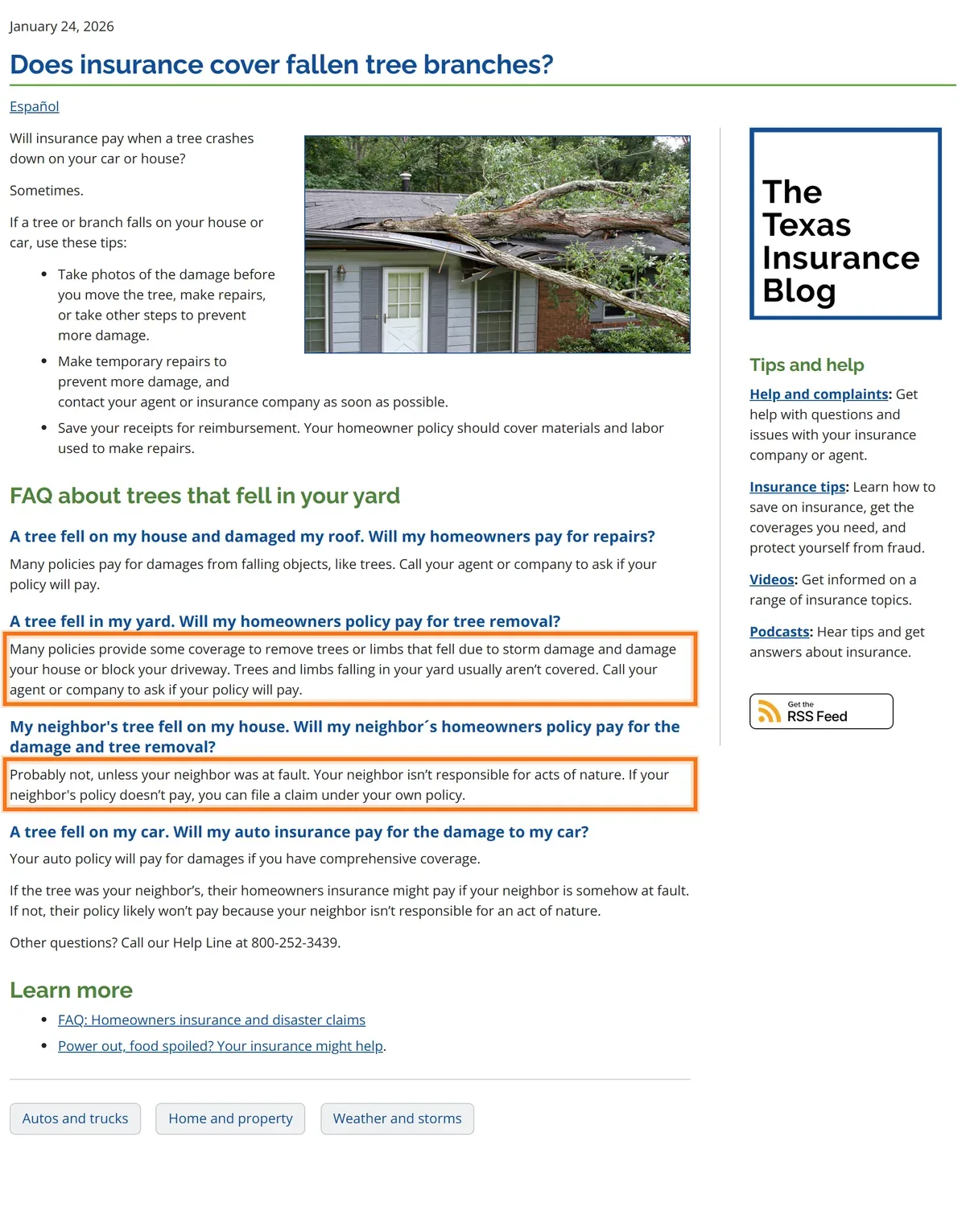
Removing the tree. TDI says many policies provide some coverage to remove trees or limbs that fell due to storm damage and damaged your house or blocked your driveway. The Insurance Information Institute says that when a tree hits an insured structure, the policy covers the cost of removing it generally up to about $500 to $1,000, depending on the insurer and the type of policy.
A tree that missed the house. TDI says trees and limbs that fall in your yard usually are not covered.
The neighbor's tree. TDI's answer to whether the neighbor's policy pays is “probably not, unless your neighbor was at fault,” because your neighbor is not responsible for acts of nature. If the neighbor's policy does not pay, you can file under your own.
What “at fault” means in practice is a question about what the neighbor knew. The Insurance Information Institute explains that in some situations your insurer may try to collect from the neighbor's insurer, a process called subrogation, and that if it succeeds you may be reimbursed for your deductible. That is your insurer's decision to pursue. If you had warned the neighbor in writing about a dead or leaning tree, give that to your adjuster. For anything beyond that, ask a Texas attorney; we are roofers.
If it was your tree that landed on the neighbor's house, the same logic runs the other way: their policy is normally the one that responds to storm damage.
Poor maintenance is a separate issue. The Insurance Information Institute notes that damage from poor maintenance is not covered by homeowners insurance, which is one reason to deal with dead limbs over the roof before a storm does.
What should you photograph before the tree is moved?
TDI's first tip is to take photos of the damage before you move the tree, make repairs or take other steps to prevent more damage. Once the tree is cut up, the evidence of how it landed is gone.
From the ground and from inside, never from the roof:
- The whole tree, from the base or break point to where it rests on the house.
- The base of the tree: uprooted, snapped, or rotten at the break. This matters if fault is ever discussed.
- Each side of the house the tree touches, wide and close.
- Gutters, fascia, siding, windows and fences that were hit.
- Inside: every ceiling, wall and floor with damage or water, and anything the tree or water damaged.
- The attic from the hatch, if it is safe to open, without walking under the impact.
Then keep a simple log: the time it fell, who you called and when, claim number, and every receipt. Our guide to documenting roof storm damage for an insurance claim has the full list.
How is the roof protected after the tree comes off?
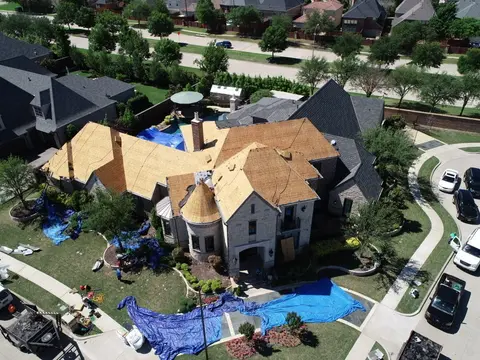
The tree itself is often the only thing keeping rain out. The moment it is lifted, the hole is open, so the tarp crew should be on site or minutes away.
A proper temporary cover does three things: it spans from above the damage to below it, it is fastened to sound framing or decking instead of to broken material, and it sheds water without ponding. Where decking is missing, the opening needs temporary sheathing or a framed support under the tarp, or the tarp will sag and fill. Our guide to emergency roof tarping explains how it should be installed and what the invoice should show.
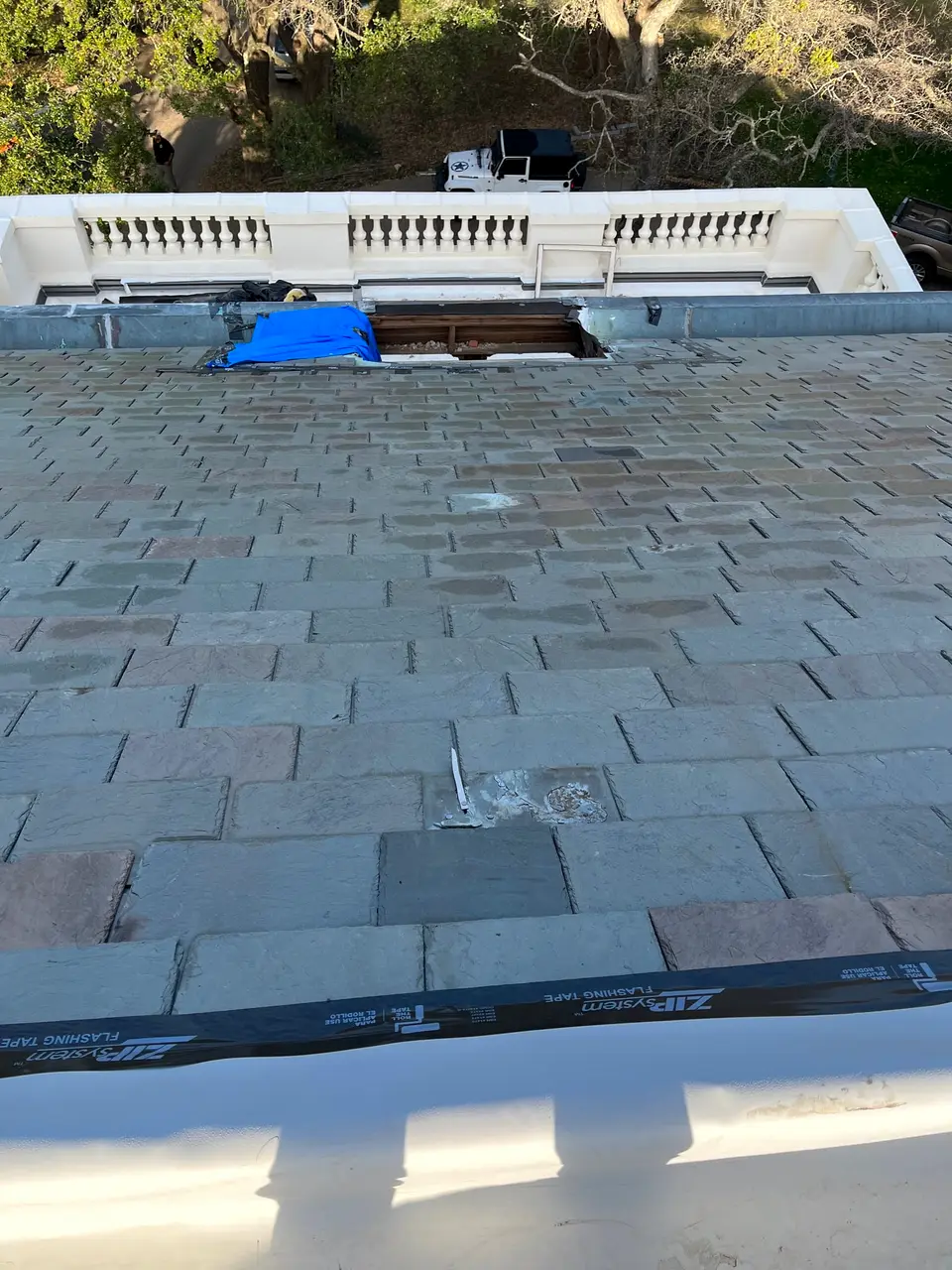
TDI says it is generally fine to make temporary repairs, that you should not make permanent repairs until you have talked to your insurance company, and that you should save receipts because the policy should pay for materials and labor used.
When I get to a roof a tree has just come off, the first thing I check is not the shingles. It is the edges of the hole: whether the decking around it is still nailed to rafters that are still whole. That decides whether a tarp can be fastened there or needs support, and whether an engineer should see it before anyone plans a repair.
If your roof is open right now, call or text (214) 687-1951. We answer around the clock.
What does the inspection have to establish in North Texas?
After the tree is gone and the roof is covered, the inspection has to answer five questions before anyone can write an honest quote.
- Is the framing broken? Cracked or snapped rafters, damaged trusses, a displaced ridge, or a wall top plate that took the load. Trusses are engineered parts: a broken truss is repaired to an engineer's or the manufacturer's detail, not improvised. This is the structural engineer's call.
- How much decking is damaged? Broken, punctured or delaminated sheets, and sheets that got wet. See what roof decking replacement costs in DFW for how that is priced.
- How far does the shingle damage extend? The impact area is obvious. Scrapes, punctures and lifted shingles along the path the tree slid are not. Limbs that whipped across other slopes can crease shingles the same way wind does; our guide to wind damage on roof shingles shows what that looks like.
- What else was hit? Gutters, fascia, soffits, vents, flashing, skylights, siding, windows and fences. Verde also repairs gutters and siding, which helps when one event damaged several parts of the exterior.
- Where did water go? Wet insulation, stained decking, ceilings and walls. Drying and interior repair belong to another trade; see who repairs wet insulation and ceiling damage after a roof leak.
A roof line that dips after the impact, even slightly, is a framing sign and not a shingle problem. Our guide to a sagging roof or wavy shingles explains how to tell the difference and how urgent each is.
Repair one section or replace the whole roof?
Most tree strikes are repairs. A limb through one slope typically means new framing members where needed, new decking over the damaged area, underlayment, and shingles tied into the surrounding roof.
Replacement becomes the reasonable option when:
- Framing damage runs across a large part of the roof, so most of a slope has to be opened anyway.
- Damage crosses several slopes.
- The existing shingles are too brittle to be lifted and woven into, or the product is no longer made, so a repair cannot be tied in or matched. Whether a policy pays for matching is a coverage question for your insurer; our guide on code upgrades and matching on a roof claim explains the terms.
- The roof was already at the end of its life, in which case the insurer pays for the covered damage and you decide whether to add your own money for the rest.
Structural repairs generally need a building permit, which is separate from a re-roof permit. Our guide to roof permits in Plano, Frisco and Dallas covers what each city asks for.
What should be written in the repair quote?
- Structural work: which members are replaced or reinforced, and to whose specification.
- Decking: sheets included and the price per additional sheet.
- Underlayment, flashing and shingles: product, color and how the repair ties in.
- Related exterior items: gutters, fascia, soffit, vents.
- Who pulls permits.
- What is excluded: tree removal, interior drying, drywall and paint, electrical.
- Photos before, during and after.
The insurer's adjuster writes their own estimate. We inspect, document the damage with photos, meet the adjuster on site to show what we found and write our repair estimate. You own the claim and deal with your insurer on coverage; the Texas roof claim process, step by step shows what happens next.
How do you lower the odds of it happening again?
TDI's roof checklist starts with one line: remove tree limbs hanging over or near your roof. Overhanging limbs also show up on TDI's list of property-condition reasons insurers give for not renewing policies.
Have a certified arborist look at large trees within falling distance of the house, especially after drought years, and deal with dead wood before spring storm season. It costs far less than a crane.
More on what we do after a storm is on our storm and hail damage page.
Tree on the roof right now?
If lines are down or anyone is hurt, call 911 first. Then call or text (214) 687-1951, 24/7, for emergency tarping and a roof inspection, or book a free roof inspection once the tree is off. Chris will document the damage with photos and give you a written estimate for the roof repair.
Questions people ask next
Is it safe to stay in the house after a tree falls on the roof?
Not in the rooms under the impact until someone qualified has looked. Stay out if the ceiling is sagging or cracked, if you hear creaking, if you smell gas, or if wires are involved. If the tree only scraped the shingles and nothing came through, the rest of the house is usually usable, but keep people away from the area under the tree until it is removed.
Does homeowners insurance pay to remove a tree from my roof?
Usually some of it. The Texas Department of Insurance says many policies provide some coverage to remove trees or limbs that fell in a storm and damaged your house or blocked your driveway. The Insurance Information Institute puts the typical limit at about $500 to $1,000. Emergency removal off a roof can cost more than that, so ask your insurer for your limit.
My neighbor's tree fell on my roof. Who pays?
In most storm cases, your own policy. The Texas Department of Insurance says the neighbor's policy probably will not pay unless the neighbor was at fault, because a neighbor is not responsible for acts of nature. You file under your own policy and pay your deductible. If your insurer later recovers from the neighbor's insurer, you may get the deductible back.
Should I remove the tree myself before the adjuster sees it?
Do not cut a tree off a roof yourself. A trunk resting on a structure is under load and can shift or roll when cut. Photograph everything first, then let an insured tree service lift it off so the opening can be covered. Insurers expect you to prevent further damage, so you do not need to wait for the adjuster before the tree comes off.
How much does it cost to get a tree off a house?
HomeGuide's national guide puts ordinary tree removal at $400 to $1,200 on average and says same-day or next-day emergency service often costs two to three times the standard rate, with more when a tree is on a structure or power lines. A crane, the tree's size and access to the yard move the price. Get the price in writing before work starts.
Will my insurance cover a tree that fell in the yard but missed the house?
Usually not. The Texas Department of Insurance says trees and limbs that fall in your yard usually are not covered, unless they damaged the house or block the driveway. The Insurance Information Institute says the same and adds that some insurers pay for removal when a tree blocks a driveway or an accessibility ramp. A tree on a fence or shed may be treated differently, so ask.
Does a tree hitting the roof mean I need a whole new roof?
Not necessarily. A limb that damaged shingles and a sheet or two of decking on one slope is often a repair. Replacement comes up when framing is broken across a wide area, when damage crosses several slopes, or when the existing shingles are too brittle or no longer made to match. A close inspection after the tree is off decides it.
Sources
- Texas Department of Insurance blog: Does insurance cover fallen tree branches? (January 24, 2026)
- Texas Department of Insurance: Homeowners insurance and disaster claims FAQ
- Texas Department of Insurance: After hail or windstorms (claim tips)
- Insurance Information Institute: If a tree falls on your house, are you covered?
- Oncor: Keep Away from a Fallen Power Line
- HomeGuide: Tree removal cost
- HomeGuide: Roof tarp cost
- HomeGuide: Structural engineer cost
- HomeGuide: Roof repair cost
Chris Grimes owns Verde Roofing in Plano, Texas, a locally owned residential and commercial roofer serving Dallas–Fort Worth. Verde is an NTRCA Accredited Member, an RCAT member and a Dallas Observer Best of Dallas Best Roofer winner (readers’ choice) in 2021, 2022 and 2023.
Keep reading
Related guides
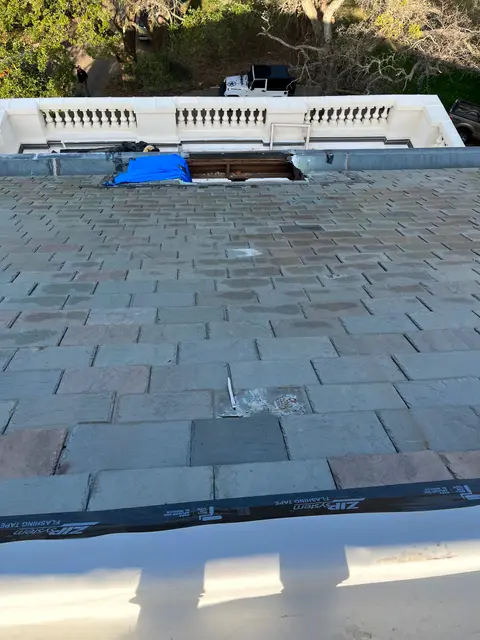 Hail & storm damageEmergency Roof Tarping: When You Need It and How It Should Be DoneYou need an emergency tarp when a storm leaves your roof open or leaking and a permanent repair cannot happen right away. HomeGuide puts the typical…Read the guide
 Insurance claimsHow a Roof Insurance Claim Works in Texas, Step by StepA Texas roof claim runs in order: protect the home, get the roof inspected and documented, report the claim, meet the adjuster, receive the insurer's decision…Read the guide Repair or replaceWho Repairs Wet Insulation and Ceiling Damage After a Roof Leak in DFW?After a roof leak in Dallas–Fort Worth, the work goes in a fixed order and usually to different companies. A roofer stops the water first. A…Read the guide