How Much Does Roof Decking Replacement Cost in DFW?
 By Chris Grimes, owner of Verde RoofingPublished November 16, 2026 · 12 min read
In short
Nobody publishes a verified Dallas–Fort Worth price for roof decking. Fixr's 2026 roof replacement guide lists decking replacement at $2 to $8 per square foot of the area replaced, which works out to roughly $64 to $256 for one 4x8 sheet. On a DFW estimate it should appear as a unit price per sheet or per square foot, agreed before tear-off, because nobody can see the deck until the old shingles are off.
Key takeaways
- Fixr's 2026 guide lists roof decking replacement at $2 to $8 per square foot of the area replaced; one 4x8 sheet covers 32 square feet, so that is about $64 to $256 a sheet.
- Decking damage is hidden under shingles and underlayment, so the fair way to price it is a unit price agreed before the job and a count taken after tear-off.
- Extra decking should be approved in writing before it is covered: photos of each sheet, the count, and the unit price already in your estimate.
- The model residential code requires asphalt shingles to be fastened to solidly sheathed decks, which is why spaced boards on older Dallas homes cannot simply be shingled over.
- Whether insurance pays for decking depends on what damaged it and on your policy; rot from a long, slow leak is usually treated differently from storm damage.
You have a roof estimate in front of you, and somewhere near the bottom is a line about decking. It might say “$X per sheet as needed.” It might say “decking not included.” Or the crew is already on the roof and your roofer has just called to say there is rotten wood under the shingles.
Either way you are being asked to agree to a cost nobody could see when the price was written. This guide explains what that line means, what published cost guides say, and how to keep a decking surprise from turning into an argument.
What does roof decking replacement cost in Dallas–Fort Worth?
There is no verified local average, and we will not invent one. What exists are national published ranges:
- Per square foot. Fixr's roof replacement guide, updated February 4, 2026, lists replacing roof decking at $2 to $8 per square foot of the area replaced.
- Per sheet, by arithmetic. A standard sheet of plywood or OSB is 4 feet by 8 feet, which covers 32 square feet. At $2 to $8 per square foot, one sheet works out to about $64 to $256 installed. That is our multiplication of Fixr's range, not a published per-sheet price.
- As a stand-alone repair. Fixr's roof repair guide, updated January 21, 2026, lists roof decking repair at $150 to $1,000, depending mainly on how much wood is rotten.
These are not Verde's prices. Our price is a written estimate after a free inspection. Ask for the decking unit price to be stated on it.
What moves the number up or down:
- How many sheets. Three sheets at an eave and thirty sheets across a slope are different jobs.
- Panel type and thickness. Thicker panels and plywood generally cost more than thinner OSB.
- Pitch and height. Carrying and setting panels on a steep two-story roof in Frisco or McKinney takes longer than on a low ranch in Richardson.
- What is under the panel. A rotten rafter tail or a cracked rafter is framing work, priced separately.
- Boards versus panels. Replacing individual 1x6 or 1x8 boards on an older home is slower than laying sheets.
- Disposal and permit. In Fort Worth, replacing any decking triggers a permit that a shingles-only job does not need.
For the price of the whole roof, see what a new roof costs in Dallas–Fort Worth, or run the squares through our roof cost calculator. The calculator assumes sound decking, so treat decking as a separate line on top.
How does decking show up on a roofing estimate?
Decking is priced by the unit because the quantity is unknown. These are the four ways the line is usually written:
| How the line reads | What it means | What to check |
|---|---|---|
| Price per sheet (4x8) | Each sheet replaced is billed at that price | Thickness and material named; partial sheets billed how |
| Price per square foot | Billed on the measured area replaced | Who measures, and that you see the measurement |
| Allowance included (for example, a set number of sheets) | That many sheets are already in the price; extra sheets at a stated unit price | The unit price for sheets beyond the allowance, and whether unused sheets are credited |
| “As needed” with no price, or not mentioned | The cost is open | Ask for a unit price in writing before you sign |
Read the table from the bottom up: the last row is the one that causes disputes. Any of the first three is fair if the unit price is written down before the job. A bid that looks cheaper because it leaves decking out is not cheaper. It has only moved the cost to a phone call in the middle of your tear-off.
When you compare two bids, compare the unit price, not just whether decking is mentioned. Our guide on how to read a roofing estimate line by line shows where this line sits among the others, and what a roofing square is explains the measurement the rest of the bid is built on.
Why can't the roofer tell you the decking cost before tear-off?
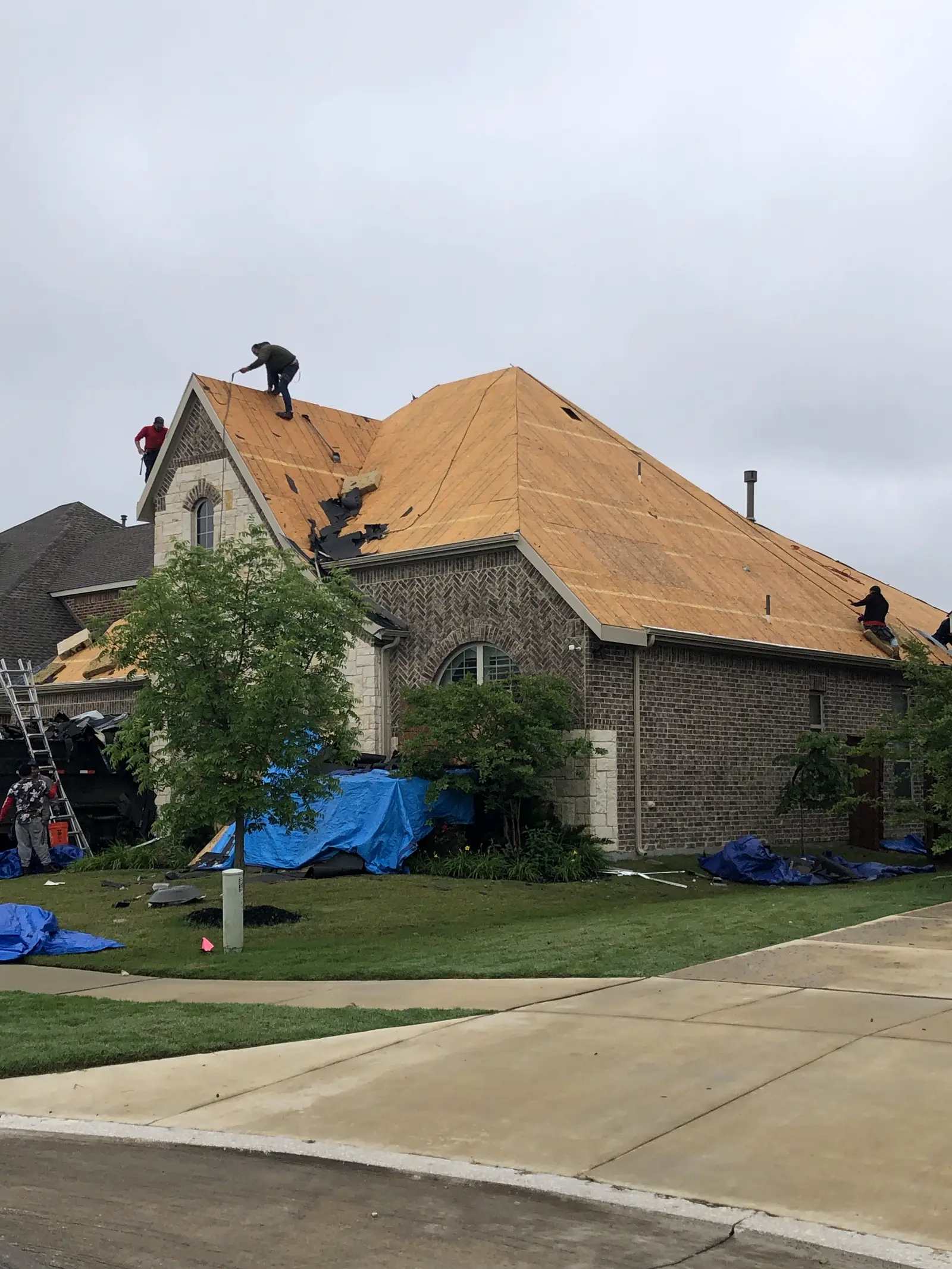
Because the deck is covered on top by shingles and underlayment, and often on the bottom by insulation, radiant barrier foil or a finished ceiling. An inspection can find clues. It cannot count sheets.
What a roofer can check before the job:
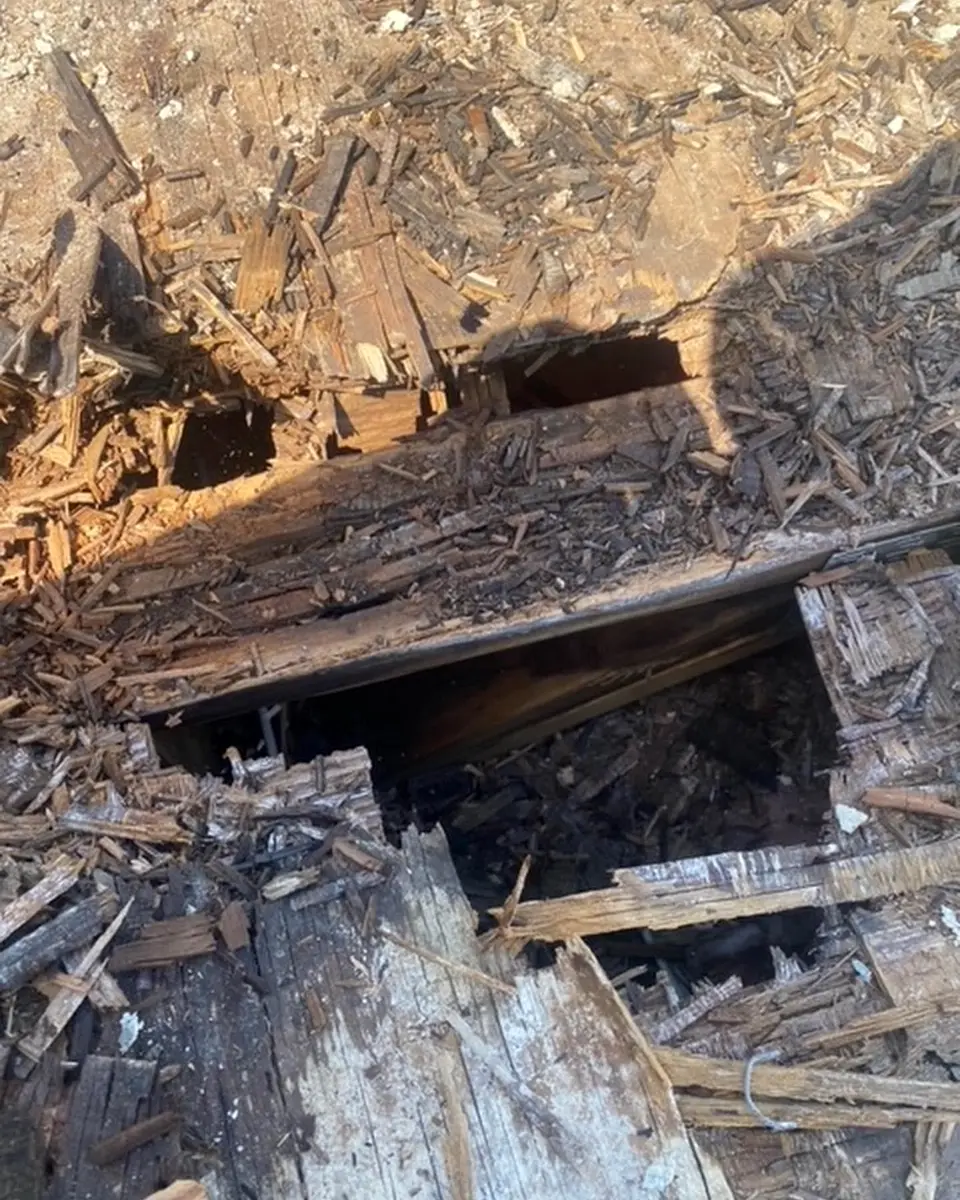
- From the attic: dark stains, mold, sagging between rafters, rusty nail tips, daylight where there should be none.
- From the roof surface: soft or spongy spots underfoot, dips between rafters, shingles that look wavy.
- From the ground: a swayback eave, stained soffits, fascia that is rotting behind the gutter.
When I inspect a roof before a replacement, I walk the eaves, the valleys and the area around every old vent and the chimney, because that is where decking fails first. It tells me whether to expect a few sheets or a lot. It does not tell me the number.
Wavy shingles and dips do not always mean rot. They can come from panel edges that swelled, panels installed without a gap, or framing problems. Our guide to a sagging roof or wavy shingles sorts those causes by urgency. Decking that has lost its grip on nails also shows up as nail pops that lift the shingles. And an attic that is damp when it has not rained points to condensation, which rots decking from below; see why an attic is wet with no rain.
How should extra decking be approved after tear-off?
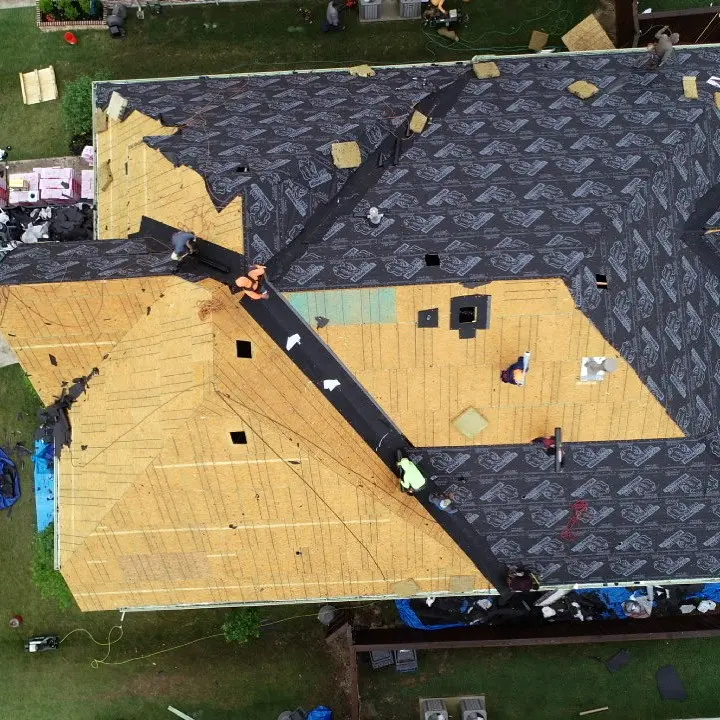
This is the part that protects you. The model residential code says a roof replacement includes removing the existing layers of roof covering down to the roof deck (2021 IRC R908.3), so tear-off is the moment the truth is visible. A fair process looks like this:
- Before the job: the unit price per sheet or per square foot is in the signed estimate, with the panel thickness and material.
- At tear-off: the crew marks every bad sheet before cutting anything out.
- Photos: each marked sheet is photographed, wide enough to show where it is on the roof and close enough to show the rot or delamination.
- The count: you get the number of sheets and the total, in a text or email, before the new panels are covered.
- Your approval in writing: a reply to that message is enough. If you are at work, a roofer should still be able to reach you; give a number you will answer on roof day.
- On the invoice: the decking line shows the count times the unit price you already agreed to. Nothing new.
If the count is much larger than anyone expected, it is reasonable to ask the crew to pause on that slope long enough for you to look at the photos. It is not reasonable to leave a roof open overnight over a disagreement, so settle the method before the job, not during it. Our walk-through of roof replacement day, hour by hour shows where this call usually falls.
Want the decking terms checked before you sign anything? Send us the estimate and we will tell you what the decking line does and does not promise.
Partial or full decking replacement: which options are reasonable?
Here is how the four common scopes compare. Cost context is the Fixr range above applied to the area involved; no guide we could open prices these scopes separately. The four scopes:
| Scope | When it fits | What the work includes | What it does not solve | Published cost context |
|---|---|---|---|---|
| Spot replacement, a few sheets | Rot limited to eaves, a valley, an old vent or one leak | Cut out bad panels to the rafter centers, install matching thickness, nail to code | The cause of the leak if it is not also fixed; hidden damage on slopes not opened | About $64 to $256 per sheet by arithmetic from Fixr's $2 to $8 per sq ft (2026) |
| Section replacement, one slope or a long eave run | Long-term leak, a tree strike, an eave rotted along its length | Same, across a continuous area; fascia and drip edge at that eave checked | Ventilation or condensation problems that caused it | Same range times the area; framing repairs extra |
| Full re-deck | Widespread delamination, deck too thin or damaged to hold nails, fire or heavy storm damage | All panels removed and replaced, panel spacing and clips set, new underlayment | Undersized or damaged rafters, which need a framing repair and sometimes an engineer | A 2,000 sq ft deck at $2 to $8 per sq ft is $4,000 to $16,000 by arithmetic |
| Solid sheathing for an old spaced-board deck | Spaced boards left from a wood shingle roof, or boards with wide gaps | A solid nailing surface built the way your city's code allows | Framing that was sized for a lighter roof; verify before adding weight | Priced per square foot of roof; ask for it as its own line |
How to use this: the first two rows are ordinary and should not alarm you. The last two change the size of the job, and they should be raised before the contract is signed whenever an attic check or the age of the house makes them likely. If a rafter is cracked or the ridge sags, a structural engineer looks at the framing first and the roofer follows that report.
OSB or plywood: does it matter which goes back?
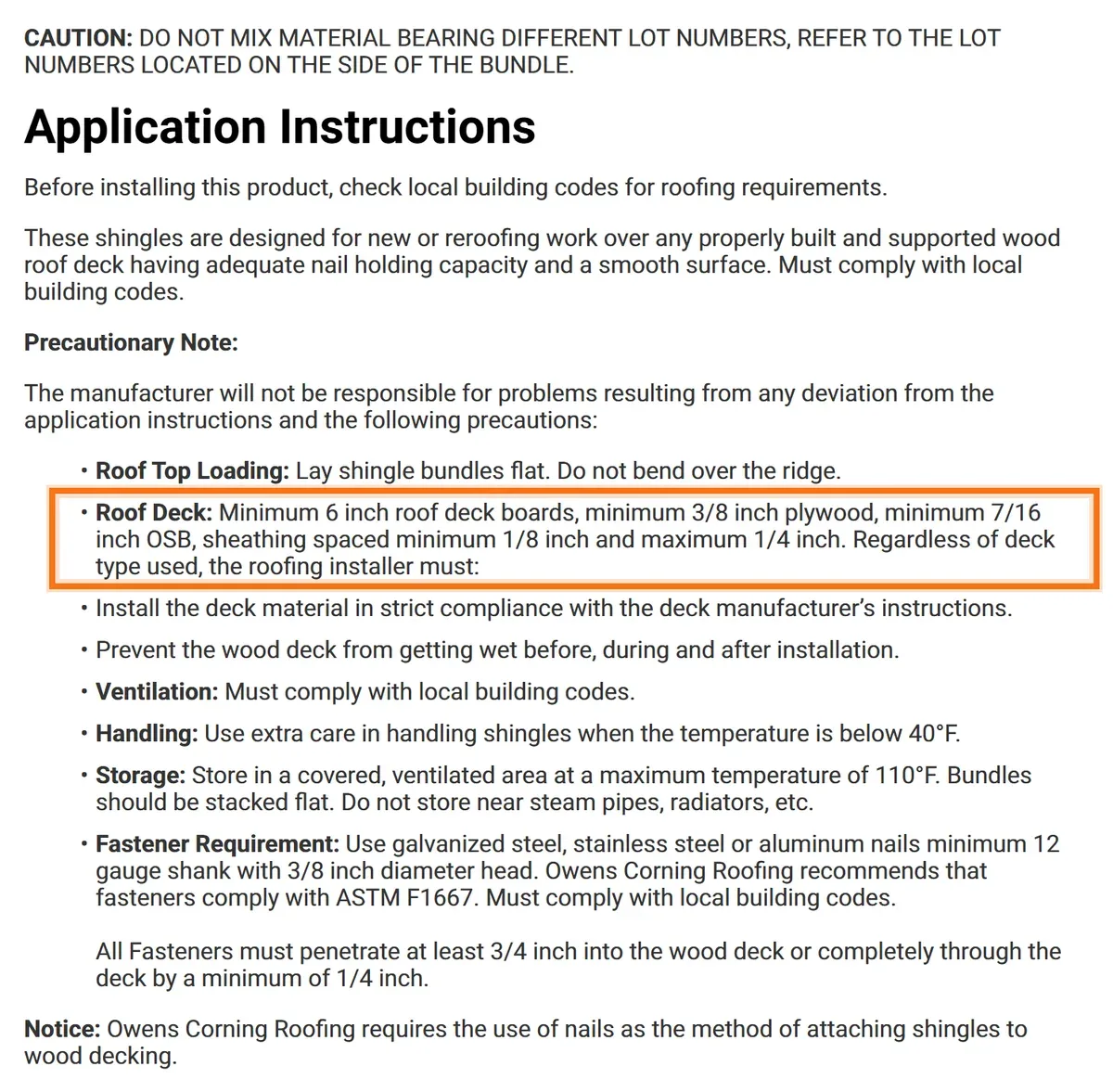
Less than the sales pitch suggests. The 2021 International Residential Code (R803.2) accepts wood structural panels that carry a grade mark and span rating, and that covers both. Owens Corning's shingle instructions set a minimum of 3/8 inch plywood or 7/16 inch OSB.
The real differences are about water. A University of Massachusetts building science article (Paul Fisette, archival) notes that the engineered wood association treats the two as equals in its performance guidelines, but that OSB swells at the edges when it gets wet and that swollen edges can show through asphalt shingles, while plywood dries out faster.
What matters on your roof:
- Match the thickness of the surrounding deck so there is no ridge under the shingles.
- Leave the gap. Panels are spaced so they can expand; panels butted tight can buckle.
- Keep it dry. New panels should be covered with underlayment the same day.
- Name it in the estimate. Material and thickness, so the per-sheet price means something.
Fort Worth's roofing FAQ adds a useful point for older homes: sheathing in good condition does not have to be replaced just because the code has changed since the house was built, and 3/8 inch panels are still allowed on rafters 24 inches apart when the panel's span rating is 24/0. So “your decking is too thin for code” is a claim to verify with your city, not a reason to accept a full re-deck on the spot. For how the deck works with the layers above it, see underlayment, ventilation and decking.
What about plank decking on older Dallas homes?
Many older homes in Lakewood, the M Streets, Oak Cliff and the Park Cities were decked with boards rather than sheets. An IIBEC technical article on board sheathing (L.D. Hogan, 2019) describes the usual condition: boards about an inch thick, originally nailed tight, with gaps of half an inch or more opening as the wood dried over decades. It notes that shingle manufacturers commonly set a quarter inch as the gap limit, and that wider gaps can show through the shingles and leave nails landing in the joint instead of in wood.
Then there are spaced boards, also called skip sheathing: boards laid with deliberate gaps under an original wood shingle or shake roof. The 2021 IRC says asphalt shingles shall be fastened to solidly sheathed decks (R905.2.1). Spaced boards are not a solid deck. A shingle nailed over a gap is held by nothing.
The fix is a solid nailing surface, and how it is built is a local code question:
- The IIBEC article says shingle manufacturers commonly recommend a layer of plywood or OSB, 3/8 inch minimum, over a board deck with problem gaps, and warns that the added weight means the framing should be checked.
- Fort Worth's roofing FAQ, answering a question about panel decking, says the code does not allow a layer of decking to be installed over an existing layer.
Those two statements pull in different directions, so ask the building department in your city which method it accepts on a board deck before the contract is written. On a house like this, the sheathing belongs in the base price, not in a surprise. If you are considering a layover to avoid the question, read new shingles over old in Texas first; a recover leaves the deck uninspected.
Does insurance pay for decking in a Texas roof claim?
Your policy governs, and the cause of the damage matters more than the wood itself.
- Wear and slow leaks. The Texas Department of Insurance says plainly that an insurance company will not pay for a new roof just because it is old or worn out. Decking that rotted over years from a slow leak or poor ventilation usually falls on that side.
- Storm damage. Decking broken by a fallen limb or soaked through an opening a covered storm created is part of that loss to document.
- Found during a covered replacement. When hidden decking damage turns up at tear-off on a claim job, it is documented with photos and the homeowner can ask the insurer to review it. That request is called a supplement, and our guide to what a roof insurance supplement is explains what a legitimate one contains. The insurer decides.
- Code items. Whether your policy pays for work required by current code depends on whether you carry that coverage; see code upgrades and matching in a roof claim.
The claim is yours. What we do is inspect, document the damage with photos, meet the adjuster on site to show what we found, and write the repair estimate. Our insurance claim help page describes that role.
Wet decking is rarely the only wet thing. If a leak reached the attic floor, read who repairs wet insulation and ceiling damage, and if the rot is at the roof edge, rotten fascia and soffits covers what else has to be opened there.
What should the decking clause in your contract say?
Use this as a checklist before you sign:
- The unit price, per 4x8 sheet or per square foot, and the material and thickness.
- How partial sheets and individual boards are billed.
- Whether an allowance is included, and what happens to sheets not used.
- That bad decking will be photographed and the count sent to you before it is covered.
- That work beyond the allowance needs your approval in writing.
- Who pulls the permit if decking replacement triggers one in your city; our guide to roof permits in Plano, Frisco and Dallas lists each city's rule.
- That framing repairs are a separate line with their own price.
Verde Roofing is based in Plano and replaces roofs across Dallas–Fort Worth. Chris inspects the roof with you, checks the attic where he can, and explains what he expects under the shingles before you commit. Our roof replacement page shows what a full replacement includes.
Want the decking question answered before tear-off day?
Call or text (214) 687-1951, 24/7, or book a free roof inspection. You will get a written estimate and photos of what we find. Ask us to put the decking price per sheet on it.
Questions people ask next
How much does one sheet of roof decking cost to replace?
No national guide we could open publishes a per-sheet figure, so the honest answer is arithmetic. Fixr's 2026 guide lists decking replacement at $2 to $8 per square foot of the area replaced, and a 4x8 sheet covers 32 square feet. That is roughly $64 to $256 per sheet installed. Your roofer's own per-sheet price belongs in the written estimate before the job starts.
How many sheets of decking does a typical roof need replaced?
There is no reliable typical number, and anyone who quotes one before tear-off is guessing. Many roofs need none or a few sheets at the eaves, valleys and around old vents. Roofs with long-term leaks, poor attic ventilation or several old layers can need much more. Ask for an attic check before you sign, and a unit price so the count does not matter to the fairness of the bill.
Can a roofer charge me for decking that was not in the estimate?
Only on the terms of your contract. A good contract states a unit price for decking and says how you will be told before extra sheets are installed. If it is silent, ask for that clause before you sign. During the job, ask for photos of each bad sheet and the total count in writing before the underlayment covers it.
Is OSB or plywood better for roof decking in Texas?
Both are accepted by the model code and by shingle manufacturers when they carry the right span rating. A University of Massachusetts building science article notes that OSB edges swell more when they get wet and that plywood dries faster. The practical rule is to match the thickness of the existing deck, keep panels dry during the job, and use the material your estimate names.
Does homeowners insurance pay for rotten roof decking?
It depends on the cause and on your policy. The Texas Department of Insurance says an insurer will not pay for a new roof just because it is old or worn out, and rot from a long, slow leak usually falls on that side of the line. Decking damaged by a covered storm, or found during a covered roof replacement, can be submitted with photos for the insurer to review.
Can new shingles go over old 1x6 plank decking?
Sometimes. Owens Corning's instructions allow roof deck boards, and solid boards in good shape with tight joints can stay. Boards with wide gaps, splits or rot, and the spaced boards left from an old wood shingle roof, do not give shingles a solid nailing surface. Those roofs need the bad boards replaced or the deck re-sheathed in the way your city's code allows.
Does replacing decking require a permit in DFW?
It depends on the city. Fort Worth's roofing FAQ says no permit is needed when only shingles are replaced on a one- or two-family home, but one is required if any decking is replaced. Plano, Frisco, Dallas and McKinney require a permit for a full re-roof anyway. Ask your roofer who pulls it and whether the fee is in the price.
Sources
- Fixr: Roof Replacement Cost (updated February 4, 2026; decking $2 to $8 per sq. ft.)
- Fixr: Roof Repair Cost (updated January 21, 2026; roof decking repair $150 to $1,000)
- Owens Corning: Supreme Shingles Installation Instructions (roof deck requirements)
- 2021 International Residential Code, Chapter 8, Section R803 Roof Sheathing (UpCodes, Texas)
- 2021 International Residential Code, Chapter 9, Sections R905.2.1 and R908.3 (UpCodes, Texas)
- City of Fort Worth: Roofing FAQs (PDF)
- IIBEC: Roof Decks A to Z, Part XII: Board Sheathing (L.D. Hogan, February 2019)
- University of Massachusetts Amherst, Building and Construction Technology: Choosing Between Oriented Strandboard and Plywood
- Texas Department of Insurance: Replacing your roof (last updated April 1, 2026)
Chris Grimes owns Verde Roofing in Plano, Texas, a locally owned residential and commercial roofer serving Dallas–Fort Worth. Verde is an NTRCA Accredited Member, an RCAT member and a Dallas Observer Best of Dallas Best Roofer winner (readers’ choice) in 2021, 2022 and 2023.
Keep reading
Related guides
 Cost & financingHow to Read a Roofing Estimate Line by LineA complete roofing estimate lists the company’s full contact details, the measured squares and waste factor, how many layers come off, the exact shingle line, underlayment…Read the guide
 Insurance claimsWhat Is a Roof Insurance Supplement and When Is It Needed?A roof insurance supplement is a documented request, made on your existing claim, asking the insurer to add work or materials its first estimate left out…Read the guide
 Repair or replaceSagging Roof or Wavy Shingles on a DFW Home: How Urgent Is It?On a DFW home, shingles that look wavy or rippled are usually a surface issue: decking seams showing through, wrinkled underlayment or a second shingle layer…Read the guide