How Do Roofers Find Wet Insulation Under a Commercial Roof in Texas?
 By Chris Grimes, owner of Verde RoofingPublished November 8, 2026 · 12 min read
In short
On a Texas commercial roof, wet insulation is found in two steps. A scan (infrared at night, a nuclear gauge or an electrical impedance meter read on a grid) marks suspect areas. Core cuts in those areas and in dry areas then confirm it. No scan is proof by itself, and each has limits on white, ballasted or thickly insulated roofs. Buy a survey that includes the cores and a marked roof plan.
Key takeaways
- Every nondestructive method (infrared, nuclear, impedance) gives relative readings; the standards behind them call for verification by core cuts.
- Infrared needs a sunny day, then a dry, calm night, and one thermography specialist rates white reflective roofs and heavily ballasted roofs as very difficult to survey.
- Electronic leak detection finds holes in the membrane, not wet insulation; it answers a different question.
- A usable report has a scaled roof plan with marked wet areas, square footage, core locations and results, photos and the weather during the survey.
- The result drives the money: small isolated wet areas are cut out and repaired, while the 2021 International Building Code does not allow a recover over a water-soaked roof.
Two contractors have looked at the same roof. One says the insulation is soaked and everything has to come off. The other says he can lay a new membrane over it. The gap between those two proposals is the biggest number in the whole project, and neither of them has shown you any evidence.
The evidence exists, and you can buy it. A roof moisture survey tells you where the insulation under the membrane is wet, how much of it, and how sure anyone can be. This guide explains the tests on offer, where each one fails, what the report has to contain, and how the result should steer the decision.
Why does wet insulation under the membrane matter?
A commercial low-slope roof is a sandwich: deck, insulation, often a cover board, then the membrane. When water gets past the membrane it does not always show up as a drip. It can spread sideways through the insulation for months.
Professional Roofing, NRCA's magazine, set out the consequences in its October 2023 article “How wet is wet?”:
- Lost insulation value. Wet insulation loses thermal resistance. A long-used benchmark treats insulation as wet and in need of replacement once it has lost 20 percent of its R-value.
- Lost strength. Some facers lose strength when they absorb moisture, and gypsum-based cover boards can degrade irreversibly; the article notes that wet gypsum can no longer resist uplift forces in an adhered roof system, which is a wind problem, not just a leak problem.
- Lost options. Building codes, industry guidelines and good practice generally do not allow a new roof to be laid over a moisture-laden one.
There is a structural side as well. Wet insulation is also heavier than dry insulation, and it keeps water in contact with the deck below. Low spots made by crushed, wet insulation are one of the causes we describe in what to do about water standing on a flat roof.
The same article is frank about a harder point: there is no single agreed number for “wet.” The 20 percent rule would let polyisocyanurate insulation hold about 262 percent moisture by weight, a level the author says gypsum boards and felt facers cannot remotely tolerate. That is why a report with readings but no explanation of how “wet” was defined is not finished.
What can a visual inspection tell you, and where does it stop?
A roofer walking the roof can find a lot without instruments: open seams, punctures, failed flashings, soft or spongy areas underfoot, ponds with dirt rings, patches on patches, and from below, stained deck or ceiling tile. That is the right first step, and it is what Verde's free inspection with photos covers.
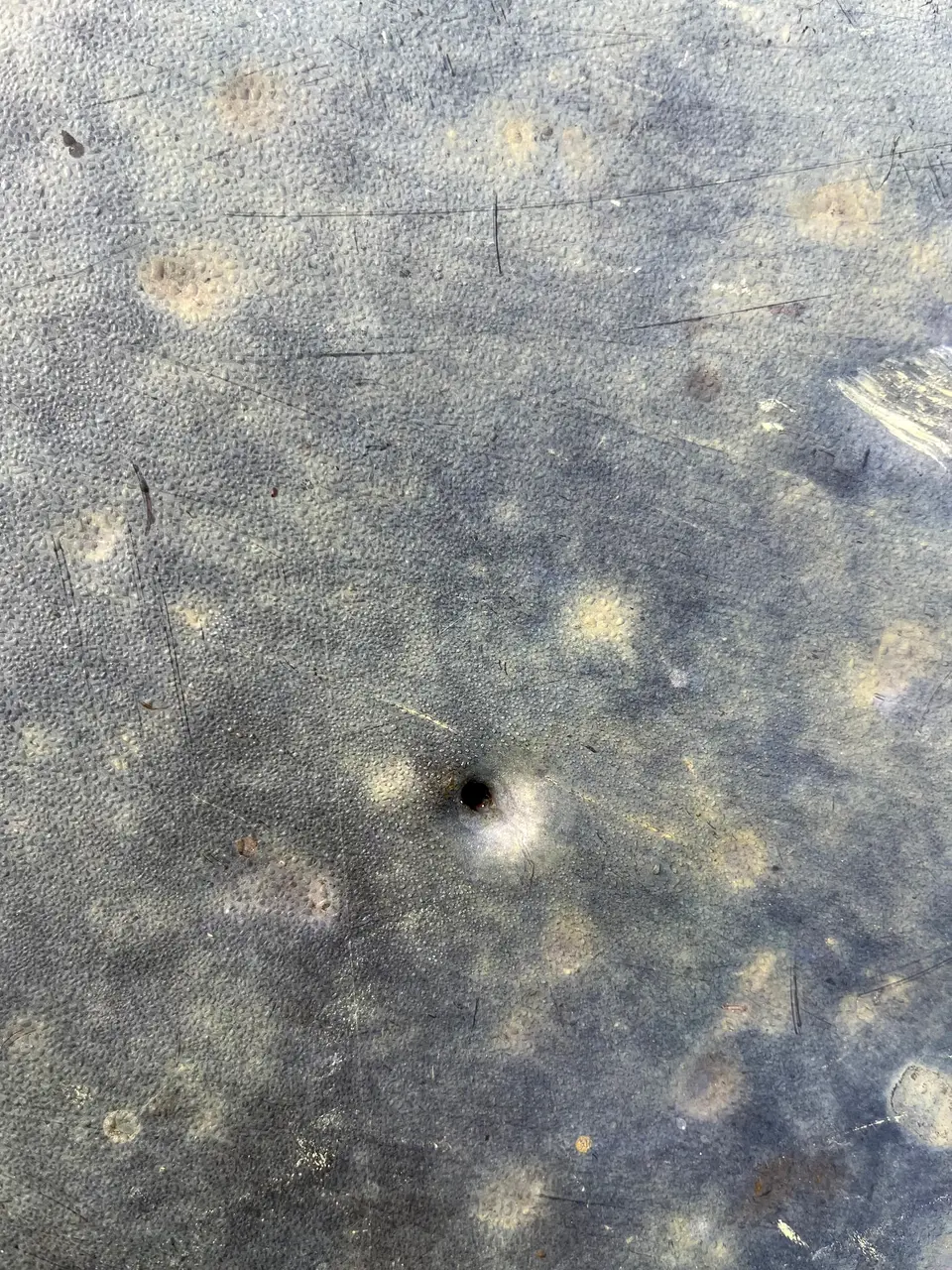
What a visual inspection cannot do is see under the membrane. A roof can feel firm and still hold water in the bottom layer of insulation, and a soft spot can be crushed dry insulation. When the decision is between a repair, a recover and a tear-off, somebody has to measure.
Which tests can an owner buy to find wet insulation?
There are three nondestructive scanning methods, one test that is often confused with them, and one destructive test that verifies all the others. Here is how they compare:
| Test | How it works | Where it struggles | What it gives you |
|---|---|---|---|
| Infrared thermography (ASTM C1153) | At night, after a sunny day, wet insulation holds heat longer than dry insulation and shows as warmer patterns on a thermal camera. Done on the roof, from a high vantage point or from the air | Needs a dry roof, low wind and no rain that night. Very difficult on white reflective membranes, heavily ballasted roofs and roofs over foil-faced insulation; not possible on inverted (protected membrane) roofs or uninsulated roofs | Coverage of the whole roof surface; suspect areas marked with paint and mapped. Not a moisture measurement |
| Nuclear gauge (ANSI/SPRI/IIBEC NT-1) | A gauge with a radioactive source counts neutrons slowed by hydrogen in the roof. Readings are taken on a grid, typically 5 to 10 feet apart | Spot readings can miss a small wet area between grid points. Readings are relative and must be quantified with cores | A grid of numbers showing where readings are high. Works on roofs where infrared does not |
| Electrical impedance or capacitance scan (ASTM D7954) | A meter senses changes in the electrical properties of the roof below it, on a grid or by continuous scanning | Must be calibrated to the roof being scanned. Metal in or under the roof, conductive primers and leak-detection mesh cause false readings. Dense cover boards can hide moisture below them | Qualitative readings that must be correlated with extracted samples |
| Electronic leak detection (ASTM D7877) | An electrical current looks for a path through a hole in the membrane to a conductive deck or layer below | Needs a conductive substrate directly under the membrane. Black EPDM is conductive and needs special methods. Scanning platforms cannot test through ballast or pavers | The location of breaches in the membrane. It does not find wet insulation |
| Core cuts with gravimetric testing | A small section of the roof is cut out, the layers are examined, and samples are weighed, oven-dried and weighed again | Tells you about that spot only. Drying temperature must be controlled or results on gypsum are skewed | The actual moisture content by weight, the roof's construction and the number of existing roofs |
How to read this: the first three rows find suspects, the fourth finds holes, and only the last row finds facts. A survey you pay for should combine one scanning method that suits your roof with enough cores to confirm it, taken in areas that read wet and areas that read dry. If a proposal offers a scan with no cores, ask what the wet areas will be verified with.
Infrared: fast, complete, and picky about weather
Infrared is popular because it looks at 100 percent of the roof instead of sampling it. A published guide by an infrared thermography specialist (Stockton, IRINFO, 2013) says an on-roof crew can survey 25,000 to 100,000 square feet in a night, and gives the conditions plainly: a dry roof, low winds and no rain on the night of the survey, after a day with enough sun to load the roof with heat.
The same guide lists roofs that are very difficult to survey this way, including white reflective roofs, heavily ballasted roofs and roofs over foil-faced insulation, and roofs where it does not work at all, such as inverted roofs with insulation above the membrane and roofs with no insulation. That list matters in Dallas–Fort Worth, where white TPO is a common commercial roof: a white roof takes on less heat during the day, so the difference the camera relies on is smaller. Ask the thermographer directly how they survey white membranes.
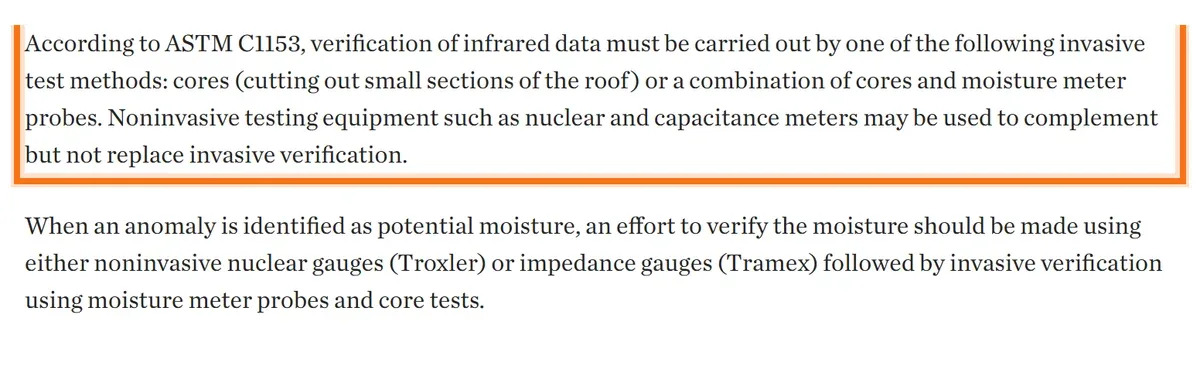
The ASTM practice for infrared roof surveys, C1153, covers night-time surveys of roofs with insulation above the deck, the weather conditions, operator qualifications and verification by invasive test methods. By its own scope it does not determine where the water got in or whether the roof works as waterproofing.
Nuclear and impedance: slower grids, fewer weather limits
Nuclear and impedance scans are read point by point on a grid marked on the roof. The thermography guide notes they are generally used where infrared is not effective, and that they are better at showing a roof is widely wet than at mapping a small repair area; in its example, an infrared survey found an 80-square-foot wet area on a 5,000-square-foot section that 65 grid readings had missed.
Professional Roofing (December/January 2025-26) is clear about what the standards require. For nuclear surveys, field readings are only “relative” and “shall” be quantified by core cuts. For impedance scans, other tools “shall not replace” core sampling. The article's warning is that meters used without the standards produce false positives, and false positives lead to roofs being torn off that did not need to be.
Electronic leak detection: a different question
Electronic leak detection is often offered in the same breath as a moisture survey, and it answers something else: where is the hole? An advisory from IIBEC, the building enclosure consultants' institute, describes it as a nondestructive test that locates breaches in a membrane, and lists what it needs: a membrane that does not conduct electricity and a conductive substrate directly underneath, such as a metal deck, reinforced concrete or a conductive layer installed for the purpose. On many insulated roofs that conductive layer is not directly under the membrane, so ask the testing firm whether the method will work on your assembly before paying for it.
It is the right tool when a roof leaks and nobody can find the entry point, or as quality control on a new roof. It is the wrong tool for deciding how much insulation to replace.
What must a moisture survey report for a Texas commercial roof contain?
A survey is only as useful as its report. Before you hire, ask for a sample, and check that the finished report includes:
- A scaled roof plan with every suspect area drawn on it, numbered, with square footage for each and a total.
- The method and the standard followed, the equipment used, and for grid methods the grid spacing and the baseline reading.
- Survey conditions: date, time, weather that day and the day before, wind, and whether the roof surface was dry.
- Core locations on the plan, in wet and dry areas, with a photo of each core, the layers found (membrane type and thickness, cover board, insulation type and thickness, deck type, number of roofs) and the moisture result.
- How “wet” was defined, and whether moisture content was measured by weight in a lab or estimated with a hand meter.
- Photos: thermal and ordinary images of each area for infrared; marked-up roof photos for grid surveys.
- Limitations, stated plainly: areas that could not be surveyed, and why.
- Who patched the cores, and with what.
Paint marks on the roof are part of the deliverable. They let the repair crew cut exactly where the survey pointed, and they let you check afterward that the wet areas on the invoice match the wet areas on the plan.
Verde's survey capabilities are a fair thing to ask us about on your particular roof. We inspect, document with photos and repair; where the decision needs an infrared, nuclear or impedance survey, we will say so and you can have it done by an independent specialist. An independent report is also easier to hand to a lender, a buyer or an insurer. If you want a first look at the roof before spending on testing, call or text (214) 687-1951.
Who performs the survey, and what should you ask before hiring?
Surveys are done by infrared thermographers, roof consultants and testing firms, and sometimes by roofing contractors who own the equipment. IIBEC's advisory on leak detection makes a point that applies to all of them: results depend heavily on the technician's training and experience, so judge the firm, not the gadget.
Questions worth asking:
- Which method do you recommend for this roof, and why not the others?
- Which standard will the survey follow?
- How many cores are included, where will they be taken, and who repairs them?
- Will moisture content be measured by weight, and by whom?
- What weather do you need, and what happens to the schedule and the price if you do not get it?
- Is the operator trained and, for a nuclear gauge, licensed to use it?
- Is the roof under warranty, and has the manufacturer agreed to the cores?
- Do you also sell roofing? If yes, would you be comfortable with a third party verifying the cores?
We have not found a published national price range for commercial moisture surveys that we would trust enough to print, so we will not quote one. Surveys are normally priced by roof area, method, access and the number of cores; get the price together with the scope in the list above.
How do the results drive repair, recover or tear-off?
The survey does not make the decision, but it removes most of the guessing. The usual reading, with the caveat that the membrane's age and condition count as much as the moisture map:
| Survey finding | What it usually supports | What to confirm first |
|---|---|---|
| A few small wet areas near known leaks; membrane otherwise sound | Cut out the wet insulation, replace it with matching dry insulation, patch the membrane and fix the leak source | That the entry point was actually found and repaired; warranty rules for the repair |
| Scattered wet areas across an older roof | Remove and replace all wet areas, then recover if the code, the deck and the new roof's manufacturer allow it | That every marked area is removed; that the roof has only one existing layer; fastener pull tests if required |
| Wet insulation across large parts of the roof, or wet at the deck | Tear-off to the deck and replacement | Deck condition once exposed; unit prices for deck repair in the contract |
| Dry insulation, leaking membrane | Repair, or restoration options such as a coating if the membrane qualifies | Seam and flashing condition; what the coating manufacturer requires |
How to read this: the more of the roof that is wet, and the deeper in the assembly the water sits, the further down the table you are. The model code draws one hard line. Section 1512.2.1.1 of the 2021 International Building Code does not permit a recover where the existing roof is water-soaked or has deteriorated to the point that it is not an adequate base, or where the roof already has two or more coverings. Texas cities adopt their own editions and amendments, so check with the local building department.
Three companion guides take the decision further: whether a new commercial roof can go over the existing one in Texas, roof coating versus replacement and what drives commercial roof replacement cost. For the membrane defects a survey often turns up along the way, see TPO seams that are opening and blisters and bubbles on a flat roof.
When is a moisture survey worth paying for?
Not every leak needs one. A single leak at an obvious flashing failure on a young roof needs a repair and a check of the insulation right around it. A survey earns its fee when:
- You are choosing between a recover and a tear-off, or between a coating and a new roof.
- Two contractors disagree about how much of the roof is wet.
- The roof has a long leak history, many patches or chronic ponding.
- You are buying the building. Our guide to what a commercial building purchase roof inspection should include explains where the survey fits in due diligence.
- A storm claim is in dispute and the extent of water damage under the membrane is the open question. The survey is evidence you own; your policy governs what it means for coverage, and the commercial hail claim guide covers that process.
- You are about to install solar or new rooftop equipment on an older roof.
Afterward, the cheapest moisture control is keeping water out in the first place: regular checks of seams, flashings and drains under a commercial roof inspection and maintenance program.
Want a first look before you pay for testing?
Verde Roofing inspects commercial roofs across Dallas–Fort Worth from its base in Plano. Call or text (214) 687-1951, 24/7, or book a free roof inspection. You will get photos, a written estimate for the repairs we can see, and a straight answer about whether your decision needs a moisture survey first and what that survey should include.
Questions people ask next
Is an infrared roof scan enough by itself?
No. An infrared camera sees temperature differences, not water. A warm patch at night can be wet insulation, or it can be something else that holds or leaks heat. The ASTM practice for infrared roof surveys includes verification by invasive test methods, and NRCA’s magazine says nuclear and capacitance meters may complement but not replace that verification.
Can a white TPO roof be scanned with infrared?
Sometimes, but it is one of the harder cases. A reflective white membrane absorbs less solar heat during the day, so wet areas show a weaker signal at night. A thermography specialist’s published guide lists white reflective roofs among those that are very difficult to survey. Ask the surveyor how they handle white membranes and whether they would use a nuclear or impedance scan instead.
Do core cuts damage the roof or the warranty?
A core is a small cut through the roof that is patched the same day, and it is how every survey method is verified. On a roof under a manufacturer’s warranty, ask the manufacturer first: its documents may require that cuts and repairs be made by an authorized contractor with its materials, and unauthorized alterations can end coverage.
How much of the roof has to be wet before it must be torn off?
There is no single percentage in the model building code. The 2021 International Building Code bars a recover where the existing roof is water-soaked or has deteriorated to the point that it is not an adequate base. In practice the decision turns on how much is wet, where it is, the membrane’s age and what the new roof’s manufacturer will accept. Get that reasoning in writing.
Who performs a roof moisture survey?
Usually a specialist: an infrared thermographer, a roof consultant or a testing firm, sometimes hired through the roofing contractor. Nuclear gauges contain a radioactive source, so ask about the operator’s licensing. Ask any provider which standard they follow, how many cores are included and who patches them. Verde can inspect the roof and document what is visible, and will tell you when a third-party survey is the right next step.
Will wet insulation dry out if the leak is fixed?
Do not count on it. Insulation sealed between a membrane and a deck has little path to dry. NRCA’s magazine notes that wet insulation loses thermal resistance, that some facers lose strength and that gypsum cover boards can be damaged for good even if they later dry. Wet material found in a survey is normally cut out and replaced.
Should I get a moisture survey before buying a commercial building?
It is one of the few tests that can change the price of the deal, because the difference between a recover and a full tear-off is large. If the roof is older, has many patches or has a leak history, ask for a survey with core verification during due diligence, and ask the seller for any earlier survey reports.
Sources
- Professional Roofing (NRCA): Surveying roof moisture, December/January 2025-26
- Professional Roofing (NRCA): How wet is wet?, October 2023
- IRINFO.org: Finding, analyzing and prioritizing moisture problems using infrared thermal imaging of insulated flat roof systems (G. Stockton, 2013)
- ASTM C1153-23: Standard Practice for Location of Wet Insulation in Roofing Systems Using Infrared Imaging (scope page)
- ASTM D7877: Standard Guide for Electronic Methods for Detecting and Locating Leaks in Waterproof Membranes (scope page)
- IIBEC Technical Advisory 018-2019: Electronic Leak Detection
- 2021 International Building Code, Chapter 15 (Section 1512, Reroofing), UpCodes Texas viewer
Chris Grimes owns Verde Roofing in Plano, Texas, a locally owned residential and commercial roofer serving Dallas–Fort Worth. Verde is an NTRCA Accredited Member, an RCAT member and a Dallas Observer Best of Dallas Best Roofer winner (readers’ choice) in 2021, 2022 and 2023.
Keep reading
Related guides
 Commercial roofingCan a New Commercial Roof Go Over the Existing Roof in Texas?Often yes. Texas has no statewide rule: Dallas, Plano, Fort Worth and other cities adopt their own edition of the International Building Code. The model code…Read the guide
 Commercial roofingWater Standing on a Flat Roof in DFW: Fix the Drain, Add Slope, or Replace the Roof?On a Dallas–Fort Worth commercial roof, water that is still standing 48 hours after rain in drying weather is ponding by NRCA’s definition. Start with the…Read the guide
 Commercial roofingBuying a Commercial Building in DFW: What Should the Roof Inspection Include?Before you close on a commercial building in Dallas–Fort Worth, the roof inspection should identify the roof system and its age, give an opinion of remaining…Read the guide