
TPO Roof Seams Are Opening on a DFW Building: Patch, Re-Weld, or Replace?
 By Chris Grimes, owner of Verde RoofingPublished November 7, 2026 · 12 min read
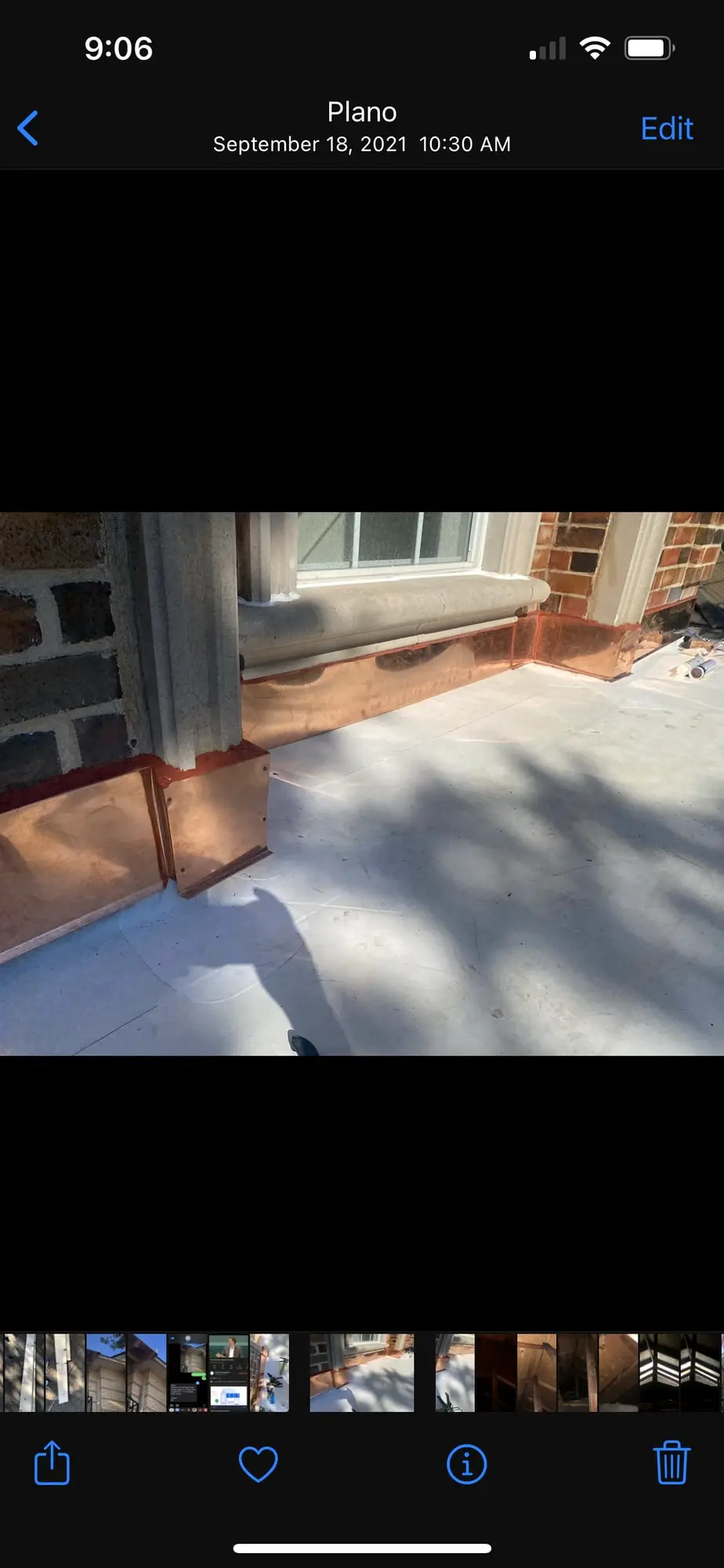
In short
On a Dallas–Fort Worth building, open TPO seams are a repair when they are few, the membrane still welds and the insulation under them is dry: the seam is cleaned and re-welded or covered with a welded strip, by the method the membrane’s manufacturer accepts. When probing finds seams failing across the roof, or the sheet is worn thin or will not take a weld, patching buys little and replacement is the honest answer.
Key takeaways
- TPO seams are hot-air welds; a weld made too cold or too fast can look closed for years and then let go, which the industry calls a cold weld.
- Every seam near an open one should be probed, because the pattern (one spot, one day’s work, or the whole roof) decides the repair.
- Aged TPO can usually still be welded after proper cleaning: a manufacturer study of 20 roofs at least 12 years old found repair welds to aged membrane stronger than an industry average for new membrane.
- Before approving a local repair, check three things: whether the insulation below is wet, whether a warranty controls who may repair and with what, and how much membrane thickness is left over the reinforcement.
- A pressure-sensitive cover strip is a specific product with specific allowed uses; one manufacturer’s data sheet says its strip cannot be used at T-joints or butt joints.
Someone was on the roof to service an air conditioner and sent you a photo: a lap in the white membrane has lifted, and you can slide a finger under it. Or the first sign was a stained ceiling tile, and the roofer who came out found the seam above it open for six feet.
A TPO roof is only one sheet thick, and its seams are what make separate rolls into one waterproof layer. So an open seam is always worth acting on. Whether it is a two-hour repair or the first sign that the roof is finished depends on things you can have checked before you spend much.
Why do TPO seams open up?
TPO seams are not glued. The overlapping sheets are fused with hot air, by a walk-behind automatic welder on the long runs and a hand welder at details. Done right, the two sheets become one: peel a good weld apart and the membrane itself tears before the weld lets go. Most seam trouble starts with a weld that was not done right.
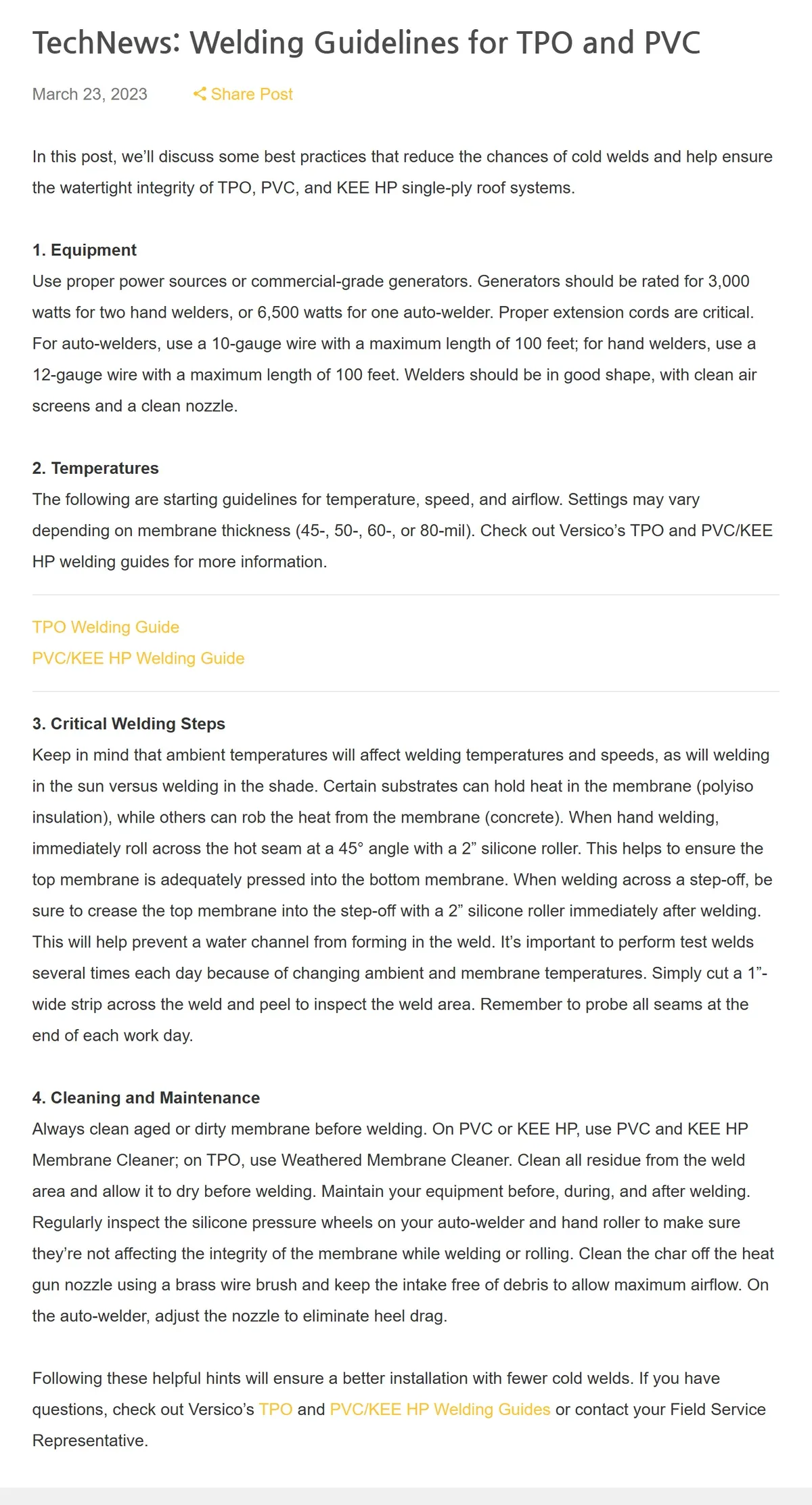
A technical bulletin from Versico, a TPO manufacturer, lists what a crew has to control to avoid what the trade calls cold welds:
- Heat and speed. Settings change with membrane thickness, and with the day: ambient temperature, sun versus shade, and even the surface below (insulation holds heat in the membrane, concrete pulls it out) all shift the right setting.
- Power. Welders need proper generators and heavy enough extension cords, or the temperature drifts.
- Test welds. The bulletin says to perform test welds several times each day because conditions change, by cutting a one-inch strip across the weld and peeling it.
- Probing. It says to probe all seams at the end of each work day.
- Clean laps. Aged or dirty membrane must be cleaned, and the weld area allowed to dry, before welding.
A cold weld is the frustrating kind of defect because it can pass for a good seam. The laps are stuck together, the roof does not leak, and then a few summers of expansion and contraction peel it open. When a roof that is only a few years old starts opening seams, this is the first suspect.
Later in a roof's life, other causes join in:
- Aging. The top layer of the sheet weathers and thins. A sheet that has lost its surface is harder to weld to and easier to crack.
- Stress. Where the membrane has pulled tight toward walls and curbs, the load ends up on the seams and fasteners. Tight, bridging membrane at the base of a wall is worth noting in an inspection.
- Traffic and trades. Foot traffic on laps, dropped panels, dragged equipment. Our guide on how HVAC and other rooftop work damages a commercial roof covers that pattern, and a commercial roof leak near an AC unit explains how to tell a roof leak from a unit leak.
- Standing water. A marginal seam under a pond is tested every time it rains. If the open seam is in a low spot, read what to do about water standing on a flat roof too.
North Texas adds heat. Long runs of days in the high 90s and above, and fast temperature swings when a storm front comes through, mean a lot of thermal movement for a marginal weld to survive.
How do you find out how many seams are affected?
By probing. A seam probe is a blunt, rounded tool that is run along the edge of the lap with light pressure. A sound weld resists it; a void, a cold weld or an unwelded edge lets the tip slip in. It is slow, unglamorous work, and it is the most important line item in a seam inspection.
When I inspect a TPO roof with one open seam, I do not stop at that seam. I probe the laps around it, then the same roll in both directions, then sample the rest of the roof, because what I am really looking for is the pattern.
The pattern is the diagnosis:
- One spot. A single open length next to a unit or along a traffic path points to damage. Repair it.
- One area or one line. Several weak seams in the same part of the roof often point to one day's welding, a welder setup problem or one bad run. Repair every seam in that area, not only the open ones.
- Everywhere. Weak laps found in most places sampled, on an older roof, point to the membrane or the original workmanship as a whole. That is a replacement conversation.
Ask for the result as a marked roof plan with the number of feet probed, the number of feet found open or weak, and photos. “Seams are failing” is an opinion. “Forty feet of weak seam in the northeast section out of 600 feet probed” is a finding you can price and check.
What should be checked before you approve a local repair?
Three things decide whether a repair is money well spent.
Is the insulation under the open seam wet?
An open seam may have been letting water in for months before anyone noticed. Welding it shut over soaked insulation traps the water. At a minimum the roofer should check the area around the opening for softness and cut in where it is suspect; on a larger or older roof, a survey may be worth it. See how roofers find wet insulation under a commercial roof for the tests and what the report should contain. Wet insulation is cut out and replaced with matching dry insulation before the membrane is closed.
Is the roof under a warranty, and what does it require?
If a manufacturer's warranty is in force, it controls the repair. NRCA's technical director wrote in Professional Roofing that on warranted roofs, repairs should follow the warrantor's requirements, and that manufacturers often require their own repair products to keep the warranty in force. Carlisle SynTec's owner's manual, as one example, tells owners to contact the manufacturer once a leak through the roof system is verified, and says alterations must be completed by one of its authorized applicators and reported.
A leak on a warranted roof may also be the manufacturer's or the installer's to fix, not yours to pay for: Johns Manville's summary of its guarantee, for example, says it pays for repairs to stop leaks that result from poor workmanship in applying the guaranteed materials. Check before you authorize anyone. Our guide to what a no dollar limit commercial roof warranty actually covers explains the notice steps, and how long a roof repair should last and what its warranty should cover covers the repair's own warranty.
How much membrane is left?
TPO is a sandwich: a weathering layer on top, a reinforcing fabric (the scrim) in the middle, a core below. What matters for remaining life is the thickness of the top layer over the scrim. A study by GAF researchers published by IIBEC in 2020 measured it on 20 roofs that were at least 12 years old: the 45-mil membranes averaged 18 mils over the scrim and the 60-mil membranes 22 mils, and the authors concluded those roofs had significant remaining life. They also wrote that their data support using thicker membranes for longer performance. Keep in mind who ran the study: it covers one manufacturer's membrane, tested by that manufacturer.
On your roof the practical checks are simpler. Is the scrim pattern showing through, or exposed? Does the sheet crack when it is folded? And the one that settles the repair question: does a test patch weld to it and tear the membrane, not the weld, when peeled?
Patch, re-weld, cover strip or replace: which fits?
Here are the four options a contractor is likely to propose, side by side:
| Option | When it fits | What the work includes | What it does not solve | What to confirm |
|---|---|---|---|---|
| Clean and re-weld the existing lap | Short open lengths; membrane in good condition; lap is clean enough to restore; roof is fairly young | Opening the lap, cleaning both surfaces with the manufacturer's cleaner, drying, hand welding, rolling, probing after it cools | Dirt and oxidation deep in an old lap; a sheet too weathered to fuse; wet insulation below | A test weld on site; whether the manufacturer accepts re-welding an old lap or wants a strip over it |
| Welded cover strip or patch over the seam | The common repair on aged TPO: the old lap is left closed or trimmed, and new membrane is welded over it onto cleaned sheet on both sides | Scrubbing the aged surface, a strip of new TPO centered on the seam, welded along both edges, rounded corners, the manufacturer's detail where seams cross, probing | Membrane that will not take a weld; widespread failure; wet insulation | Compatibility of the new membrane with the old; manufacturer's repair detail; who is allowed to do it under the warranty |
| Pressure-sensitive (peel-and-stick) cover strip with primer | Only where the membrane's manufacturer says it may be used | Cleaning, primer, strip pressed and rolled, per the product data sheet | Uses the product is not approved for; dirty or damp surfaces; cold-weather application without heat | The data sheet. One manufacturer's bulletin says its strip is intended for stripping in flat metal flanges and cannot be used at T-joints or butt joints |
| Recover or replace the roof | Weak seams across the roof; membrane thin, brittle or unweldable; widespread wet insulation | A new roof system: tear-off or recover as code and conditions allow, insulation, new membrane, flashings, edge metal | Nothing, if scoped properly, but it is a capital project | Moisture survey results; code limits on recover; warranty terms on the new roof |
How to read this: the first two rows are true repairs that restore a fused, watertight lap, and on most roofs with a local problem one of them is the answer. The third row is a product decision that belongs to the manufacturer, not the installer. The fourth row is the right answer only when the inspection shows the problem is everywhere, and a contractor who jumps to it without probing results and photos has skipped the diagnosis.
On cost, HomeGuide's flat roof repair guide (updated November 7, 2025) lists TPO membrane repair at $2 to $9 per square foot, a typical leak repair at $500 to $1,200 and flat roof replacement at $3 to $11 per square foot. Those are national figures drawn from small roofs. A commercial seam repair is driven by the feet of seam, travel across the roof, how much cleaning the aged sheet needs, any insulation replacement and warranty requirements.
If you would like the seams on your building probed and the findings put on a roof plan, call or text (214) 687-1951.
How is aged TPO actually repaired?
Old TPO does not weld like new TPO, and repair guidance from the industry is consistent on why: the surface oxidizes and collects embedded dirt, and that layer has to come off first.
- The Western States Roofing Contractors Association published TPO repair and maintenance guidelines in 2011. NRCA's summary in Professional Roofing says they recommend scrubbing repair areas with a relatively abrasive pad and the manufacturer's solvent to remove embedded dirt and restore weldability.
- The same guidelines suggest that where welding to the top surface cannot be achieved, a patch can be placed under the membrane and welded to its underside. NRCA notes this may help on mechanically attached systems.
- The GAF study tested both. New membrane welded to the top of aged sheet averaged about 45 pounds per inch of ply adhesion, and welded to the underside about 59, against an industry average of 40 for new membrane. The authors did not test underside welds on adhered roofs, saying leftover adhesive would make such repairs unreliable.
The study also found something every owner should hear: on two of the 20 roofs the original seams showed no fused bond at all when peeled, which the authors attributed to poor workmanship at installation. Aged welds that were made well were still performing. A seam problem is far more often about how the roof was welded than about TPO as a material.
A repair scope for seams should therefore say, in writing:
- Which seams, by location and length, shown on a roof plan.
- The method for each (re-weld, welded strip, patch) and the membrane brand and thickness used.
- How the old surface will be cleaned.
- That test welds will be made and peeled on site before production work.
- That every repaired seam will be probed after it cools.
- What happens, and at what unit price, if wet insulation is found.
- Whether the manufacturer was notified, if a warranty applies.
- The warranty on the repair itself.
When is replacement the honest answer for a North Texas TPO roof?
When more than the seams are worn out. The signs, taken together:
- Probing finds weak or open laps in most areas sampled.
- Repairs made in the last year or two are opening again, or new seams open next to old patches.
- The scrim shows through the top layer, or the sheet cracks at folds and around fasteners.
- A test weld will not fuse even after proper cleaning.
- A moisture survey shows wet insulation across large areas.
- The roof has already been recovered once, so the model building code does not allow another layer (2021 International Building Code, Section 1512.2.1.1; cities adopt their own editions).
HomeGuide's rule of thumb is to consider replacing a flat roof that is 10 to 15 years old and needs extensive repairs; the GAF data above is a reminder that age alone is not the test, because well-made roofs older than that were still sound. Condition decides.
If the answer is replacement, three guides help with what comes next: whether a new commercial roof can go over the existing one in Texas, what drives commercial roof replacement cost and how TPO compares with other flat roof systems. If the membrane is sound and only tired on the surface, roof coating versus replacement explains when a coating is a real option; open seams must be repaired first either way.
And if the answer is repair, keep it repaired. Seams are on every checklist in a commercial roof inspection and maintenance program, and a spring and fall walk with a probe finds the next weak lap while it is still a small repair.
Want the seams probed before you decide?
Verde Roofing installs and repairs TPO on commercial roofs across Dallas–Fort Worth: offices, convenience stores, warehouses and multi-family. Call or text (214) 687-1951, 24/7, or book a free roof inspection. You will get photos, a plan of what we found and where, and a written estimate for the repair or, if the roof is past repair, a plain explanation of why.
Questions people ask next
Can old TPO be re-welded?
Often, yes. Weathered TPO has to be cleaned first, with the manufacturer’s cleaner and sometimes a mildly abrasive pad to remove the oxidized surface. A study by one manufacturer of 20 roofs at least 12 years old found that new membrane welded to the aged surface averaged about 45 pounds per inch of ply adhesion, above an industry average for new TPO. A test weld on your roof settles it.
Why do TPO seams come apart?
Most open seams trace back to the day they were welded: too little heat, too much speed, dirt or moisture in the lap, or a welder that was not re-tested as the temperature changed. Those cold welds can hold for a while and then release. Later causes are membrane aging, stress on the seam where the sheet has pulled tight, foot traffic and damage from other trades.
Can I seal an open TPO seam with caulk or roof cement?
Only as a temporary measure, and not with asphalt products. One manufacturer’s owner’s manual allows its own lap sealant or a good-grade rubber caulk for minor emergency repairs and says not to use asphaltic roof cement. Sealant on top of a seam does not restore the weld, and it has to be cleaned off before a proper repair.
How much does TPO seam repair cost?
HomeGuide’s November 2025 guide lists TPO membrane repair at $2 to $9 per square foot and a typical flat roof leak repair at $500 to $1,200, as national figures for small roofs. A commercial price depends on how many feet of seam are open, access, whether wet insulation must be replaced and whether a warranty requires a particular contractor or product.
Will repairing seams myself or with any roofer void the TPO warranty?
It can. Manufacturer documents commonly require repairs and alterations to be made by an authorized or approved contractor, sometimes with the manufacturer’s own repair products, and to be reported. If the roof is under a manufacturer’s warranty, report the leak to the manufacturer first and ask in writing who may repair it.
How long does a TPO seam repair last?
A proper welded repair on sound membrane becomes part of the roof and should last as long as the membrane around it. A repair on a sheet that is thin, brittle or failing everywhere lasts only until the next seam opens. That is why the inspection has to say which roof you have before you pay for either.
When do open seams mean the TPO roof needs replacing?
When the problem is the roof, not the spot: open or weak seams found in many areas when probed, membrane worn down toward the reinforcing fabric, a sheet that cracks or will not take a test weld, and wet insulation across large areas. One or two of those in one corner is a repair. All of them together is a replacement budget.
Sources
- Versico Roofing Systems: TechNews, Welding Guidelines for TPO and PVC (March 2023)
- Professional Roofing (NRCA): Tech Today, on WSRCA’s TPO Roof Membrane Repair and Maintenance Guidelines (August 2011)
- IIBEC Interface: Testing Field-Aged TPO Roofs; Demonstrating Real-World Performance (July 2020)
- IIBEC: Performance Analysis of Aged TPO Membranes (Keegan and Kirby, 2020)
- Versico: VersiWeld TPO Pressure-Sensitive Coverstrip, technical data bulletin (PDF)
- Carlisle SynTec Systems: Owner’s Manual (PDF)
- Johns Manville: Understanding Your JM Peak Advantage Guarantee, RS-7396 10-25 (PDF)
- 2021 International Building Code, Chapter 15 (Section 1512, Reroofing), UpCodes Texas viewer
- HomeGuide: How much does flat roof repair cost? (November 7, 2025)
Chris Grimes owns Verde Roofing in Plano, Texas, a locally owned residential and commercial roofer serving Dallas–Fort Worth. Verde is an NTRCA Accredited Member, an RCAT member and a Dallas Observer Best of Dallas Best Roofer winner (readers’ choice) in 2021, 2022 and 2023.
Keep reading
Related guides
 Commercial roofingTPO vs. Modified Bitumen, PVC and EPDM: Choosing a Flat RoofTPO is a white, heat-welded single-ply membrane that sits in the middle on price and is popular in Texas because it reflects sun. PVC costs more…Read the guide
 Commercial roofingHow Do Roofers Find Wet Insulation Under a Commercial Roof in Texas?On a Texas commercial roof, wet insulation is found in two steps. A scan (infrared at night, a nuclear gauge or an electrical impedance meter read…Read the guide
 Commercial roofingCommercial Roof Warranties in Texas: What Does No Dollar Limit Actually Cover?On a Texas commercial roof, a no dollar limit (NDL) warranty means the manufacturer puts no cap on what it spends to repair a leak the…Read the guide