
Bubbles or Blisters on a Flat Roof in North Texas: Do They Need Repair?
 By Chris Grimes, owner of Verde RoofingPublished November 5, 2026 · 11 min read

In short
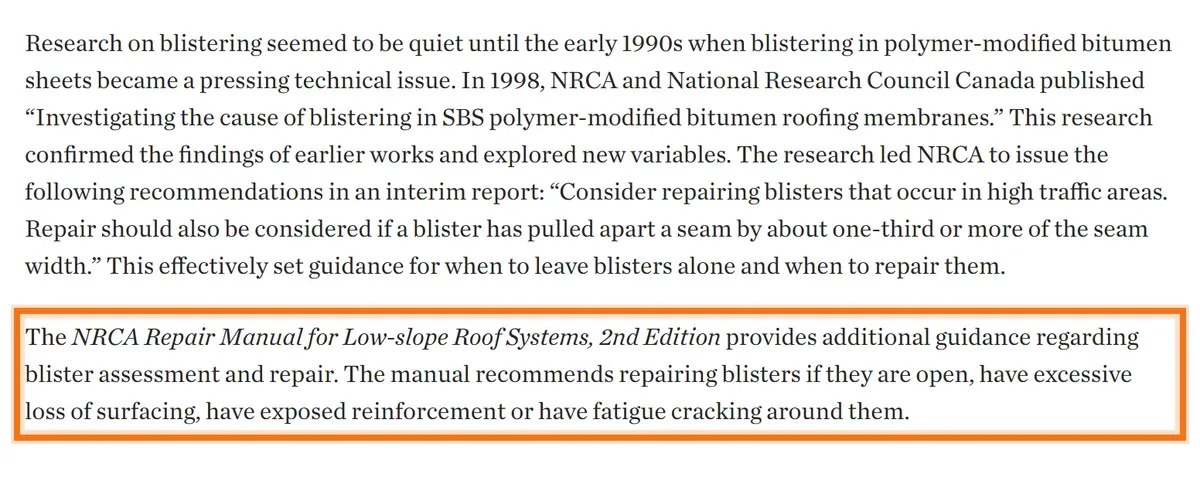
On a North Texas flat roof, a closed blister that is not being walked on usually does not need repair: it is a pocket of air and water vapor that is still keeping water out. NRCA’s guidance is to repair blisters that are open, cracked around the edge, have lost their surfacing or show reinforcement, sit in traffic areas, or have pulled a seam apart by about a third of its width.
Key takeaways
- A blister is a pocket of air and water vapor trapped between layers of the roof; it swells in the heat of the day and can relax at night.
- NRCA’s published guidance: consider repairing blisters in high-traffic areas and those that have pulled a seam apart by about one-third or more of its width; repair blisters that are open, have lost surfacing, show reinforcement or have fatigue cracks around them.
- On adhered single-ply roofs such as TPO, a bubble is usually an unbonded area; it matters most at perimeters and edges, where loose membrane raises the risk of wind damage.
- Never step on or pop a blister to see what is inside: an intact blister is watertight and a broken one is a leak.
- Before paying for patching, a coating or a new roof, find out how many blisters there are, whether they are growing and whether the insulation under them is wet.
You are on the roof for another reason, an air conditioner or a satellite dish, and there it is: a raised bubble in the roof surface the size of a dinner plate. A few steps on there is another, long and narrow, running along a lap. They feel springy. Nothing is leaking below.
The instinct is to have them all cut out and patched. For most blisters that is the wrong call, and for a few it is urgent. The difference is something you can see, measure and write down.
What is a blister on a flat roof?
A blister is a confined pocket of air and water vapor inside the layers of a roof. That is the definition used by Matt Dupuis, a roofing engineer, in NRCA's Professional Roofing magazine (September 2024), and he adds that when blister gases have been sampled, they are almost entirely air and water vapor.
Every blister starts with a void: a spot where two layers never bonded, or have come unbonded. From there the physics is simple. The sun heats the roof, the gas in the pocket expands and the blister inflates. At night it cools and can go slack. If the daytime pressure is enough to peel the edge of the pocket a little further, the blister grows, and Dupuis describes this as a ratcheting effect that continues until the blister reaches a balance. Water vapor makes the effect much stronger than dry air would.
The article describes three shapes worth being able to name when you talk to a contractor:
- Plate or pancake blisters: dinner-plate size or larger, one continuous air space. Some hold enough pressure to support a person.
- Linear blisters: several feet to 20 or 30 feet long, usually along sheet laps.
- Rash blisters: small, a quarter to half an inch, in tight clusters, often at tapes or in liquid coatings.
A North Texas summer supplies exactly what a blister feeds on: long days of strong sun and a wide swing between afternoon and night. That does not create blisters where the layers are bonded, but it shows you every place they are not.
Is a blister on a built-up or modified bitumen roof the same as a bubble in TPO?
No, and the roof type changes what the bubble means.
Built-up roofs and modified bitumen. These are layered asphalt roofs, and their blisters form between the layers: between felts, between a base sheet and a cap sheet, or between the membrane and what is under it. Richard Fricklas, writing in Buildings (July 2015), lists the usual origins: poor adhesion during application, bitumen applied at the wrong viscosity, moisture in or on the felts, unfilled insulation joints and trapped debris. The moisture then feeds the growth cycle.
Adhered single-ply roofs (TPO, PVC, EPDM). Here a bubble is usually an area where the sheet never bonded to the layer below, often because of how the adhesive was applied. Dupuis notes blisters can form between an uncured adhesive and a single-ply membrane, and Roofing Contractor magazine names lack of adhesion at installation as the usual cause. These are less a membrane defect than an attachment question.
Mechanically attached single-ply roofs. These sheets are fastened in rows and are not glued down between them, so some billowing and wrinkling between fastener rows is how the system is built. That is not a blister. What deserves attention on these roofs is a ridge with water under it, or a seam under strain; see what to do when TPO seams are opening.
Not sure which roof you have? Our comparison of TPO and other flat roof systems describes each one, and a photo sent to a roofer usually answers it in a minute.
Which blisters should be left alone, and which need repair?
NRCA's guidance has been stable for a long time, and it is short.
Here is how those criteria, and the single-ply guidance from two trade articles, sort out by roof type:
| Roof type | Usually left alone and monitored | Consider repair | Repair |
|---|---|---|---|
| Built-up roof (gravel or smooth) | Closed, intact blisters out of traffic paths, with surfacing still in place | Blisters in high-traffic areas, including where other trades or future equipment will work | Open or broken blisters; excessive loss of gravel or surfacing; exposed felts or reinforcement; fatigue cracking around the blister |
| Modified bitumen | Closed blisters that are holding air, with granules intact | Blisters in traffic areas; a blister that has pulled a seam apart by about one-third or more of the seam width | Open blisters; granule loss or exposed reinforcement; reduced seam coverage; cracking around the edge |
| Adhered single-ply (TPO, PVC, EPDM) | Small unbonded areas in the field where the membrane is not weathered or cracked | Unbonded areas that are large or frequent | Unbonded areas at perimeters and low-profile edges, which raise the risk of blow-off; any that are cracked or open, by the manufacturer's repair procedure |
How to read this: start in the right-hand column. Anything there is a leak or a wind risk now and goes on a repair list. The middle column is judgment, and the deciding question is usually whether anyone will be walking there. Everything in the left column gets photographed, measured and looked at again at the next inspection. Roofing Contractor magazine's article on the subject calls the decision on unopened blisters a judgment call, and offers the cautious contractor's rule: when in doubt, take them out.
Two reasons the default is to leave a sound blister alone. First, as the same article says of modified bitumen roofs, blisters that are keeping air in will keep water out. Second, every repair is a cut in the roof with a new set of edges to fail. A patch should be an improvement on what it replaces.
Why traffic changes the answer
A blister is the membrane stretched over a void with nothing under it. Step on it and it can crack or burst; roll a cart over it and it will. That is why NRCA singles out high-traffic areas, and why Buildings gives solar panel installation areas as an example.
For an owner this means two practical things. Do not let anyone test blisters with a boot. And look at where they are in relation to the roof hatch, the service side of each rooftop unit and the routes between them. Blisters along those routes should be repaired or the route should be moved and marked with walkway pads. Our guide on how HVAC and other rooftop work damages a commercial roof covers how to control that traffic.
What should be identified or tested before you pay for anything?
Three proposals are common after someone finds blisters: patch them all, coat the roof, or replace the roof. Before choosing, have the inspection answer these, with photos:
- What roof is this? Membrane type, how it is attached, how many roofs are on the deck and roughly how old the top one is.
- How many blisters, where, and how big? Marked on a roof plan, with the largest measured.
- Which are open, cracked, bare of surfacing or on a seam? That is the repair list.
- Which are in traffic paths?
- Are they growing? If there are earlier inspection photos, compare. If there are none, paint a line at each blister's edge and date it.
- Is there moisture below? Moisture is what drives blister growth, and a roof with many of them may have wet insulation. On a roof with widespread blistering, a moisture survey with core cuts is worth discussing before any large spend; see how roofers find wet insulation under a commercial roof. Does water stand in the same area? Then read what to do about water standing on a flat roof.
- Is the roof under warranty? If so, the manufacturer decides what is covered and who may cut into it.
When I find blisters on a low-slope roof, I photograph each one next to a tape measure and mark it on the plan before I say anything about repair. Half the value of the visit is having something to compare against next spring.
Verde's free inspection covers the visual part of that list, with photos and a written estimate for repairs. Core cuts sent to a lab and instrument surveys are done by testing firms and roof consultants; ask any contractor who offers them who actually performs the work.
Patch, coat or replace: what does each option really do?
The three proposals compared:
| Option | When it fits | What the work includes | What it does not solve | Published cost context |
|---|---|---|---|---|
| Monitor | Closed blisters, out of traffic, surfacing intact, no wet insulation found | Photos, measurements, marked edges, a re-check at each spring and fall inspection | Nothing is fixed; it is a decision to watch | Part of a routine inspection |
| Cut out and patch the blisters that meet the criteria | A limited number of open, cracked, bare or traffic-path blisters on an otherwise serviceable roof | Removing the blistered membrane back to well-bonded material; checking and replacing wet insulation; a patch of matching material extended beyond the cut, by the manufacturer's method; restoring surfacing | The cause of the voids elsewhere; new blisters can still appear | HomeGuide (Nov. 2025): $250 to $1,250 on average to repair a blistering or cracking membrane, small roofs, national |
| Coat the roof | A sound, dry roof where the blisters needing repair have been patched first and the coating maker accepts the surface | Repairs, cleaning, primer if required, coating at the specified thickness | Unbonded layers, wet insulation, blisters left under the coating | HomeGuide: $1 to $4 per square foot to seal or coat a flat roof |
| Recover or replace | Blisters across most of the roof, with membrane deterioration or wet insulation | A new roof system, with tear-off where the existing roof is wet or already has two layers | Nothing, if scoped properly, but it is a capital project | HomeGuide: $3 to $11 per square foot to replace a flat roof, national |
How to read this: the first two rows are where most blistered roofs belong, and they can be combined, with a short repair list and a watch list on the same plan. A coating or a new roof is justified by the condition of the whole roof, never by the blisters alone. The cost figures are from a national guide written around small flat roofs and are there for scale; a commercial price follows from the count and size of repairs, the membrane, access and what is found underneath.
For the larger decisions there are fuller guides: roof coating versus replacement, whether a new commercial roof can go over the existing one in Texas and what drives commercial roof replacement cost. The model building code is relevant to the last row: the 2021 International Building Code does not permit a recover over a roof that is water-soaked or already has two or more coverings, and Texas cities adopt their own editions and amendments.
If you would like the blisters on your roof counted, measured and sorted into a repair list and a watch list, call or text (214) 687-1951.
What does a proper blister repair include?
The trade articles describe the same sequence for asphalt roofs, and it is useful as a checklist against a quote:
- Clean the surface well beyond the blister; on a gravel-surfaced roof, remove the loose and embedded aggregate from the repair area.
- Cut out the blistered membrane until well-adhered material is reached on all sides.
- Look at what is underneath. If the insulation is wet or damaged, replace it with dry insulation of the same thickness, and check the deck.
- Prime where the system calls for it.
- Install the patch: on a built-up roof, at least two plies, each extending beyond the one below; on modified bitumen, a patch of like material extending about 8 inches beyond the cut, with rounded corners.
- Restore the surfacing: gravel, granules or a compatible coating.
On adhered single-ply roofs, both articles say the same thing: follow the membrane manufacturer's repair procedure. That usually means the manufacturer's own materials, and on a warranted roof, a contractor the manufacturer accepts. Johns Manville's guarantee summary, for example, excludes repairs made after completion unless they are performed in a manner acceptable to the manufacturer by an approved contractor.
A repair quote should state the number and locations of blisters to be repaired, the patch materials, what happens if wet insulation is found and at what unit price, and the warranty on the repair. Our guide to how long a roof repair should last and what its warranty should cover explains what to expect there.
When do blisters point to a bigger problem on a North Texas roof?
A handful of stable blisters on a roof that is otherwise sound is a maintenance note. These patterns are more than that:
- New blisters every year. The supply of moisture or unbonded area has not run out.
- Blisters with soft, wet insulation under them. The roof is taking in water somewhere.
- Linear blisters lifting the laps. Seam coverage is being lost along whole runs, not at single spots.
- Bubbling at the edges of an adhered single-ply roof. The attachment is in question where wind loads are highest.
- Blisters across a roof that is only a few years old. That is an installation issue to raise in writing with the installer and the manufacturer while the warranties are in force. Our guide to what a no dollar limit commercial roof warranty actually covers explains the notice steps.
If you are buying a building and the inspection report mentions blisters, ask for the count, the map and the moisture question to be answered before closing; what a commercial building purchase roof inspection should include has the full list.
For everything else, the plan is routine. Blisters belong on the checklist of a commercial roof inspection and maintenance program, measured in spring and fall, and Verde's maintenance plans can put those visits on a schedule.
Want the blisters on your roof sorted into repair and watch?
Verde Roofing inspects and repairs commercial roofs across Dallas–Fort Worth from its base in Plano. Call or text (214) 687-1951, 24/7, or book a free roof inspection. You will get photos of each blister, a marked plan, a written estimate for the repairs we can make, a plain statement of which blisters need nothing, and a note wherever the manufacturer or another specialist should be involved first.
Questions people ask next
Should I pop a blister on my flat roof?
No. An intact blister is a sealed pocket, and a trade article on the subject puts it simply: a blister that is keeping air in will keep water out. Cutting or stepping on it turns a cosmetic condition into an opening that must be repaired right away. If a blister has to be opened, it should be cut out and patched as one planned repair.
Are roof blisters covered by the manufacturer’s warranty?
It depends on the document, and usually on whether the blister causes a leak. Johns Manville’s summary of its commercial guarantee, for example, lists leaks caused by ridges, buckles and wrinkles among covered items, and says a blister rider can be purchased under the right configuration. Read your own warranty and report the condition to the manufacturer before anyone cuts into the roof.
Why did blisters appear on a new roof?
Blisters start from a void: a spot where two layers never bonded. On asphalt roofs that comes from uneven or too-cool bitumen, moisture in or on the materials, or debris. On adhered single-ply roofs it usually comes from adhesive that was not applied or cured properly. On a recently installed roof, document it with photos and notify the installer and manufacturer in writing.
Can a roof coating fix blisters?
A coating does not re-bond layers that have separated, and it does not dry out a wet roof. Blisters that meet the repair criteria should be cut out and patched before any coating goes on, and the coating manufacturer should say in writing what it requires of the surface. A roof with blisters across most of its area is rarely a good coating candidate.
How much does it cost to repair roof blisters?
HomeGuide’s November 2025 flat roof repair guide lists $250 to $1,250 on average for repairing a blistering, cracking or alligatoring membrane, as a national figure for small roofs. A commercial price depends on the number and size of blisters, the membrane type, whether wet insulation must be replaced under them and warranty requirements.
Do blisters mean the roof is leaking?
Not by themselves. A closed blister is not letting water through. But blisters grow on moisture, so a roof with many of them deserves a check for wet insulation, and any blister that is open, cracked or sitting on a seam should be treated as a possible leak path until someone has looked at it closely.
Do blisters get worse in the Texas heat?
Heat is what drives them. The gas inside a blister expands as the membrane heats up and contracts as it cools, and each cycle can pull the edge loose a little further until it reaches a balance. Long, hot summers give a blister many cycles, so photograph and measure them in summer and compare year to year.
Sources
- Professional Roofing (NRCA): Back to the start, roof blisters, September 2024
- Roofing Contractor: Blisters: To Repair or Not to Repair (2003)
- Buildings: Blisters: Repair or Re-Cover? (R. Fricklas, July 2015)
- Johns Manville: Understanding Your JM Peak Advantage Guarantee, RS-7396 10-25 (PDF)
- 2021 International Building Code, Chapter 15 (Section 1512, Reroofing), UpCodes Texas viewer
- HomeGuide: How much does flat roof repair cost? (November 7, 2025)
Chris Grimes owns Verde Roofing in Plano, Texas, a locally owned residential and commercial roofer serving Dallas–Fort Worth. Verde is an NTRCA Accredited Member, an RCAT member and a Dallas Observer Best of Dallas Best Roofer winner (readers’ choice) in 2021, 2022 and 2023.
Keep reading
Related guides
 Commercial roofingCommercial Roof Inspections and Maintenance Programs for Property ManagersNRCA recommends inspecting roof systems at least twice a year, preferably in spring and fall, and again after severe weather such as hail. In North Texas…Read the guide
 Commercial roofingTPO Roof Seams Are Opening on a DFW Building: Patch, Re-Weld, or Replace?On a Dallas–Fort Worth building, open TPO seams are a repair when they are few, the membrane still welds and the insulation under them is dry…Read the guide Commercial roofingHow Do Roofers Find Wet Insulation Under a Commercial Roof in Texas?On a Texas commercial roof, wet insulation is found in two steps. A scan (infrared at night, a nuclear gauge or an electrical impedance meter read…Read the guide