
Leaking Skylight in North Texas: Repair the Flashing, Replace the Unit, or Remove It?
 By Chris Grimes, owner of Verde RoofingPublished November 18, 2026 · 12 min read
In short
On a North Texas home, repair the flashing when the skylight itself is sound and water enters where it meets the shingles. Replace the unit when the glass seal, frame or gaskets have failed. Remove it and roof over the opening when you no longer want it or the roof is being replaced anyway. First rule out condensation, which no roof repair will fix.
Key takeaways
- A skylight can leak in three places: the flashing where it meets the roof, the unit itself (glass seal, frame joints, gaskets), or the roof above it. Each one is a different purchase.
- Fog or water between the panes means the insulated glass seal has failed; the Building America Solution Center lists that as a reason to replace the unit, not to reflash it.
- HomeGuide's February 2026 guide puts leaking skylight repair at $225 to $800, a like-for-like replacement at $800 to $2,400, and removing a skylight and roofing over the opening at $350 to $1,000.
- Closing the ceiling after a removal is interior work (framing, insulation, drywall, paint) and is usually a separate trade and a separate price.
- The cheapest time to replace or remove a skylight is during a roof replacement, when the shingles around it are coming off anyway.
There is a brown ring on the drywall inside the skylight shaft, or a drip that lands on the kitchen floor every time it storms. You have probably already heard two opinions: one person says a tube of sealant will handle it, another says the whole skylight has to go.
Both can be wrong, because a leaking skylight is really three different problems that look the same from inside the house. This guide walks through how to tell them apart, what each fix includes, what national cost guides publish for each, and what a quote should say before you sign it.
Is it a leak at all, or condensation?
Start here, because no roofer can fix condensation from the roof.
- Water during or right after rain is a leak. Note whether it happens in every rain or only in wind-driven storms from one direction.
- Moisture on the room side of the glass with no rain, usually on cold mornings or in a bathroom, kitchen or laundry room, is indoor humidity condensing on a cold surface. The fix is ventilation, a bath fan that actually exhausts outdoors, or a better-insulated unit.
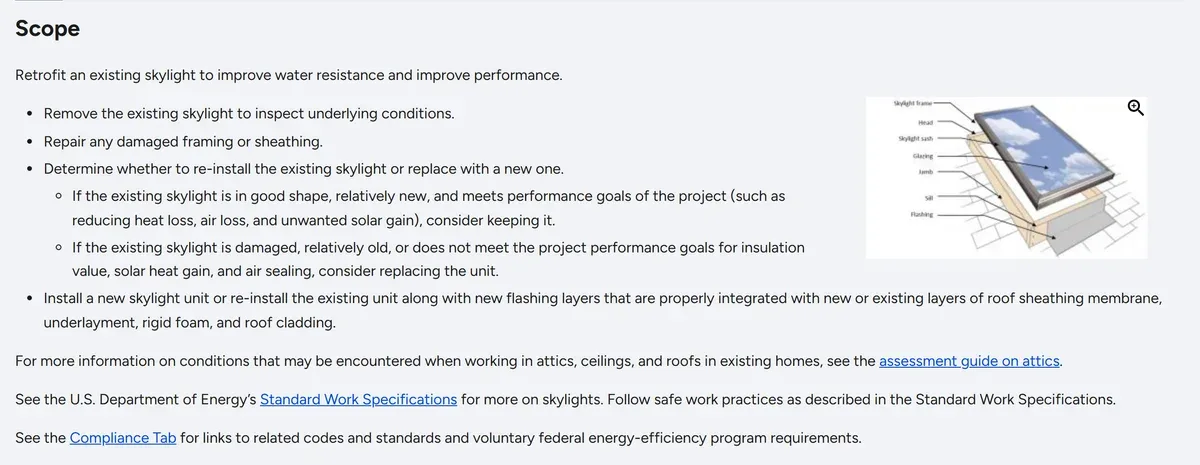
- Fog or droplets between the two panes means the seal of the insulated glass unit has failed. The Building America Solution Center, the U.S. Department of Energy's construction guidance site run by Pacific Northwest National Laboratory, says condensation between the panes indicates the seals have failed, and lists it among the problems that may warrant replacing the unit.
A wet attic or shaft in dry weather has other causes too, from a disconnected bath fan duct to an air conditioning line. Our guide on why an attic is wet when it has not rained covers those.
Where does a skylight actually leak?
The same federal guide names the common leak locations: through the joints in the skylight frame, between the frame and the sash on units that open, and through the joint between the skylight and the roof. Add the roof above the skylight and you have the full list a roofer has to sort through.
The flashing. Flashing is the metal, and on better installations a self-adhered membrane under it, that bridges the gap between the skylight and the shingles. Along the sides it is step flashing, small L-shaped pieces woven into each course of shingles. Across the top is a head flashing and across the bottom a sill flashing. When pieces were skipped, reused, face-nailed or replaced with roofing cement, water gets behind them. This is the same family of failure described in our guide to chimney, flashing and vent leaks.
The unit. Glass seals fail, frame corners open up, gaskets and weather stripping on venting skylights harden, and acrylic domes craze and crack with age and hail. A unit that leaks through itself will keep leaking under perfect flashing.
The roof above. Water that enters at a lifted shingle, a nail pop or a debris dam uphill can run down the deck and show up at the skylight opening, because the opening is the first place it can drop. Our guide to roof nail pops shows one common source.
There is also a design difference worth knowing. Curb-mounted skylights sit on a raised wood frame built on the roof deck. Deck-mounted skylights have a low built-in flange fastened straight to the deck. The Building America guide says curb-mounted units have better potential for controlling bulk water and are particularly recommended when a skylight is replaced without replacing the roof covering around it.
What does an inspection have to establish before anyone quotes?
A price given from the driveway is a guess. A real diagnosis answers these questions, in this order:
- When does it leak? Your notes on rain, wind direction and timing narrow the search before anyone climbs a ladder.
- What does the inside show? Stains at the top corners of the shaft point one way, stains under the glass another. The Building America guide tells inspectors to look for peeling paint and water stains on the framing around the opening.
- What condition is the unit in? Fog between panes, cracks, open frame joints, brittle gaskets, a dome that has yellowed.
- What does the flashing look like? Real step, head and sill flashing, or layers of old sealant and roofing cement.
- What is uphill? Shingles, nail pops, debris and any other penetration above the skylight.
- Is the wood sound? The curb, the decking around the opening and the framing below it. Rot changes the scope.
- How old are the shingles around it? Brittle shingles crack when they are lifted to reach the flashing, which can turn a small repair into a larger one.
When the evidence is unclear, a controlled water test settles it: wetting one area at a time, starting low, with someone watching inside. The federal guide cautions that this has to be done carefully, because spraying too hard or upward at seals can create leaks that never happen in real weather, and it says the work is best done by someone experienced rather than by most homeowners. Please do not test it yourself from a wet or steep roof.
When I look at a leaking skylight, I start inside with a flashlight before I get on the roof. The stain pattern on the shaft usually tells me whether to look at the top corners, the glass or the shingles above.
Repair, replace or remove: how do the three options compare?
These are the three purchases side by side, with national cost ranges from guides we opened in November 2026:
| Option | When it fits | What the work includes | What it does not solve | Typical published cost |
|---|---|---|---|---|
| Repair the flashing | The unit is sound, fairly young and dry between the panes; water enters at the roof joint | Shingles around the skylight removed, wood checked, new membrane and step, head and sill flashing, shingles replaced | A failed glass seal, cracked dome, leaking frame, condensation, heat gain from an old unit | Flashing repair $150 to $500; leaking skylight repair $225 to $800 (HomeGuide). Fixr: $300 to $800 |
| Replace the unit | Fog between panes, cracked glazing, open frame joints, worn gaskets with no parts available, or an old unit under a new roof | Old unit out, opening and curb checked, new skylight with its matching flashing kit, shingles tied back in | Interior stains and shaft drywall; a larger or different-size unit adds framing and interior patching | $800 to $2,400 like for like (HomeGuide). Fixr: up to $2,800 |
| Remove it and roof over | You no longer want it, the room overheats, or it has leaked repeatedly and the roof is being replaced | Unit and curb removed, opening framed, new decking, underlayment and shingles | The hole in the ceiling: insulation, drywall, texture and paint are interior work. On an older roof the new shingles may not match | $350 to $1,000 for removal and roofing over, depending on roof type; removal alone $125 to $250 (HomeGuide) |
Read the table from the left: the "when it fits" column decides the option, not the price column. A flashing repair on a skylight with a failed seal is money spent twice, and a new unit does nothing if the water was coming from a nail pop three feet uphill. All figures are national and typical, not our prices. Verde's price is a written estimate after a free inspection.
What moves the number on your house: roof pitch and height, tile or metal instead of shingles, rotted decking or curb, whether the unit is a standard size, how many skylights there are, and whether the work happens during a roof replacement. HomeGuide notes that skylight labor is cheaper when it is done while reroofing than as a standalone job.
If you would rather talk it through before deciding, call or text (214) 687-1951 and we will tell you which of the three your photos point to.
When does each option make sense?
When is repairing the flashing enough?
Reflashing is the right purchase when the unit passes inspection and the leak is at the roof joint. For a standalone repair with the roof left in place, the Building America guide describes cutting the shingles and underlayment back about 2 inches at the sides and 3 inches at the top and bottom to expose the deck, removing the old metal, inspecting and replacing damaged wood, then rebuilding from the bottom up so each layer laps over the one below it.
That last part is the whole job. A repair that only adds sealant on top of the old metal has not changed where the water goes. And if the shingles around the skylight are too brittle to lift and relay, a flashing repair may not be possible without a larger section of new roofing. Our guide on how long a roof repair should last explains what to expect from a repair on an aging roof and what a repair warranty should say.
When should the skylight be replaced?
Replace the unit when the unit is the problem: fog between the panes, cracked or crazed glazing, water tracking through frame joints, or gaskets that have failed with no replacement parts available. The federal guide also suggests replacement when a skylight is relatively old or no longer performs, and notes that new units offer better air tightness, energy performance and condensation resistance than old ones. That matters on a west-facing Texas roof.
Two cautions. The same guide points out that a replacement of a different size needs extra framing and interior patching, so like-for-like sizing keeps the cost down. And keep a replacement in proportion: one failed skylight is a repair, not a reason to replace the roof. If the roof itself is near the end, our repair or replace decision guide shows how to weigh that honestly.
When does removing the skylight make sense?
Removal is permanent, and it is the right call more often than people expect: a skylight in a hallway nobody uses, a room that bakes in July, a unit that has leaked through two repairs, or an old skylight sitting in a roof that is about to be replaced. During a replacement the roofer is already down to the deck, so framing in the opening and decking over it adds little, and the new shingles run straight across with no patch to match.
Done as a standalone job on an older roof, a roof-over leaves a rectangle of new shingles in a weathered field. It will be watertight, but it may be visible from the yard. Ask the roofer to show you the closest available match before you agree. If the work is part of a larger plan, the roof cost calculator gives a typical range for the full roof so you can compare a repair now against doing everything at once.

What do hail and heat do to skylights on North Texas roofs?
Two local conditions shorten a skylight's life here. Summer sun bakes exposed sealant and rubber gaskets until they shrink and crack, which is why sealant-only repairs rarely last in Plano, Frisco or anywhere else in DFW. And spring hail can crack acrylic domes, break glass and dent the soft metal flashing around the frame.
After a storm, photograph the skylight and its flashing before anything is repaired or covered, the same way you would for the rest of the roof. Our guide on how to document roof storm damage lists the photos that help. Whether a damaged skylight is covered depends on the cause and on your policy. The Texas Department of Insurance reminds homeowners that an insurer will not pay for roof work just because something is old or worn out, so wear and a sudden storm loss are treated differently.
One more local point: on a roof that is being replaced after hail, the skylights should be an explicit line in the scope, whichever way you go. A building code note explains why this is normally straightforward: the International Residential Code exempts unit skylights from the cricket rule that applies to wide chimneys, provided they are installed and flashed according to the manufacturer's instructions. The manufacturer's flashing kit is the standard to hold the work to.
What should be written in the quote?
Whichever option you choose, ask for these in writing:
- The diagnosis in one sentence: where the water enters and how that was confirmed.
- Photos of the failed flashing or unit, taken before the work.
- For a repair: new flashing and membrane, not sealant over existing metal, and how the surrounding shingles will be handled.
- For a replacement: brand, model, size, glazing type, curb-mounted or deck-mounted, and the manufacturer's matching flashing kit.
- For a removal: how the opening will be framed and decked, the underlayment, the shingle match, and who closes the ceiling.
- A price per sheet or per foot for rotted decking or curb lumber, agreed before anything is opened.
- What is excluded, especially interior drywall, insulation and paint.
- The workmanship warranty on this repair and the manufacturer's warranty on any new unit, both in writing.
A quote that says only "fix skylight leak" with a single number tells you nothing about which of the three purchases you are buying. Our guide to what common roof repairs cost explains how repair pricing is put together.
Who else is involved, and in what order?
- Stop the damage. Catch the water and move what is under it. The first steps are in what to do when the roof is leaking.
- Roofer first. The leak source has to be found and the roof side made watertight before anything inside is repaired. Flashing, skylight replacement and roofing over an opening are roofing work.
- Electrician, if needed. A hard-wired venting skylight or motorized shade may need its wiring disconnected or reconnected.
- Dry-out. Wet insulation and drywall in the shaft need to dry or be removed. If the leak ran for a long time, a water-damage restoration company handles drying and any mold concern.
- Drywall and paint last. Interior ceiling and shaft repairs are a drywall and painting trade. Wait for a rain or a water test that confirms the roof side is dry before closing anything up.
Verde does the roof side: finding the source and the roof repair itself. Interior drywall and interior painting are a separate trade, and our guide on who repairs wet insulation and ceiling damage after a roof leak explains how to sequence it. If the skylight is in a roof that was installed recently, read who should fix a leak in a brand-new roof before paying anyone else to touch it.
Find out which of the three you actually need
Call or text (214) 687-1951, 24/7, or book a free roof inspection. Chris will look at the skylight from inside and from the roof, show you photos of what failed, and give you a written estimate for the option that fits, including the one where the answer is a small repair.
Questions people ask next
How do I know if my skylight is leaking or just has condensation?
Watch when the water appears. Drips that show up during or right after rain point to a leak. Moisture that forms on the room side of the glass on cold mornings, or in a bathroom or kitchen, with no rain, is condensation from indoor humidity. Fog trapped between the two panes is a third thing: a failed glass seal, which means the unit itself is worn out.
Can a leaking skylight be fixed with caulk or sealant?
Sealant can slow a leak for a while, and HomeGuide lists resealing at $75 to $250, but it is maintenance, not a repair of failed flashing. Texas heat dries and cracks exposed sealant. If the leak is at the joint between the skylight and the roof, the lasting fix is new flashing layered with the shingles and underlayment so water sheds on its own.
Should I replace my skylights when I replace my roof?
Usually it is the right time to decide. The Building America Solution Center says installers should inspect skylights whenever a roof is redone, and HomeGuide notes skylight labor costs less during a reroof than as a standalone job. An older unit that is reinstalled under a new roof can become the first thing to leak, so ask for a price both ways.
How much does it cost to remove a skylight and close the roof?
HomeGuide's February 2026 guide lists removing a skylight and roofing over the opening at $350 to $1,000 depending on the roof type, and removal alone at $125 to $250. Those are national figures for the roof side. Framing the opening, insulating it and finishing the ceiling inside are additional, so ask each contractor what the number includes.
Does homeowners insurance cover a leaking skylight in Texas?
It depends on the cause and on your policy. Sudden damage from a covered event such as hail or a fallen limb is treated differently from seals and flashing that wore out over time. The Texas Department of Insurance says insurers do not pay to replace a roof just because it is old or worn. Photograph the damage and read your own policy before assuming either way.
How long does a skylight last?
HomeGuide's 2026 skylight guide says skylights last 15 to 40 years on average depending on the type, brand, climate and installation quality. Flashing and sealant around the unit can fail sooner than the glass. A skylight that is older than the shingles around it deserves a close look at every roof inspection, especially after hail.
Sources
- Building America Solution Center (PNNL / U.S. Department of Energy): Existing Skylights Repaired or Replaced and Fully Flashed
- HomeGuide: How much does it cost to repair or replace a skylight? (February 2026)
- HomeGuide: How much does roof repair cost? (February 2026)
- Fixr: How Much Does It Cost to Repair a Roof Leak? (2026)
- UpCodes: 2021 International Residential Code, Chapter 9 Roof Assemblies (R903.2)
- Texas Department of Insurance: Insurance and your roof
Chris Grimes owns Verde Roofing in Plano, Texas, a locally owned residential and commercial roofer serving Dallas–Fort Worth. Verde is an NTRCA Accredited Member, an RCAT member and a Dallas Observer Best of Dallas Best Roofer winner (readers’ choice) in 2021, 2022 and 2023.
Keep reading
Related guides
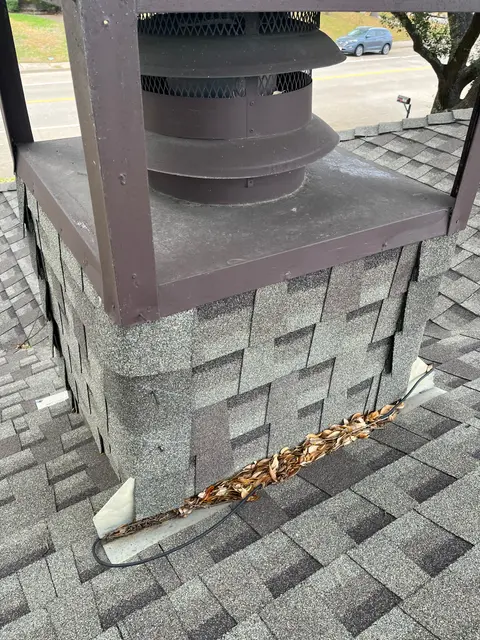 Repair or replaceChimney, Flashing and Vent Leaks: The Most Common Roof RepairsMost roof leaks start where the shingles stop: at chimneys, walls, skylights and pipe or exhaust vents. Rubber pipe boots crack in Texas sun, chimney step…Read the guide
 Hiring a rooferHow Long Should a Roof Repair Last in Texas, and What Should Its Warranty Cover?A roof repair in Texas that replaces the failed part, such as a pipe boot, flashing or damaged shingles, should last as long as the roof…Read the guide
 Repair or replaceWho Repairs Wet Insulation and Ceiling Damage After a Roof Leak in DFW?After a roof leak in Dallas–Fort Worth, the work goes in a fixed order and usually to different companies. A roofer stops the water first. A…Read the guide