

Roof Leak Under Solar Panels in Texas: Who Inspects and Fixes It?
 By Chris Grimes, owner of Verde RoofingPublished November 15, 2026 · 12 min read

In short
In Texas, a roof leak under solar panels usually takes two trades. A roofer traces the water, starting in the attic, and repairs the flashing, shingles or decking. The solar installer or a licensed electrical contractor shuts the system down, detaches the panels over the repair, then resets and restarts them. Check the solar contract’s leak warranty first, and get each company’s part in writing.
Key takeaways
- Most rooftop arrays are bolted through the roof covering into the rafters, so every mount is a penetration that depends on its flashing, not on sealant alone.
- A leak under an array is found from the attic first; panels come off only over the suspect area, and only after the system is shut down by someone qualified.
- HomeGuide puts removing solar panels at $200 to $500 per panel nationally, with remove-and-reinstall at the high end of that range.
- Three different warranties can be in play: the roofer’s workmanship warranty, the solar installer’s penetration or workmanship warranty, and the shingle manufacturer’s warranty.
- Since September 1, 2025, Texas solar sales contracts must name the licensed electrical contractor who installs the system, which helps when the seller is gone.
There is a stain on the ceiling, and the part of the roof above it is covered by solar panels. You call the solar company and hear that it must be the roof. You call a roofer and hear that nobody can see anything until the panels come off. Meanwhile the next rain is on its way.
This guide sorts out who does what: who finds the leak, who is allowed to move the panels, who repairs the roof, who turns the system back on, and which warranty is supposed to pay for each step.
Who do you call first for a roof leak under solar panels in Texas?
Start with the paperwork, then make two calls.
- Protect the inside. Catch the water, move what you can, and take photos of the ceiling and the attic. Our guide on what to do when the roof is leaking covers the first hour.
- Find the solar contract. Look for a section on roof penetrations, leaks or workmanship. Many solar agreements include a leak warranty for a set number of years. If yours is still running, the installer has to be told, in writing, before anyone else works on the mounts.
- Call the solar installer if that warranty is active, or if the system is leased or under a power purchase agreement. In a lease, the system is not yours to move.
- Call a roofer for an independent inspection. A roofer looks at the whole roof, not only the array, and can tell you whether the water is coming in at a mount or somewhere else entirely.
- Do not go on the roof. Wet shingles, a slope and live electrical equipment are a bad combination.
If water is actively coming in and a storm is ahead, a roofer can often protect the area around the array with emergency tarping while the two companies sort out the schedule. Verde Roofing offers 24-hour emergency service across Dallas–Fort Worth.
Why do roofs leak under solar panels?
Because the array is fastened through the roof. The Pacific Northwest National Laboratory's Building America Solution Center, a U.S. Department of Energy resource, puts it plainly: with the exception of raised-seam metal roofs, most roof types require penetrations for rack mounts, and in the best installations the lag screws or bolts tie into structural members.
A typical home array has dozens of these attachment points. Each one is a hole through shingles, underlayment and decking. What keeps it dry is the flashing: a metal plate that slides up under the shingle course above the mount, so water runs over it the same way it runs over the shingles.
The same guide explains why sealant by itself is not enough. Early installations that relied on sealant alone became a problem because the sealant often broke down from sun exposure, oxidation, expansion and contraction, and wind vibration. It also notes that the International Residential Code now specifically requires roof penetrations for rooftop solar to be flashed and sealed.
The causes an inspection looks for under and around an array:
- A mount with no flashing, or flashing laid on top of the shingles instead of tucked under the course above.
- A lag screw that missed the rafter. It may hold the rail but leaves a hole through the decking that sealant alone is covering.
- Abandoned holes. When an installer misses a rafter and moves the mount, the first hole has to be sealed.
- Shingles cracked or scuffed during installation, especially on a hot roof.
- Nails pulled to fit the flashing and the old holes never sealed.
- The wire entry. Conduit or a rooftop junction box is its own penetration with its own flashing.
- Debris. Leaves and nests collect behind the rails and hold water against the shingles.
- A roofing problem that only happens to be under the array: a pipe boot, a worn valley, or flashing at a chimney or vent.
- Storm damage. After North Texas hail, the exposed shingles around the array can be damaged while the ones under it are not.
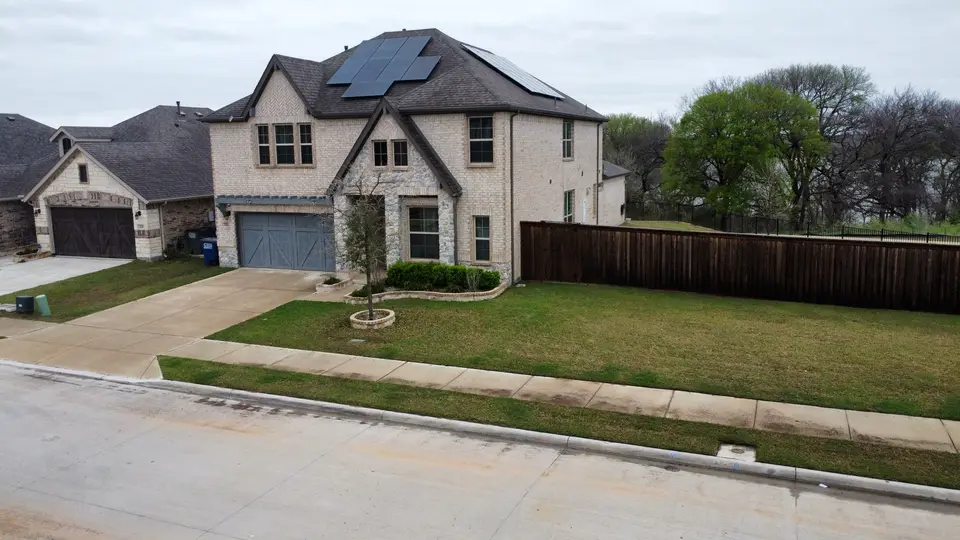
How does a roofer find a leak when panels cover the roof?
From the inside first. Most of the diagnosis happens in the attic, not on top of the glass.
- Attic inspection. Water stains on the decking, a rusty lag screw tip, or daylight at a hole show where water enters. The rows of lag screws coming through the decking, or the shiners that missed a rafter, also map exactly where the mounts are.
- Measure it out. The roofer measures from a fixed point, such as a plumbing vent, to the stain, then finds the same spot on the roof.
- Look under the array edge. Many arrays sit a few inches off the roof. A light and a camera from the edge show flashing, broken shingles and debris for the first row or two.
- Check everything nearby. Pipe boots, valleys and wall flashings upslope of the stain are checked before anyone blames the array.
- Controlled water test, when the source is still unclear: water is run on one area at a time, lowest first, while someone watches in the attic.
- Remove panels over the suspect spot, only after the system is shut down, and only by whoever is allowed to do it under your solar contract.
When I trace a leak under an array, the attic tells me more than the roof does. If the stain lines up with a row of lag screws, it is almost always a mount. If it sits between rows, I look upslope for something else.
What you should receive at the end: photos of the entry point, a statement of the cause, and a written scope that says how many panels have to come off and who takes them off.
Who removes and reinstalls the solar panels?
This step is called a detach and reset, and it is electrical work as much as roof work. Panels produce voltage whenever the sun is on them. The system has to be shut down in the right order, the modules and rails unbolted and stored, and afterwards everything reconnected, tested and restarted.
Here is how the work usually divides between the trades:
| Step | Who normally does it | What to get in writing |
|---|---|---|
| Find the entry point and the cause | Roofer, with the solar installer present if a warranty claim is likely | Photos, cause, and whether it is at a mount |
| Shut down, detach and store panels and rails | The original solar installer, or a licensed electrical contractor with solar experience | Number of panels, price per panel, who is liable for a cracked module |
| Repair decking, underlayment, shingles and flashing | Roofer | Materials, area, and how each mount will be flashed |
| Reinstall mounts, rails and panels | Solar installer or electrical contractor, coordinated with the roofer | New mounting hardware or reused, and the flashing method |
| Restart, test and confirm production | Solar installer or electrical contractor | Confirmation that the system and its monitoring are working |
| Permits | Whoever the contract names | Which permits, and who pays the fees |
How to read this: nobody should be doing two columns' worth of work without saying so in the contract. The most common gap is the middle of the table, where the roofer assumes the solar company will re-flash the mounts and the solar company assumes the roofer did.
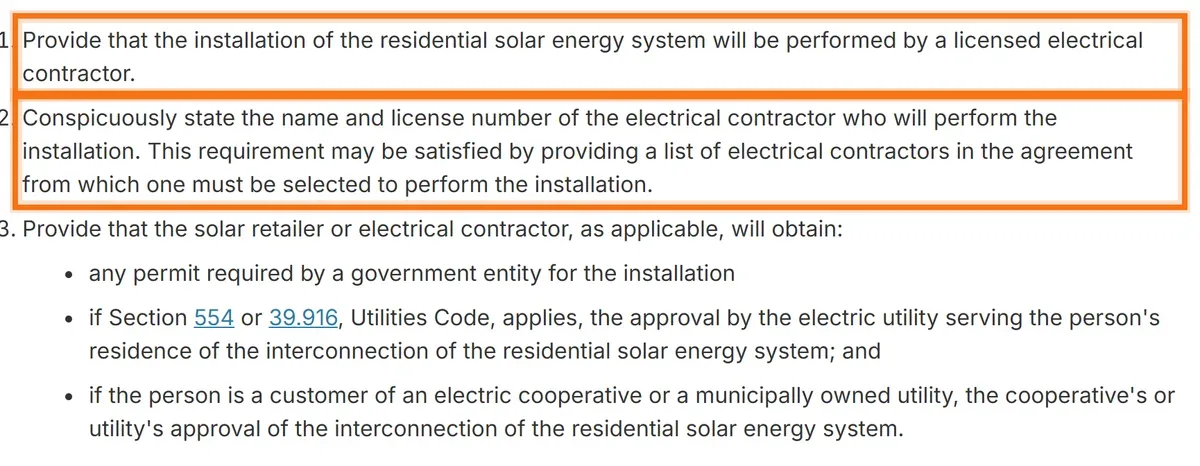
Texas law now helps you identify the electrical side. The Texas Department of Licensing and Regulation says that since September 1, 2025, a residential solar sales or lease agreement must provide that the installation will be performed by a licensed electrical contractor, and must state that contractor's name and license number. Since September 1, 2026, solar retailers and salespeople must be registered with TDLR.
Cities can add their own step. McKinney's roofing guide, for example, says that if existing solar panels are removed from the roof and reinstalled, an electrical permit must also be obtained. Ask your city before work starts; our guide to roof permits in Plano, Frisco and Dallas shows where each city keeps its rules.
About our own role: Verde Roofing repairs roofs and offers rooftop solar for homes and businesses. Whether the detach and reset on your job is done by your original installer, by a licensed electrical contractor, or under our scope is something we settle and write into the scope before any panel is touched. Do not assume it from any roofer, including us.
What are the repair options, and what do they cost?
The right repair depends on where the water enters and how much life the roof has left. These are the realistic options:
| Option | When it fits | What the work includes | What it does not solve | Published cost context |
|---|---|---|---|---|
| Repair outside the array | Entry point is a pipe boot, valley, wall or shingle next to the panels | Ordinary roof repair, no panels moved | Any mount that is also failing | HomeGuide: roof repair $150 to $1,000 for minor problems |
| Detach a few panels and rebuild one or two mounts | One clear entry point at a mount, roof otherwise sound | Shutdown, partial detach, new flashing and shingles, reset, test | Other mounts installed the same way | HomeGuide: $200 to $500 per panel removed, reinstall at the high end; some companies charge a minimum job fee |
| Detach the array on one slope and re-flash every mount | Several mounts leaking or flashed wrong | Full detach on that slope, shingle and decking repair, all mounts re-flashed | An aging roof | HomeGuide: $4,000 to $10,000 for a 20-panel system removed and reinstalled, plus the roof repair |
| Replace the roof and reset the array | Roof near the end of its life, or storm damage across the slope | Full detach, tear-off, new roof, mounts flashed as the roof goes on, reset | Nothing left to solve on the roof side | HomeGuide: a detach and reset averages about one third of the original solar project cost, plus the new roof |
How to read this: the numbers are national figures from HomeGuide's cost guide, dated June 2024, not Verde's prices and not Texas-specific. What moves the price is the number of panels, roof pitch and height, whether new mounting hardware is needed, permits, and the electrician's time. Our price is a written estimate after a free inspection.
The last row matters more than it looks. PNNL notes that many efficiency programs recommend a roof have 10 or more years of useful life left before solar goes on it. If your roof is already near the end, paying for a detach and reset twice makes little sense. You can get a ballpark for the roof itself with our roof cost calculator, and our guide on whether to repair or replace walks through the decision.
Which warranties can be affected?
Three, and they belong to three different companies.
The solar installer's workmanship or penetration warranty. This is the one written for exactly this problem. Lengths and terms vary by contract, so read yours. It normally requires that you notify the installer and let them inspect. If another company removes panels or reworks mounts first, the installer may argue the warranty no longer applies.
The roofer's workmanship warranty. If the roof was installed by a roofer and then drilled by a different company, the roofer's warranty often does not cover leaks at those penetrations. Our guide on who fixes a new roof that leaks explains how that responsibility is sorted out.
The shingle manufacturer's warranty. Manufacturers publish how mounts must be installed on their shingles. Owens Corning's technical bulletin on solar mounts, dated January 2026, lists the specific flashing and flashless mounts it approves. For existing shingles it describes sliding the flashing under the course directly upslope, sealing the holes of any nails that had to be pulled, drilling pilot holes into the rafters and filling them with sealant, and replacing any shingle damaged in the process. Ask which mount is on your roof and whether it was installed to the shingle maker's instructions.
Panel, inverter and racking warranties are product warranties. They cover the equipment, not water in your ceiling.
Before the repair, ask each company one question in writing: “Will this work affect my warranty with you, and what do you need from me to keep it in force?” Our roof warranty guide explains the difference between the types, and our guide on how long a roof repair should last covers what a repair warranty should say.
What if the solar installer is out of business?
It happens, and it changes the order of the calls but not the work.
- Collect the documents: the contract, the city permit, the equipment list with panel and inverter model numbers, the utility's interconnection approval, and any monitoring login.
- Check who owns the system. If it is leased, financed through the seller's partner, or under a power purchase agreement, call that company. They may have a service contractor, and they may have to approve any removal.
- Find the electrical contractor. On contracts made since September 2025, the licensed electrical contractor who installed the system is named in the agreement. That company may still be operating even if the sales company is not.
- Call the manufacturers. Product warranties on panels, inverters and racking are theirs. Ask whether a detach and reset by another licensed contractor affects coverage.
- Hire the two trades directly: a roofer for the leak and a licensed electrical contractor with solar experience for the detach, reset and restart. Put in writing who is responsible if a module is cracked or the system does not come back on.
- Ask your electric utility or retail provider whether putting the same system back needs any notice or inspection on their side.
A workmanship warranty from a company that no longer exists usually has nobody behind it. That is one reason to choose the mount and flashing method carefully during the repair, since the company doing the repair is the one who will stand behind it now.
What should the written scope say before work starts on a DFW home?
Use this as a checklist when you compare quotes:
- The cause of the leak, with photos, and the exact location.
- How many panels come off, the price per panel, and where they are stored.
- Who shuts the system down and who restarts it, by company name.
- The mount and flashing that will be used when panels go back, and whether new hardware is included.
- Decking replacement price per sheet if rotten wood is found.
- Who pulls the roofing and electrical permits your city requires.
- What each company warrants afterwards, and for how long.
- Who repairs the interior. Wet insulation and stained drywall are usually separate work; see who repairs wet insulation and ceiling damage.
If the damage followed hail or wind, document it before anything is repaired. Verde inspects, photographs the damage, meets your adjuster on site to show what we found and writes the repair estimate. The claim stays yours; our guide to the roof insurance claim process in Texas explains each step. Your own policy decides what is covered, including how the solar equipment is treated.
One more check: not every stain under an array is a roof leak. If the ceiling gets wet in dry weather, read why an attic can be wet when it has not rained before paying anyone to lift panels. And if you are still planning a system, solar panels and your roof covers what to settle before the first mount goes in.
Get the leak found before anyone lifts a panel
Call or text (214) 687-1951, 24/7, or book a free roof inspection. Chris inspects the roof and attic with you, photographs where the water is coming in, and gives you a written estimate that says which part is roofing work and which part belongs to the solar side.
Questions people ask next
Who is responsible if my solar panels cause a roof leak?
It depends on where the water gets in. A leak at a mount, a wire entry or a shingle broken during installation usually points to the solar installer, and many solar contracts include a leak or penetration warranty for a stated period. A leak at a pipe boot, valley or worn shingle next to the array is a roofing matter. An inspection with photos of the exact entry point is what settles it.
Can a roofer fix a leak without removing the solar panels?
Sometimes. If the entry point is at the edge of the array or outside it, such as a pipe boot or a wall flashing, the repair may not touch the panels. If the water is coming in at a mount or under the middle of the array, the panels over that spot have to come off so the flashing and shingles can be rebuilt properly.
How much does it cost to remove and reinstall solar panels for a roof repair?
HomeGuide’s national cost guide puts solar panel removal at $200 to $500 per panel, or $4,000 to $10,000 for a 20-panel system, with removal plus reinstallation at the high end. It also notes that some companies charge a minimum job fee. A leak repair usually needs only part of the array removed, so ask for a per-panel price in writing.
Will removing my solar panels void the solar warranty?
It can, depending on the contract. Some solar agreements require the original installer, or a contractor they approve, to do any removal and reinstallation. Before anyone touches the array, read the warranty section of your solar contract and ask the installer in writing who is allowed to detach and reset the panels without affecting your coverage.
What if the company that installed my solar panels went out of business?
Gather your contract, permit and equipment list first. Product warranties on panels, inverters and racking come from the manufacturers, so contact them directly. For the roof, hire a roofer to find and repair the leak, and a licensed electrical contractor with solar experience to detach, reset and restart the system. If the system is leased or financed, call that company before any work.
Does homeowners insurance cover a roof leak under solar panels?
It depends on the cause and on your policy. Sudden storm damage is treated differently from an installation defect or gradual wear, and policies differ on how they treat the solar equipment itself. Read your policy or ask your agent before you assume either way. If hail or wind caused the damage, document it with photos before any repair.
Should I turn off my solar system if the roof is leaking under it?
If water is reaching wiring, a junction box or the inverter, yes: follow the shutdown procedure on the label at your inverter or disconnect, or call your installer. Do not go on the roof, and do not touch wet electrical equipment. Panels produce voltage whenever the sun is on them, so the conductors on the roof are not safe to handle just because a switch is off.
Sources
- PNNL Building America Solution Center: Roof Anchor System for Solar Panels
- PNNL Building America Solution Center: Flashing of Penetrations in Existing Roofs
- Owens Corning Technical Bulletin TB-10026725-B: Installation of Solar Mounts and Owens Corning Limited Warranties (January 2026, PDF)
- HomeGuide: Cost to remove solar panels (June 2024)
- Texas Department of Licensing and Regulation: Residential Solar Retailers, What’s in Effect When
- City of McKinney: Roofing Guide (PDF)
Chris Grimes owns Verde Roofing in Plano, Texas, a locally owned residential and commercial roofer serving Dallas–Fort Worth. Verde is an NTRCA Accredited Member, an RCAT member and a Dallas Observer Best of Dallas Best Roofer winner (readers’ choice) in 2021, 2022 and 2023.
Keep reading
Related guides
 Gutters, siding, paint & solarSolar Panels and Your Roof: Replace First, Costs and Incentives in TexasIf your roof is within several years of replacement, replace it before installing solar, because panels must be removed and reinstalled to reroof later; Fixr puts…Read the guide
 Hiring a rooferRoof Warranties Explained: Manufacturer vs. WorkmanshipA new roof usually carries two warranties. The manufacturer’s warranty covers defects in the shingles and accessories; the contractor’s workmanship warranty covers installation mistakes. Neither covers…Read the guide
 Hiring a rooferMy Brand-New Roof Is Leaking in Texas. Who Should Fix It?In Texas, the roofer who installed the roof should come back first, because most leaks on a brand-new roof trace to an installation detail covered by…Read the guide