

Roof Leaking Where It Meets a Wall in DFW: Will Siding Need to Come Off?
 By Chris Grimes, owner of Verde RoofingPublished November 11, 2026 · 11 min read
In short
Often yes, but usually only the bottom course or two. On a Dallas–Fort Worth home, step flashing has to sit behind the siding, so a real repair loosens or removes the siding along the roof line. Brick and stone are not removed: a joint is cut for counterflashing. Stucco is cut back in a strip. Sealant on the surface avoids all of that, and rarely lasts.
Key takeaways
- A roof-to-wall joint has four parts that can fail: step flashing along the slope, kickout flashing at the bottom, counterflashing over the top edge, and headwall flashing where a roof ends against a wall.
- The International Residential Code requires sidewall flashing at least 4 inches high and 4 inches wide, with the vertical leg running under the siding, which is why siding usually has to be loosened.
- The Building America Solution Center says to remove siding to expose at least 8 inches of wall when flashing is missing or damaged, then repair any damaged sheathing and framing.
- Vinyl, fiber cement and brick can hide a wall leak for years, so the visible stain is often smaller than the damage behind it.
- The order is roofer, then wall and sheathing repair, then flashing and shingles, then siding, stucco or masonry, then paint; interior drywall comes last.
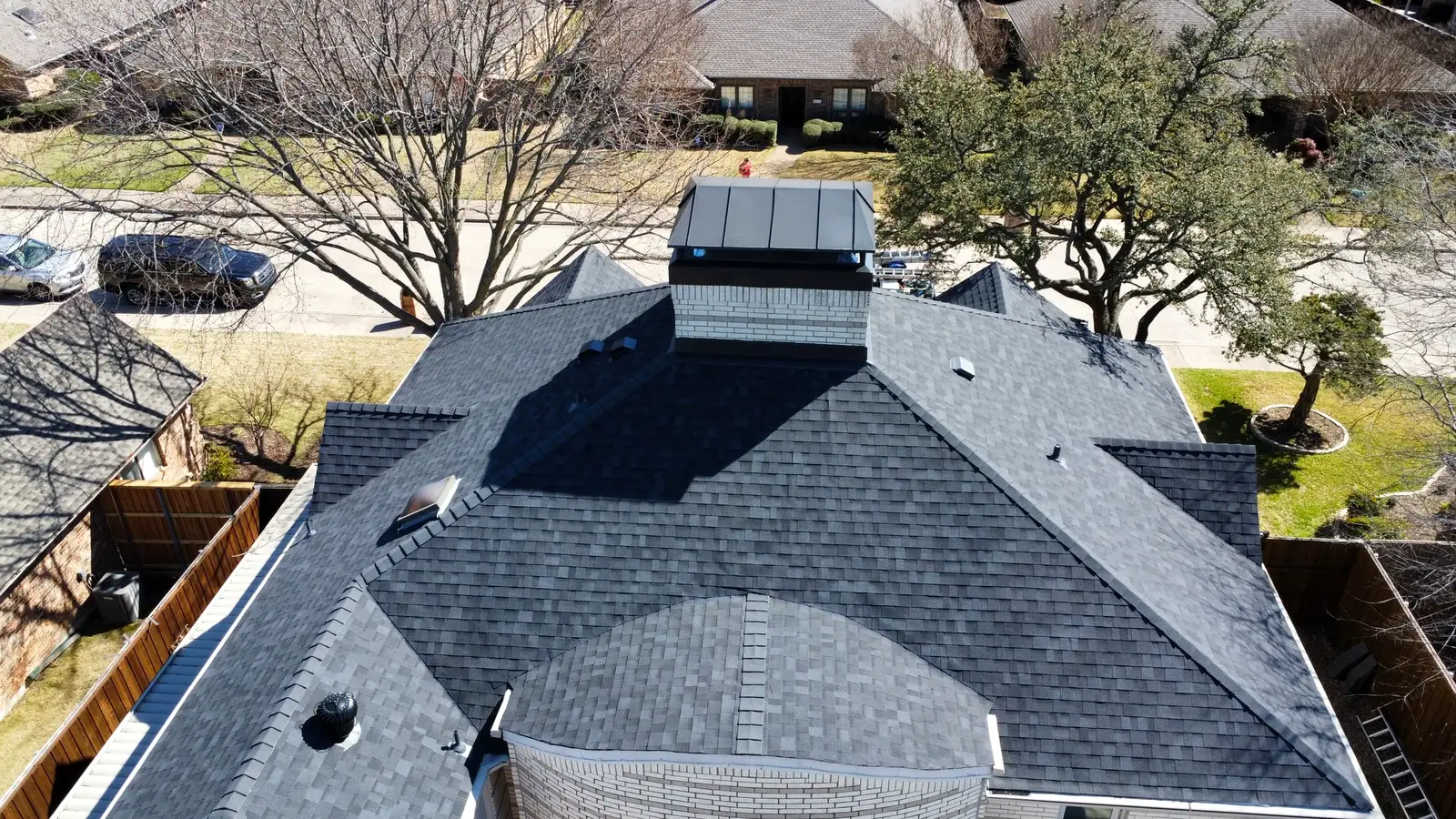
The stain is not in the middle of a ceiling. It is at the top of a first-floor wall, above a window, or in the corner of a room that sits under a second-story wall. Outside, a lower roof runs straight into that wall.
The first roofer mentions step flashing. The second says the siding has to come off, and now a roof repair sounds like a remodeling project. Here is what is actually behind that joint, how much of the wall has to be opened for each wall type, and who does which part.
Why is this leak so common on two-story DFW homes?
Look at almost any two-story home in Frisco, McKinney, Allen or West Plano and you will find a garage roof, a porch roof or a first-floor bump-out that dies into a taller wall. Each of those joints is a place where the entire flow from a roof slope runs alongside a wall for several feet.
The Building America Solution Center, the U.S. Department of Energy's construction guidance site run by Pacific Northwest National Laboratory, puts it this way: heavy rains can pour thousands of gallons of water onto a roof in a single storm, and where roofs intersect walls, that joint channels much of it. If the sidewall flashing is lacking, water gets into the wall.
The same guide explains why these leaks go unnoticed. Older wood siding showed the problem with peeling paint. Newer claddings such as fiber cement, vinyl and brick veneer can mask the evidence for years. That is why the stain you see is often the last symptom, not the first.
What is actually behind a roof-to-wall joint?
Four pieces of flashing do the work, and a leak means at least one is missing, damaged or installed wrong.
- Step flashing. Individual L-shaped metal pieces, one per course of shingles, running up the slope. One leg lies on the roof under the shingle above it, the other goes up the wall behind the siding.
- Kickout flashing. A small angled diverter at the very bottom of the run. It turns the water that has been following the wall out into the gutter.
- Counterflashing. A second layer that covers the top edge of the step flashing. On siding walls the house wrap and siding do this job. On brick, stone and stucco it is a separate metal piece.
- Headwall (apron) flashing. One continuous piece where the top of a roof slope ends against a wall, such as under a second-story window.
The International Residential Code (2021 edition, R905.2.8.3) requires the base flashing against a sidewall to be continuous or step flashing at least 4 inches high and 4 inches wide, directing water away from the wall and onto the roof or into the gutter. It also says that where siding is present, the vertical leg must be continuous under the siding. Section R903.2.1 adds the kickout: a flashing must divert water away from where the eave of a sloped roof meets a vertical sidewall. Your city's adopted edition and amendments are what apply to your house.
ARMA, the asphalt shingle manufacturers' association, adds two details that matter in a repair: each step flashing piece is nailed to the roof and not to the wall, and step flashing must then be counterflashed.
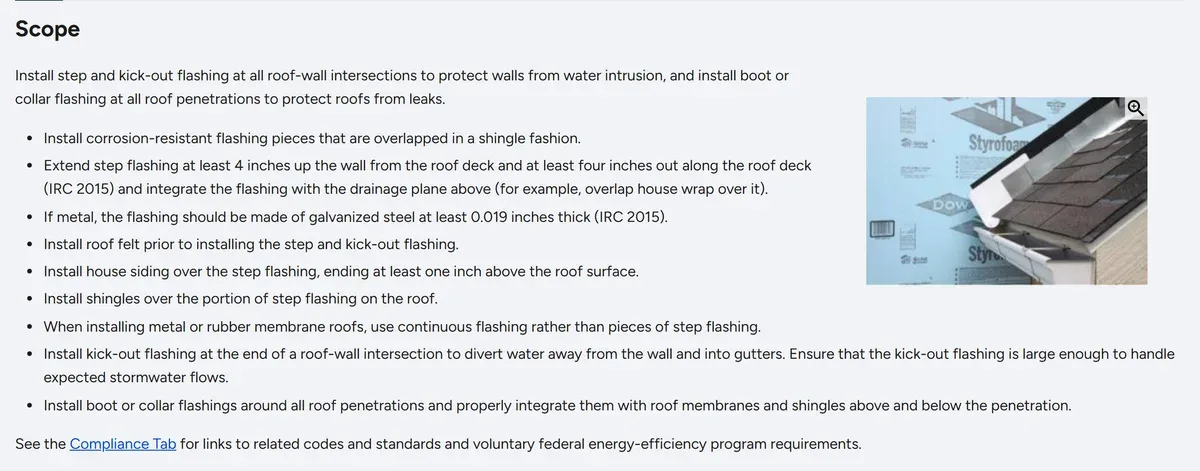
That requirement, flashing behind the wall covering, is the whole reason the siding question comes up. Our broader guide to chimney, flashing and vent leaks covers the same principle at chimneys and pipes.
Will the siding, stucco or brick have to come off?
It depends on what the wall is made of. Here is how access usually works for each wall type:
| Wall covering | What usually has to be opened | Who does that part | What to watch for |
|---|---|---|---|
| Vinyl siding | Bottom courses unlocked and lifted or removed along the roof line, then relocked | Roofer or siding crew. Verde repairs vinyl siding | Old vinyl can crack when unlocked in cold weather; faded panels are hard to match |
| Engineered wood, composite or clapboard lap siding | Bottom one or two courses removed along the roof line; rotted boards replaced | Roofer or siding crew. Verde repairs these sidings | Swollen or rotted bottom edges where siding was run tight to the shingles; repainting needed |
| Fiber cement lap siding | Bottom courses removed; boards can break coming off, so some are replaced | Siding contractor | Matching profile and texture; repainting |
| Brick veneer | No brick removed. A mortar joint is cut and new counterflashing set into it over new step flashing | Roofer for the flashing; a mason if mortar or brick is deteriorated | Counterflashing glued to the brick face instead of set in a joint; cracked mortar above |
| Stucco | A strip of stucco along the roof line is cut out so flashing can go behind it, then patched | Roofer plus a stucco contractor | Patch texture and color; surface-mounted metal with sealant is a lesser fix |
| Stone veneer | Stones along the roof line removed and reset, or a joint cut for counterflashing where the stone allows | Roofer plus a mason | Irregular stone makes a clean counterflashing line difficult |
How to read it: on siding walls the answer to the title question is yes, a little. On brick, the wall is cut, not removed. Stucco and stone are the hardest, because a proper repair involves a second trade to cut and patch. Verde does siding repair and exterior painting; stucco and masonry are other trades, so the written estimate should say who cuts and patches the wall.
How much comes off depends on what is found. The Building America guidance for existing homes says that when flashing is missing, damaged or letting water into the wall, the siding and old flashing should be removed to expose at least 8 inches of wall, and any damaged sheathing and framing repaired. When the siding goes back, the same guidance calls for a gap of about an inch to an inch and a half between the bottom of the siding and the shingles, so the siding does not wick water.
How much hidden damage should you expect?
Nobody knows until the wall is opened, and an honest quote says so. But there are signs that predict it.
- Soft, swollen or flaking siding at the bottom edge along the roof line.
- A dark streak or stain on the wall below the end of the gutter, where a kickout should be.
- Peeling paint, or caulk that keeps cracking, at the top corner of a window below the joint.
- A musty smell or stained baseboard on the inside of that wall.
- Sealant smeared along the roof-to-wall line from an earlier repair.
When I look at a wall leak, I check the bottom corner first, where the roof edge, the gutter and the wall meet. If there is no kickout there, I already know where to press on the siding.
The damage, when there is some, is usually in the wall sheathing below and beside the bottom of the joint, sometimes reaching the framing around a window underneath. Roof decking along the wall can be soft too. Rot at the roof edge itself may have a different cause; our guide on rotten fascia and soffits sorts roof causes from gutter causes.
If you can see any of the signs above, call or text (214) 687-1951 and send a photo of the joint. It is usually enough to tell you whether this is a small repair or a wall that needs opening.
What are the repair options, and what do they cost?
These are the realistic scopes, smallest to largest, with national cost context from guides we opened in November 2026:
| Option | When it fits | What the work includes | What it does not solve | Typical published cost |
|---|---|---|---|---|
| Reseal or reattach | Sound flashing with a loose counterflashing or one open joint | New sealant, refastened metal | Missing or rusted step flashing; anything behind the wall. Sealant is maintenance and ages fast in Texas sun | $200 to $500 for minor flashing repair (HomeGuide) |
| Add a kickout | Step flashing is sound, the bottom diverter is missing, wall still dry and solid | Bottom shingles and siding corner opened, kickout installed, gutter end adjusted | Rot already in the wall below | Within HomeGuide's $200 to $500 minor repair range, plus any siding repair |
| Replace the flashing along the wall | Step flashing missing, reused, face-nailed or rusted | Shingles along the wall removed, siding opened, membrane, new step flashing and kickout, shingles and siding back | Hidden sheathing damage, priced separately once seen | $500 to $1,500+ for major repair or full flashing replacement (HomeGuide) |
| Rebuild with wall repair | Soft sheathing, rotted siding or trim, damage around a window | All of the above plus sheathing, house wrap, siding or masonry repair and paint | Interior drywall and insulation, which follow later | Flashing as above, plus siding repair at $2 to $14 per square foot, stucco $8 to $50, brick $11 to $24 (HomeGuide) |
Read the last column as context, not as a quote. These are national averages, and none of them is Verde's price, which is a written estimate after a free inspection. HomeGuide also notes that most roof repair contractors have a minimum job fee of $250 to $300 or more, and that brick repairs on upper levels typically cost 25 to 65 percent more because of access.
What moves the number: the length of the joint, one story or two, roof pitch, the wall material, how much sheathing is soft, whether the siding can be reused or matched, and how much repainting is needed to blend the repair. Our guide to what common roof repairs cost explains the roof side, and siding repair or replacement covers matching and material choices for the wall.
In what order do the trades work?
The sequence matters more here than in almost any other roof repair, because each layer laps over the one before it.
- Roofer: diagnose. Confirm the joint is the source, from the attic or wall cavity if possible and from the roof. Photos of what is there now.
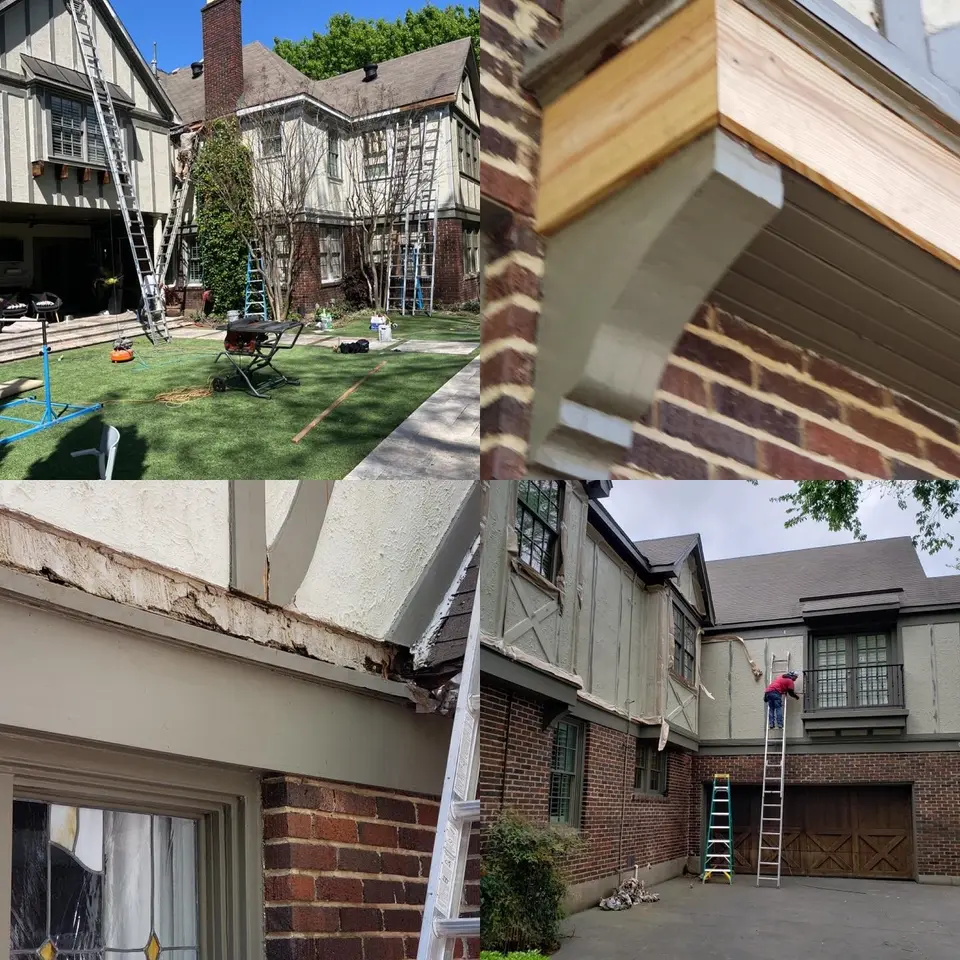
- Open the wall. Siding loosened or removed, stucco cut, or a mortar joint cut, depending on the wall.
- Assess and repair the structure. Rotted sheathing replaced. If framing is damaged, a carpenter repairs it, and if the damage looks structural, a structural engineer should see it before it is covered.
- Roofer: rebuild the joint. Self-adhered membrane, new step flashing and kickout, counterflashing, shingles relaid.
- Close the wall. House wrap lapped over the flashing, then siding back on, or stucco patched, or masonry repointed.
- Paint. New siding and trim primed and painted to blend. Verde does exterior painting, and our guide to exterior painting in the Texas climate explains timing.
- Gutter check. The kickout has to land in the gutter, so the gutter end may need adjusting. See gutters and downspouts.
- Interior last. Wet insulation and drywall are repaired only after a rain has shown the wall is dry. See who repairs wet insulation and ceiling damage after a roof leak.
The Building America guide makes the same point about coordination: these materials are installed by roofers working with house wrap and siding installers, and the task should be written into the contract of the right trade. On a repair, the simplest arrangement is one contractor responsible for both the flashing and the siding repair, so nobody can blame the other side of a six-inch overlap.
What should be written in the quote?
- The confirmed source of the leak and how it was confirmed, with photos.
- Linear feet of step flashing to be replaced, the metal type and gauge, and a kickout at the bottom.
- How the wall will be opened: which courses of siding, how much stucco, or which mortar joint.
- Whether existing siding will be reused or replaced, and the match if replaced.
- The membrane and house wrap details behind the flashing.
- A unit price for sheathing and for rotted siding or trim, agreed before the wall is opened.
- Who patches stucco or repoints masonry, and whether that is in this price or a separate contract.
- Priming and painting: included or excluded.
- Exclusions, especially interior repairs.
- The workmanship warranty in writing. See how long a roof repair should last for what to ask.
Be cautious with a quote that promises to fix a wall leak without touching the wall. On a few joints that is honest. On most it means sealant.
When is the joint a sign of a bigger problem?
A single failed joint on a sound roof is a repair. Step back and look wider in three cases.
The roof is new. A wall joint that leaks in the first couple of years points at the installation, where old step flashing may have been reused or left in place. Start with who should fix a leak in a brand-new roof.
Every joint looks the same. If one roof-to-wall joint has no kickout, the others on the house probably do not either. Have them all checked in one visit, including porch and patio tie-ins, which our guide to porch, patio and garage roof leaks covers.
A valley ends at the wall. Water from a valley that empties against a wall overwhelms ordinary step flashing. That junction needs its own detail; see repairing a leaking roof valley.
And if the roof is due for replacement anyway, that is the time to correct every wall joint. The Building America guidance says new flashing should be installed at roof-wall intersections when the roof covering is replaced. Ask for it as a written line item, not an assumption.
Get the joint looked at before the wall gets worse
Call or text (214) 687-1951, 24/7, or book a free roof inspection. Chris will check the joint, the wall below it and the attic side, show you photos of what he finds, and give you a written roof repair estimate that says exactly how much of the wall has to be opened and who does each part.
Questions people ask next
Can step flashing be replaced without removing siding?
Sometimes. Vinyl siding can often be unlocked and lifted, and some lap siding has enough clearance to slide new pieces up behind it. When the siding sits tight to the shingles, is nailed through the old flashing or is rotted at the bottom, the lower courses have to come off. The Building America Solution Center's retrofit guidance calls for exposing at least 8 inches of wall.
What is kickout flashing and do I need it?
A kickout is a small angled diverter at the bottom of a roof-to-wall joint that turns the water running down the wall line out into the gutter. Without it, that water runs behind the gutter end and down the wall. The International Residential Code requires a flashing that diverts water where an eave meets a sidewall. If yours has none and the wall below is stained, that is likely the cause.
Why does my roof leak where it meets the brick wall?
On brick, step flashing is covered by counterflashing that should be set into a cut mortar joint. Leaks come from counterflashing that was glued or caulked to the brick face, sealant that dried out, cracked mortar above the roof line, or missing step flashing underneath. Brick also absorbs water, so some wall leaks are masonry problems that need a mason rather than a roofer.
How much does it cost to fix flashing where a roof meets a wall?
HomeGuide's January 2026 flashing guide lists minor flashing repairs at $200 to $500 and major repair or complete replacement at $500 to $1,500 or more. Siding, stucco or masonry work and any rotted sheathing are extra. HomeGuide lists siding repair at $200 to $1,100 on average. These are national figures, not Verde's prices.
Who do I call first for a leak at a roof-to-wall joint: a roofer or a siding contractor?
A roofer, because the flashing is part of the roof system and the leak source has to be confirmed before anything is opened. The ideal is one contractor who can do both the flashing and the siding, since the two overlap by a few inches. For stucco, brick or stone walls, expect the roofer to coordinate with a stucco contractor or mason.
Is wall rot from a missing kickout covered by homeowners insurance?
Do not assume so. Damage that developed slowly from a missing or failed flashing is usually treated differently from sudden damage caused by a storm, and your own policy decides. The Texas Department of Insurance says insurers will not pay for a roof simply because it is old or worn. Document what is found with photos before repairs and ask your agent how your policy treats it.
Sources
- Building America Solution Center (PNNL / U.S. Department of Energy): Step and Kick-Out Flashing at Roof-Wall Intersections
- Building America Solution Center (PNNL / U.S. Department of Energy): Flashing at Roof-Wall Intersections in Existing Homes
- UpCodes: 2021 International Residential Code, Chapter 9 Roof Assemblies (R903.2.1, R905.2.8.3)
- Asphalt Roofing Manufacturers Association (ARMA): Good Application Makes a Good Roof Better, laminated shingles (step flashing)
- HomeGuide: Roof flashing repair cost (January 2026)
- HomeGuide: Siding repair cost (February 2026)
Chris Grimes owns Verde Roofing in Plano, Texas, a locally owned residential and commercial roofer serving Dallas–Fort Worth. Verde is an NTRCA Accredited Member, an RCAT member and a Dallas Observer Best of Dallas Best Roofer winner (readers’ choice) in 2021, 2022 and 2023.
Keep reading
Related guides
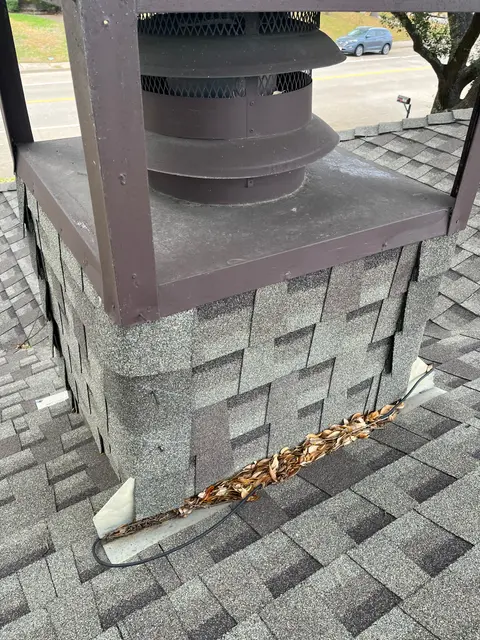 Repair or replaceChimney, Flashing and Vent Leaks: The Most Common Roof RepairsMost roof leaks start where the shingles stop: at chimneys, walls, skylights and pipe or exhaust vents. Rubber pipe boots crack in Texas sun, chimney step…Read the guide
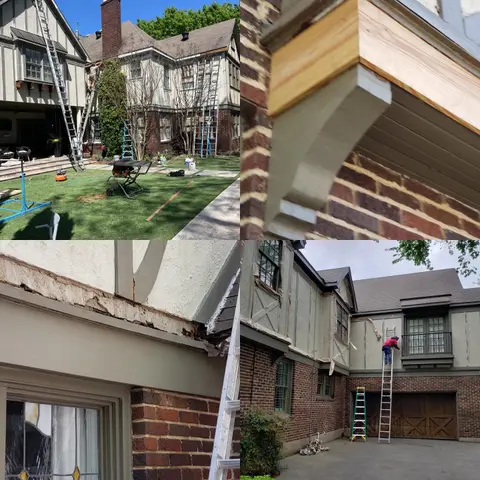 Gutters, siding, paint & solarSiding Repair or Replacement: Vinyl, Engineered Wood, Composite and ClapboardRepair siding when the damage is limited to a few boards or one wall, the material is still available and the sheathing behind it is dry…Read the guide
 Repair or replaceWho Repairs Wet Insulation and Ceiling Damage After a Roof Leak in DFW?After a roof leak in Dallas–Fort Worth, the work goes in a fixed order and usually to different companies. A roofer stops the water first. A…Read the guide